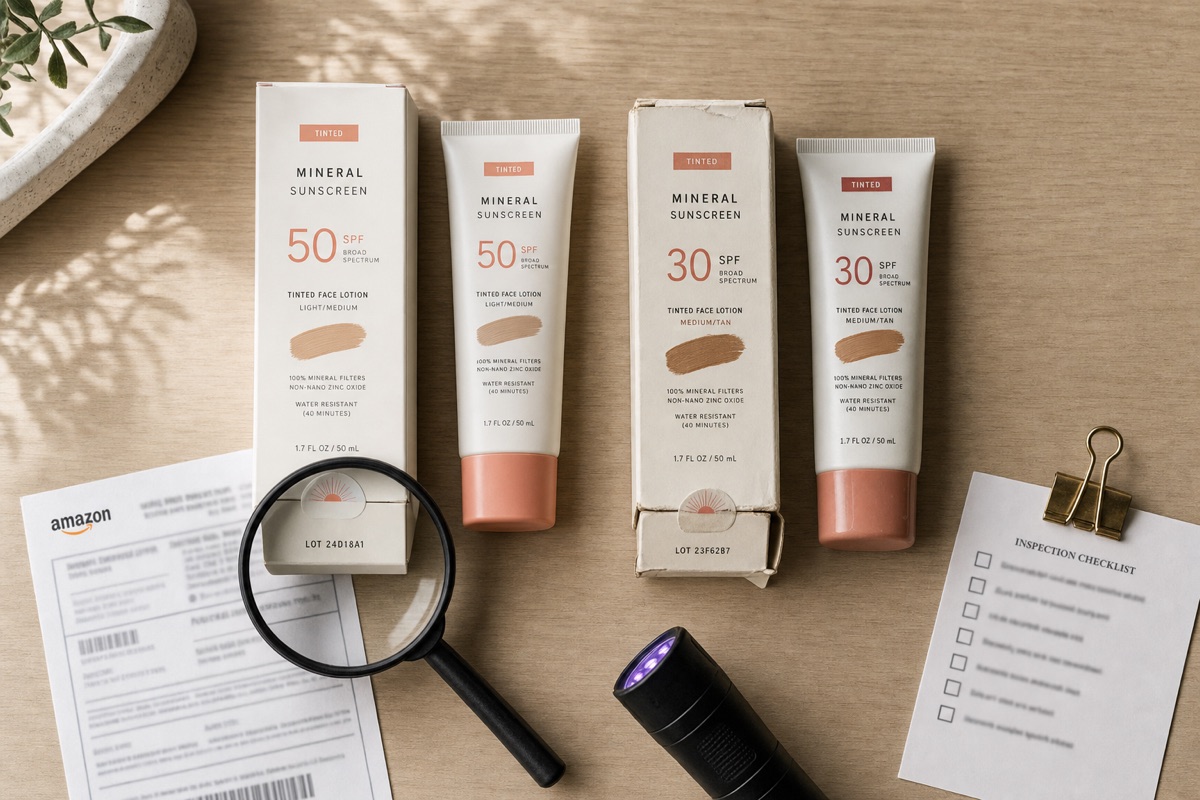
How to Spot Fake Tinted Sunscreens on Amazon Without Guesswork
A practical guide to verifying tinted sunscreen listings on Amazon, including seller checks, ASIN red flags, expiration clues, and safer product examples.
We analyzed FDA counterfeit-medicine guidance, Amazon Brand Registry claims, 5,831 Amazon review signals from 3 tinted sunscreens, and 4 PubMed sources on visible-light protection. The safest Amazon buy is usually a current ASIN sold by Amazon or the brand, with intact SPF labeling, iron oxides, lot details, and review history that matches the product.
Editor's top Amazon picks for this guide
Real Amazon products that match this protocol. Affiliate links — your purchases support BeautySift.

Sun Bum
Mineral SPF 30 Tinted Face Sunscreen
$18.49
"A widely reviewed tinted mineral option with a clear SPF 30 face-sunscreen listing, 4.5/5 Amazon rating, and recent review language about tint and texture."
What real Amazon buyers say
4.5★· 4,730 reviews"This is my new favorite sunscreen. It goes on matte, but is still easy to put on/not pasty. The tint is enough to get rid of the ghost look but not so much that it looks like fake tanner."
"Good lord this is a beautiful mineral sunscreen. And at a reasonable price. It has a mouse-like consistency, is light and airy dries down to a satin-like finish after 15 or so minutes."

DRMTLGY
Physical Tinted Moisturizer SPF 44
$31
"A mineral tinted moisturizer listing with SPF 44, 4.4/5 Amazon rating, and user-review language about light coverage and discoloration."
What real Amazon buyers say
4.4★· 790 reviews"My daily go to sunscreen. Light coverage that evens skin tone and minor discoloration. Blends well w my medium skin tone. All physical sunscreen so very safe and effective for daily use even in So Cal."
"Has a very nice texture and blends easily. Does not look dry, cakey, or masky. I don't need any foundation, due to this being tinted"

Think
Thinkdaily SPF 30 Tinted Sunscreen for Face
$15.58
"A lower-review-count tinted zinc-oxide face sunscreen that is useful for practicing ASIN, seller, review-recency, and package checks before buying."
What real Amazon buyers say
4.4★· 311 reviews"This spring I tried four different clean beauty facial sunscreens. This is my favorite. First, it goes on with a light tint that rubs in, which moisturizers and becomes a primer for my bare minerals powder foundation makeup."
"Great face sunscreen! It has high zinc and looks nice under makeup. I will continue to purchase."

CoTZ
Face Moisture Lightly Tinted Mineral Sunscreen SPF 35
$31
"A silicone-primer-style tinted mineral sunscreen to compare against suspicious listings because the ASIN, SPF, size, and tint language are specific."

Neutrogena
Purescreen+ Tinted Mineral Sunscreen SPF 30 Light
$15.49
"A drugstore-brand tinted mineral option where shade name, SPF 30, size, and brand packaging are easy to cross-check before purchase."
What you'll learn
- Start with the seller line: a tinted sunscreen is safer to buy when it is sold by Amazon or the brand, not an unfamiliar third-party storefront.
- Match the Amazon title, ASIN, SPF number, tint shade, size, and package photos against the brand's current US product page before ordering.
- For hyperpigmentation, look beyond SPF: AAD guidance favors tinted sunscreens with iron oxides because visible light can worsen dark spots.
- Do not rely on star ratings alone; counterfeit and listing-hijack risk is easier to spot by reading the newest 1-star reviews and seller feedback.
- If the tube arrives unsealed, relabeled, expired, separated, oddly scented, or different from brand photos, do not keep using it on your face.
Steps
-
1 Step 1: Confirm the seller before you read reviews
On Amazon, check the lines that say Ships from and Sold by before trusting the listing. A safer listing is sold by Amazon, the brand, or a clearly authorized storefront. If the product is sold only by a random third party with a short feedback history, treat the listing as higher risk and compare it against the brand's current US retail channels.
-
2 Step 2: Match the ASIN, size, SPF, tint, and packaging
Copy the ASIN from the Amazon URL and compare the product name, size, SPF, shade, active ingredients, and package photos against the brand's current US product page. A fake-risk listing may mix old packaging, wrong fluid ounces, a discontinued shade, or a title that says tinted while the photos show an untinted product.
-
3 Step 3: Read the newest 1-star and 2-star reviews first
Ratings can be pooled across shade variations or older packaging. Sort reviews by most recent and scan low-star reviews for repeated phrases such as expired, separated, different packaging, no seal, fake, watery, wrong shade, or burned. One complaint is not proof, but a cluster across recent reviews is a practical warning sign.
-
4 Step 4: Check the sunscreen facts like an OTC drug label
In the US, sunscreen is regulated as an over-the-counter drug. The label should clearly show SPF, broad-spectrum status when claimed, active ingredients, directions, warnings, and Drug Facts formatting. If the Amazon images hide the Drug Facts panel or conflict with the product description, choose a different listing.
-
5 Step 5: Inspect the tube the day it arrives
Before applying a new tinted sunscreen to your face, inspect the box, seal, lot code, expiration date, texture, odor, and shade. Tinted mineral formulas can vary slightly, but they should not smell rancid, leak oil, arrive half-empty, or look unlike brand photos. When in doubt, request a return and buy through a clearer listing.
Why fake-risk checks matter more with tinted sunscreen
Tinted sunscreen sits in an awkward category. It looks like makeup, but in the United States sunscreen is regulated as an over-the-counter drug. That means the product is not just there to even out redness or soften a white cast. You are relying on the formula for labeled SPF protection.
BeautySift did not test these sunscreens in a lab. We analyzed FDA counterfeit guidance, FDA sunscreen guidance, Amazon Brand Registry disclosures, AAD advice on tinted sunscreen with iron oxides, PubMed-indexed visible-light research, and Amazon listing evidence for current US products.
The FDA warns that counterfeit products passed off as authentic may contain wrong, inactive, or harmful ingredients. For a tinted moisturizer without SPF, a bad marketplace purchase might mean wasted money or irritation. For sunscreen, the downside is larger: you may under-protect skin while believing you applied broad-spectrum SPF.
For women 35-55 managing sun damage, melasma-prone patches, or post-inflammatory hyperpigmentation, the tinted part is not cosmetic fluff. The AAD says tinted sunscreen with iron oxide can help protect against visible light, which may contribute to dark spots. PubMed-indexed research from 2014, 2021, 2024, and 2025 supports the broader idea that visible-light protection matters in pigment-prone skin.
Affiliate disclosure: we may earn a commission on shopping links. Product inclusion here is based on listing clarity, review evidence, and relevance to the checking protocol, not first-party testing.
The 60-second Amazon screen before you buy
Start above the fold. Find the lines that say Ships from and Sold by. If the seller is Amazon, the brand, or a clearly named brand storefront, risk is lower. If it is a third-party seller with an unfamiliar name, open the seller page and look for feedback age, volume, and repeated complaints.
Next, copy the ASIN from the Amazon URL. A real Amazon product URL usually includes /dp/ followed by 10 letters or numbers. The ASIN alone does not prove authenticity, but it gives you a fixed identifier to compare against the product title, photos, shade, SPF, and review history.
Then read the title slowly. A clean listing should not mash together unrelated claims, such as SPF 50 in the title and SPF 30 on the tube, or tinted in the headline while the bottle photo shows an untinted formula. Variation families can also create confusion: one parent listing may combine multiple shades, sizes, or formulas, and the review count may not reflect the exact shade in your cart.
If anything looks off in the first minute, do not try to rationalize it because the star rating is high. The newest negative reviews tell you more about current inventory than a five-year-old average.
Step 1: verify the seller line, not just the brand name
A product title can say a famous brand even when the current offer is from a third-party seller. On Amazon, seller identity is one of the most practical authenticity signals a shopper can control.
Safer patterns include Sold by Amazon, sold by the brand’s own storefront, or sold by a seller the brand names as authorized. Higher-risk patterns include a new seller with little feedback, a seller name unrelated to beauty or the brand, or a listing where the Buy Box changes between visits.
Amazon says its Transparency program has verified over 2.5 billion product units as genuine through unique serial codes. That is useful context, but it does not mean every beauty listing deserves blind trust. Your job as the shopper is to look for alignment: brand, seller, ASIN, packaging, shade, size, and reviews all pointing in the same direction.
For higher-stakes sunscreen purchases before a beach trip, procedure appointment, or pigment-focused routine, consider buying earlier than you need it. That gives you time to inspect the tube and return a questionable order instead of using it because you are out of SPF.
Step 2: match the exact product to the brand’s current US page
Open the brand’s current US product page in another tab. Compare five fields: product name, SPF number, active ingredients, size, and shade name. For tinted mineral sunscreens, also compare the tint range. A formula sold in Light, Medium, and Deep should not arrive as a shade that does not exist on the brand’s site.
The label should make sense as a sunscreen label. FDA sunscreen guidance centers on broad-spectrum protection, SPF, directions, and reapplication at least every 2 hours outdoors. If Amazon photos only show a glam front bottle with no Drug Facts panel, that is not automatically fake, but it gives you less to verify.
Watch for listing drift. Counterfeit-risk and wrong-item complaints often show up when a listing has old packaging photos, merged variations, or a product title that has been edited over time. A user may leave a real review for an older SPF 30 tube, while your cart contains a newer SPF 50 shade. That mismatch can make ratings less useful.
The practical rule: if the ASIN page cannot tell you exactly what you are buying, skip it. Tinted sunscreen should not require detective work after payment.
Step 3: sort reviews by most recent and read the bad ones first
Star averages are blunt instruments. For this guide, we captured Amazon listing snapshots for 3 top examples with 5,831 combined ratings: Sun Bum Mineral SPF 30 Tinted Face Sunscreen at 4.5/5 across 4,730 ratings, DRMTLGY Physical Tinted Moisturizer SPF 44 at 4.4/5 across 790 ratings, and Thinkdaily SPF 30 Tinted Face Sunscreen at 4.4/5 across 311 ratings.
Those numbers help show whether a listing has meaningful user history, but they do not replace review triage. Sort by most recent. Open the 1-star and 2-star reviews. Look for clusters, not isolated frustration.
Red-flag phrases include expired, no seal, watery, separated, fake, counterfeit, smells off, wrong shade, old packaging, different from photo, burned my skin, and not the same as usual. Some of those complaints can come from normal formula preference, but repeated recent complaints about packaging, expiration, seal, or texture deserve attention.
Also read a few 4-star reviews. They often contain the most useful fit information: tint depth, pilling, cast, oiliness, and whether the formula works under makeup. A real tinted sunscreen may still be a bad match for your skin tone, but that is different from a suspicious listing.
Step 4: check for visible-light protection if dark spots are the reason you want tint
If your goal is hyperpigmentation support, do not stop at SPF. The AAD specifically points to tinted sunscreen with iron oxide for visible-light protection in dark spots. PubMed-indexed reviews in 2021 and 2024 discuss tinted sunscreens as photoprotection beyond ultraviolet radiation, and a 2014 randomized trial examined near-visible light and UV photoprotection in melasma.
That evidence does not mean every tinted sunscreen is equally protective against visible light. Look for iron oxides on the ingredient list. Common label names include iron oxides, CI 77491, CI 77492, and CI 77499. Titanium dioxide and zinc oxide are UV filters in mineral sunscreen; iron oxides are the tint pigments often discussed for visible-light defense.
If the Amazon page says tinted but the ingredient list shows no colorants and the brand page describes the product as untinted, pause. It may be a bad listing merge, an old photo, or a seller mistake. Either way, it is not the best choice when your routine depends on the tinted component.
For perimenopausal skin that is drier, more reactive, or more pigment-prone than it used to be, this extra check is worth the minute. Irritation plus sun exposure can make uneven tone look more stubborn.
Step 5: inspect the product before the first face application
When the package arrives, do not toss the box immediately. Check the outer box, tube, cap, seal, lot code, expiration date, and Drug Facts panel. Compare them with the Amazon photos and brand page. A minor packaging refresh can be legitimate, but multiple mismatches should make you cautious.
Squeeze a small amount onto tissue or the back of your hand. Tinted mineral sunscreen can have a mousse, cream, lotion, or silicone-primer feel depending on the formula. It should not smell rancid, leak clear oil, contain grit, or look dramatically separated. If you have bought the same product before and the shade, scent, or texture is noticeably different, document it with photos before requesting a return.
Do not patch-test a questionable sunscreen by wearing it for a long outdoor day. If authenticity is unclear, the safer answer is not to use it for UV protection. Return it and repurchase from a clearer Amazon offer, the brand, or another authorized US retailer.
Three safer shopping examples and what to check on each
Sun Bum Mineral SPF 30 Tinted Face Sunscreen is a useful budget example because the Amazon listing has a clear product identity and a large review base. The checking point is texture and tint: recent Amazon reviewers describe a matte, primer-like feel, so complaints about a watery or radically different texture would be a reason to pause.
DRMTLGY Physical Tinted Moisturizer SPF 44 is a coverage-oriented example. Because tinted moisturizers can be mistaken for makeup, verify the SPF 44 language, mineral positioning, size, and seller before assuming a tube is the same product you saw in a social post. Amazon reviewers mention light coverage and tone evening, which fits the listing’s tinted-moisturizer role.
Thinkdaily SPF 30 Tinted Sunscreen for Face has a smaller review base, which makes review recency more important. A lower count is not a problem by itself. It just means you should be stricter about seller identity, Drug Facts clarity, lot code, and whether the tint language matches what arrives.
CoTZ and Neutrogena are useful comparison checks because their listings are specific about SPF, tint, mineral positioning, and size. If a third-party offer blurs any of those details, choose a cleaner offer rather than relying on brand recognition alone.
What to do if you think you bought a fake
Stop using it, especially if the texture, smell, seal, expiration date, or packaging seems wrong. Take photos of the Amazon order page, seller line, box, lot code, expiration date, seal, tube front and back, and the product texture.
Request a return or refund through Amazon and describe the concrete issue: missing seal, expired product, wrong item, packaging mismatch, separation, or suspected counterfeit. Avoid vague language if you have specifics. If you experience irritation, keep the product packaging and consider reporting the adverse effect through FDA MedWatch.
Then replace the sunscreen through a clearer channel. The FDA recommends reapplying sunscreen at least every 2 hours outdoors, but that advice only helps when the product is authentic, in date, and used in enough quantity.
Related reading
Best French Pharmacy Mineral Sunscreens 2026
Supergoop Unseen Sunscreen SPF 40 Review 2026: Texture and Makeup Wear
How to Fade Dark Spots After 40: An 8-Week Protocol for 2026