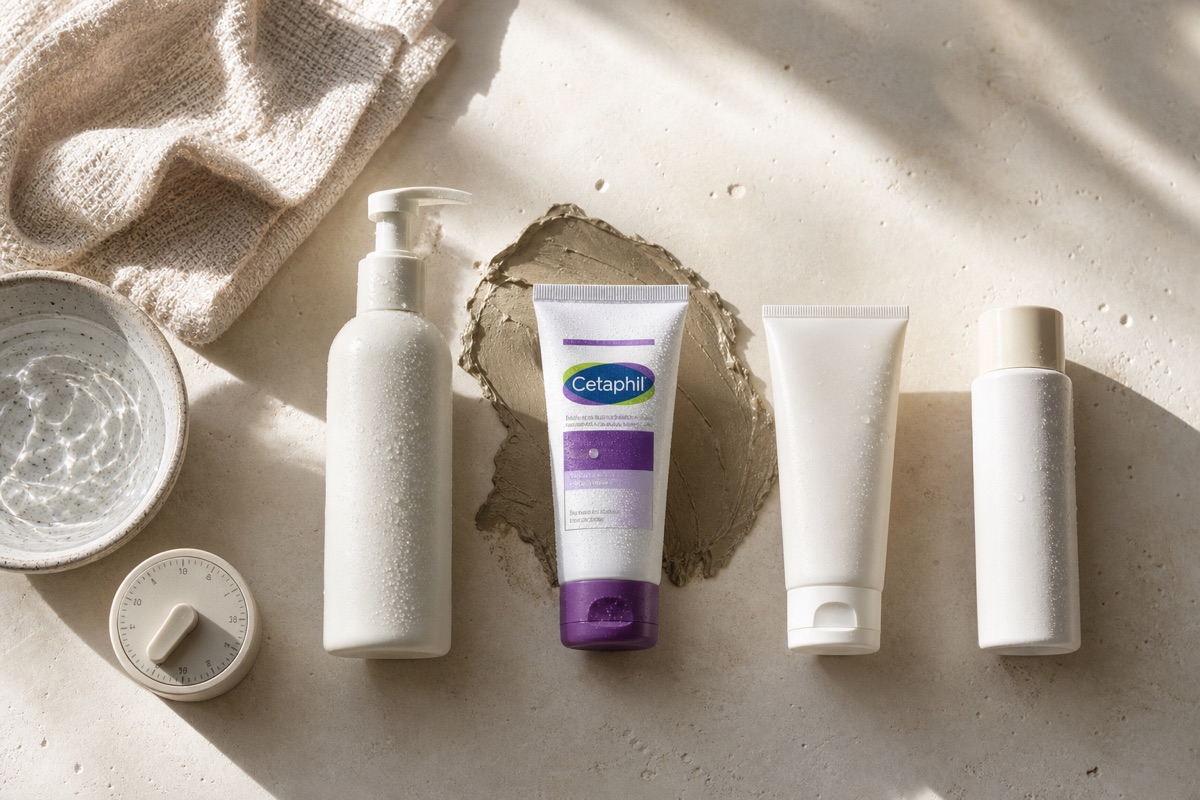
How to Use Clay Masks Correctly Without Over-Drying Skin
An evidence-led guide to using clay masks for oily, congested, or hormonal-breakout-prone skin without stripping mature skin.
We analyzed a 2023 PubMed clay-mask study of 75 adults, 108,654 Amazon rating signals across 3 US-available masks, FDA OTC acne-active rules, brand directions, and Reddit routine threads. Use clay masks 1 to 2 times weekly, rinse before they crack, and moisturize immediately.
Editor's top Amazon picks for this guide
Real Amazon products that match this protocol. Affiliate links — your purchases support BeautySift.

Cetaphil
Cetaphil DermaControl Purifying Clay Mask
$35.25
"Best sensitive-skin starter lane: kaolin/bentonite positioning, oily-sensitive-skin brand direction, and 4.7/5 across 4,713 Amazon ratings."
What real Amazon buyers say
4.7★· 4,713 reviews"I have tried many clay masks over time. Many that I had liked are discontinued. And I just stopped that part of my routine."
"Generally, this works well. It's a good product for the price point. I cleanse and dry my skin before using this."

La Roche-Posay
La Roche-Posay Effaclar Clarifying Clay Face Mask
$21.99
"Best oily T-zone lane: kaolin-based oil-control positioning, US brand directions, and 4.6/5 across 4,713 Amazon ratings."
What real Amazon buyers say
4.6★· 4,713 reviews"The best thing you can but to prevent oiliness and pimples on your face! It's doesn't irritate and removes the impurities you have."
"I’ve been using this product for a few days now and I’m honestly impressed. The packaging is clean and practical, and the quality exceeded my expectations."

Aztec Secret
Aztec Secret Indian Healing Clay
$11.79
"Best low-cost occasional clay powder: 100% calcium bentonite format, strong Amazon volume, and best used sparingly on oily zones."
What real Amazon buyers say
4.7★· 99,228 reviews"I love this item to refresh my skin. I use it once every two weeks and mix it even parts apple cider vinegar and clay with enough water"
"This is excellent for a skin softener it does soften your skin it is excellent at cleansing the skin and does make your skin nice and silky smooth"
What you'll learn
- Use a clay mask as an oil-management step, not as a daily acne treatment or a replacement for prescription care.
- For women 35-55, the safest starting rhythm is once weekly; increase to twice weekly only if skin stays comfortable.
- Rinse when the mask turns tacky or mostly matte, before it cracks into a tight shell that can leave skin feeling stripped.
- Moisturizer after rinsing is part of the protocol, especially if retinoids, hot flashes, or winter air already make skin drier.
- Choose kaolin-leaning or buffered formulas for sensitive mature skin, and reserve pure bentonite powder for occasional spot or T-zone use.
Steps
-
1 Start with a clean, calm face
Use clay masks after a gentle cleanse, not after scrubs, peel pads, benzoyl peroxide, or a retinoid night. If your skin already stings when you apply moisturizer, postpone the mask because the issue is barrier recovery, not a need for more oil absorption.
-
2 Apply a thin, even layer only where oil collects
A thin coat is enough. For many women 35-55, that means the T-zone, chin, or jawline rather than the whole face. Keep the mask away from eyelids, corners of the nose, and dry cheek patches unless the brand directions specifically say otherwise.
-
3 Time it by texture, not by maximum dryness
Rinse when the mask looks mostly matte but still feels flexible, usually before the crackly stage. The 2023 PubMed study assessed twice-weekly use over 4 weeks, but that does not mean longer contact time is better for every formula or every skin type.
-
4 Remove with water and light pressure
Soften the mask with lukewarm water, then use fingertips or a damp soft cloth with minimal pressure. Do not turn removal into a scrub session. Redness that lasts beyond a few minutes is a sign to shorten contact time or reduce frequency.
-
5 Moisturize immediately after rinsing
Pat skin damp, then apply a plain moisturizer. This step helps prevent the common cycle where a mask makes skin feel clean for an hour, then tight and reactive by bedtime. Add sunscreen in the morning because acne marks and irritation look worse with UV exposure.
-
6 Keep the weekly active schedule simple
On clay-mask nights, skip retinoids, exfoliating acids, and strong vitamin C until you know your skin tolerates the routine. If you use a salicylic acid product for clogged pores, place it on a different night at first.
Bottom line
Clay masks work best when you treat them as a short-contact oil-management step, not as punishment for pores or hormonal breakouts. The most defensible protocol is simple: cleanse gently, apply a thin layer only where oil collects, rinse before the mask cracks, and moisturize right away.
BeautySift did not test clay masks on a panel. We analyzed a 2023 PubMed-indexed study of 75 adults with oily or combination skin, a 2024 PubMed review of bentonite and montmorillonite clays, 108,654 Amazon rating signals across three US-available clay-mask products, FDA OTC acne-active rules, official brand directions, Reddit routine discussions, and INCI-level tolerability logic. We may earn a commission from Amazon links, but affiliate status does not influence selection or scoring.
For US women 35-55, the biggest clay-mask mistake is overuse. Skin may be oilier through the T-zone and still drier around the cheeks, mouth, and eyes, especially if retinoids, indoor heat, or perimenopause-related dryness are in the background. A mask that helps the chin can leave the cheeks tight if you apply it like a full-face paint job.
What clay masks can and cannot do
Clay masks can absorb surface oil, make pores look cleaner for a short window, and help a routine feel more controlled when shine or clogged-looking texture is the main frustration. Zhang et al. reported in Skin Research and Technology in 2023 that 75 adults with oily or combination skin used a clay mask twice weekly for 4 weeks, with significant improvements in sebum content, acne-related outcomes, skin evenness, stratum corneum water content, and transepidermal water loss. The same PubMed abstract notes that pore area and porphyrin area did not significantly change.
That distinction matters. A clay mask may make pores look less greasy today; it does not permanently shrink pores. It may support an acne-prone routine; it does not replace a clinician-guided plan for painful nodules, scarring acne, or hormonal breakouts that flare around the jawline every cycle.
The FDA OTC acne-drug monograph is useful context here. Recognized over-the-counter acne drug actives are regulated separately from cosmetic clay masks. Plain kaolin or bentonite in a rinse-off mask is best framed as oil control and cleansing support, not as an acne medication. If a product includes salicylic acid, sulfur, or benzoyl peroxide and makes acne-drug claims, evaluate it as an active treatment, not just a clay mask.
Step 1: wash gently, then stop exfoliating for the night
Use a clay mask after a mild cleanse or a water rinse. Do not stack it after a grainy scrub, peel pad, dermaplaning session, benzoyl peroxide cleanser, or strong exfoliating toner. Clay is already doing an absorbing job. Adding friction and acids in the same session increases the chance that clean turns into tight, shiny, or irritated.
If you wear long-wear sunscreen or makeup, remove it first with a cleansing balm, oil cleanser, or gentle micellar step, then follow with a mild cleanser. The mask should touch clean skin, not a film of foundation. That does not mean your skin needs to feel squeaky. Squeaky usually means you removed too much lipid before the mask even started.
For hormonal-acne-prone skin, this baseline matters because irritation can make breakouts harder to read. If the jawline is inflamed and tender, a clay mask may help with surface oil around the chin, but it will not calm a deep cyst overnight. Use the mask around congestion, not over broken skin or picked spots.
Step 2: use less product than Instagram shows
A thin, even layer is enough. You should not need a thick opaque coating that takes 25 minutes to dry. For combination or mature skin, map the product to the problem: nose, inner cheeks, center forehead, chin, or jawline. Leave naturally dry areas bare.
This is where product choice changes the experience. Cetaphil DermaControl Purifying Clay Mask is the most conservative starter in our product-comparison weighting because the brand positions it for oily, sensitive skin and the Amazon snapshot showed 4.7/5 across 4,713 ratings. La Roche-Posay Effaclar Clarifying Clay Face Mask is the more direct oily T-zone lane, with a 4.6/5 Amazon snapshot across 4,713 ratings and US brand positioning around shine control. Aztec Secret Indian Healing Clay is the lowest-cost powder lane, but pure bentonite paste leaves more room for user error because you control the mix and thickness.
If your cheeks are dry, do not make them participate just because the jar is open. Multi-zone masking is not fussy; it is practical. Apply clay to oily areas, moisturizer to dry areas, and stop treating the whole face as one skin type.
Step 3: rinse before the mask fully cracks
The old rule was to wait until a clay mask dries completely. That is the step most likely to over-dry mature skin. Instead, rinse when the mask is mostly matte but still slightly flexible. If it flakes when you smile, you waited too long.
The 2023 PubMed study used twice-weekly application over 4 weeks, but the abstract does not mean every shopper should use every clay mask twice weekly forever. Frequency depends on skin type, formula, weather, and the rest of the routine. A woman using retinol 3 nights weekly in Midwest winter has a different tolerance profile than someone with an oily T-zone in a Florida summer.
Start with 5 to 10 minutes unless the product directions are shorter. If your skin feels comfortable for several sessions, you can follow the brand’s stated timing. If it feels tight, red, or itchy, shorten the contact time before blaming every clay mask in the category.
Step 4: remove like you are preserving your barrier
Removal should be boring. Splash with lukewarm water to re-soften the mask, then massage lightly with fingertips. If you prefer a washcloth, use a soft damp cloth and press, do not scrub. Hot water plus friction is a common reason a mask that seemed fine at minute eight causes redness at minute twelve.
Watch the after-feel. Fresh and smooth is reasonable. Shiny-tight, burning, or tightness that lasts into the next morning means the protocol is too aggressive. Change one variable at a time: less product, shorter contact, fewer nights, or a gentler formula.
Do not use a clay mask on sunburn, windburn, active dermatitis, a fresh peel, or skin that has been picked open. Clay can absorb oil, but it cannot compensate for a compromised barrier.
Step 5: moisturize immediately, even if you are oily
Moisturizer is not optional after a clay mask. Pat skin so it is damp, then use a simple moisturizer with glycerin, ceramides, petrolatum, dimethicone, or other barrier-supporting ingredients. You are not trying to make the skin greasy; you are preventing the rebound tightness that makes people abandon masks or over-correct with another active.
If you are acne-prone, choose a lightweight gel-cream or lotion rather than skipping moisturizer. If you are dry or perimenopausal, layer a richer cream on the cheeks and a lighter layer on the T-zone. The correct finish is comfortable, not squeaky.
Morning matters too. Use broad-spectrum sunscreen after any routine that includes acne actives, retinoids, exfoliating acids, or post-breakout marks. A clay mask does not make skin sun-sensitive in the same way a retinoid or acid can, but irritation and marks look worse when UV exposure is uncontrolled.
Step 6: place clay masks in the weekly active schedule
A beginner schedule can be simple: clay mask once weekly on a non-retinoid, non-exfoliation night. If skin stays comfortable after 2 to 3 weeks, oily zones can move to twice weekly. Keep retinol, salicylic acid, glycolic acid, and benzoyl peroxide on separate nights at first.
For hormonal-acne routines, clay masks pair best with consistency. Use them to manage surface oil before clogged pores look worse, not as a last-minute rescue after squeezing. If jawline acne is painful, deep, or cyclic, talk with a dermatologist or primary-care clinician. The mask is a support tool; it is not a hormone-management plan.
Product-comparison weighting favored three different roles rather than one universal winner. Cetaphil is the sensitive-skin starter, La Roche-Posay is the oily T-zone option, and Aztec Secret is the occasional powder for people who already know their skin tolerates bentonite. If you are new to clay masks after 40, start with the gentlest role, not the strongest-looking jar.
Common mistakes to avoid
The first mistake is masking too often. Daily clay use is rarely necessary and is especially risky if your routine already includes retinoids or exfoliating acids. The second mistake is using clay on the entire face when only the nose and chin are oily. The third is letting the mask fully crack because it feels more productive.
The fourth mistake is mixing pure clay powder with harsh add-ons. Apple cider vinegar is common in user routines, including visible Amazon reviews for Aztec Secret, but it can be too sharp for reactive or mature skin. Water is the safer first mix. If you want more slip, use a plain hydrating toner only if your skin already tolerates it.
The fifth mistake is expecting pore permanence. The 2023 PubMed abstract specifically noted no significant change in pore area. A good clay-mask routine can make skin look clearer and less shiny temporarily. It cannot erase anatomy.
FAQ
How often should I use a clay mask if I have hormonal acne?
Start once weekly and keep it to oily or congested zones. If your skin stays comfortable for 2 to 3 weeks, increase oily areas to twice weekly. Persistent cystic jawline acne needs medical guidance; clay masks manage surface oil, not hormones.
Should a clay mask dry completely before I rinse it?
No. Rinse when it is mostly matte but still flexible. If the mask cracks when you move your face, it has stayed on longer than most mature or retinoid-treated skin needs.
Can I use a clay mask on the same night as retinol?
Separate them at first. Use the clay mask on a recovery night and retinol on another night. After several comfortable weeks, some oily skin types may tolerate both in one week, but same-night stacking is not the best beginner move.
Is kaolin or bentonite better for skin over 40?
Kaolin-leaning formulas are usually easier to start with because they tend to feel less aggressive. Bentonite can be useful for oily zones, but pure powder masks demand more caution with mixing, thickness, and contact time.
Can clay masks shrink pores?
They can temporarily make pores look cleaner by absorbing oil and residue. They do not permanently shrink pore size. Zhang et al. 2023 reported significant sebum-related improvements, while pore area did not significantly change.