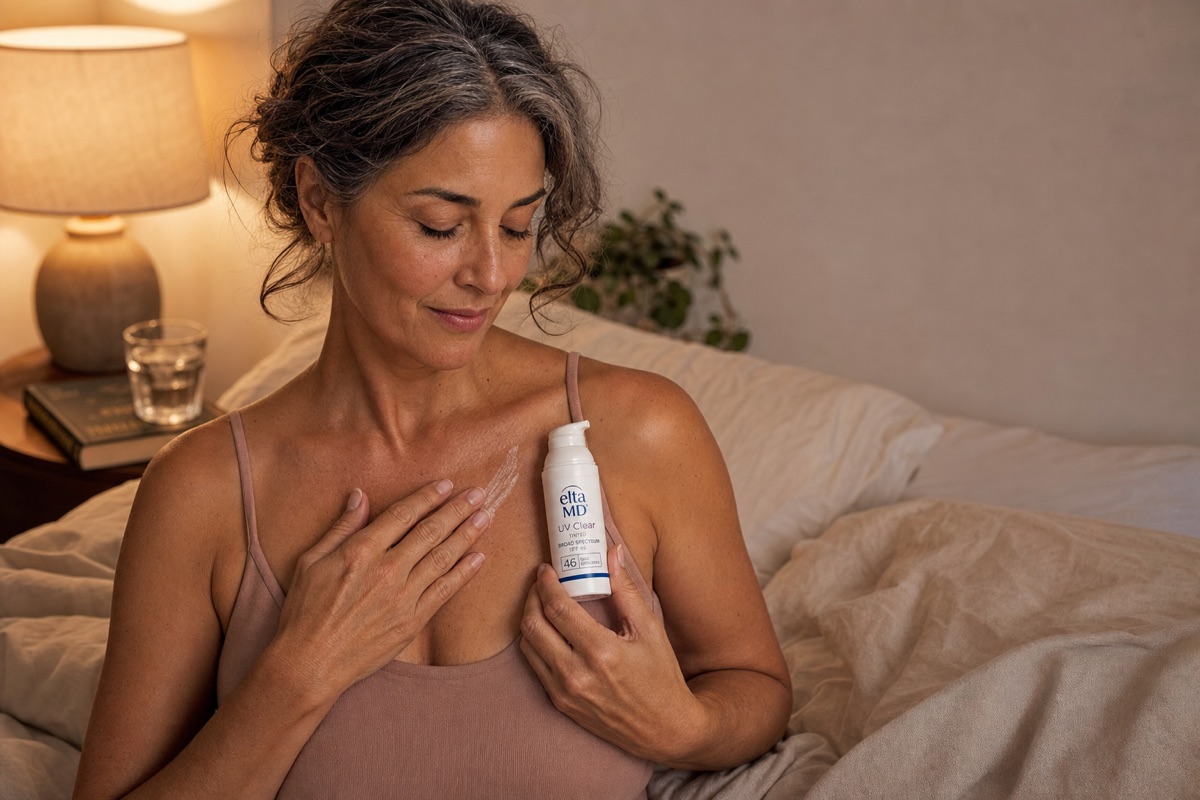
How to Use Decolletage Treatments Correctly: A Step-by-Step Routine for Sun Damage and Fine Lines
An evidence-led guide to applying decolletage treatments correctly, including sunscreen, antioxidants, retinol, moisturizer, and realistic timelines.
We analyzed 8 sources, including FDA sunscreen guidance, AAD photoaging advice, Kafi 2007 (n=36), and Wünsch 2014 (n=136). Use decolletage treatments in this order: daily broad-spectrum SPF, morning antioxidant support, slow evening retinol or peptide use, and moisturizer to limit irritation.
Editor's top Amazon picks for this guide
Real Amazon products that match this protocol. Affiliate links — your purchases support BeautySift.

EltaMD
UV Clear Tinted Sunscreen SPF 46
$37.60
"Broad-spectrum tinted SPF 46 fits the sunscreen-first step for exposed neck and chest skin."
What real Amazon buyers say
4.6★· 20,967 reviews"The texture is very lightweight and spreads easily without feeling heavy or greasy. It absorbs fairly quickly and doesn’t leave a sticky residue, which is a big plus for daily wear."
"I also love the light tint because it helps my skin look more even without feeling like makeup. It doesn’t leave a white cast and it feels comfortable for daily use."

La Roche-Posay
Pure Retinol Face Serum with Niacinamide
$37.59
"Retinol plus niacinamide fits the slow evening treatment lane once sunscreen and moisturizer habits are stable."
What real Amazon buyers say
4.6★· 18,055 reviews"The texture is lightweight, absorbs well, and doesn’t feel sticky or greasy. I was pleasantly surprised that it didn’t cause irritation, especially since retinol can be tricky."
"The formula feels lightweight, absorbs well, and doesn’t leave my skin greasy. It layers nicely with the rest of my skincare too."

CeraVe
Moisturizing Cream
$18.99
"Ceramide-rich, fragrance-free cream supports barrier recovery on non-retinol nights and when the chest feels dry."
What real Amazon buyers say
4.7★· 144,295 reviews"I absolutely love this CeraVe Moisturizing Cream! It keeps my skin soft, smooth, and well-hydrated all day long. I use it on both my face and body, and it doesn’t feel greasy at all."

CeraVe
Vitamin C Serum 10% Pure Vitamin C
$23.86
"10% pure vitamin C plus ceramides fits the morning antioxidant lane when the decolletage tolerates ascorbic acid."
What you'll learn
- Treat the decolletage like facial skin: protect it every morning, then introduce active treatments slowly at night.
- Sunscreen is the non-negotiable first step because new UV exposure can keep restarting pigment and collagen stress.
- Retinol can support fine-line care, but the neck and chest often tolerate it less well than the cheeks or forehead.
- A simple 12-week protocol is more realistic than stacking vitamin C, exfoliating acid, and retinol on the same night.
Steps
-
1 Step 1: Start every morning with sunscreen on the neck and chest
Apply broad-spectrum sunscreen from the jawline down to the upper chest before the area sees daylight. FDA guidance says sunscreen should be applied before sun exposure and reapplied at least every 2 hours outdoors, or more often with sweating or swimming. For the decolletage, that usually means extending the same sunscreen you use on your face onto exposed V-neck, scoop-neck, and button-down areas.
-
2 Step 2: Use one morning antioxidant lane under SPF
If your skin is not irritated, add one antioxidant product in the morning before sunscreen. Vitamin C and niacinamide are common choices for uneven tone, while barrier-supporting formulas may suit dry perimenopause skin better than a strong acid serum. The AAD lists vitamin C among ingredients used for dark spots, but sunscreen still does the heavy lifting because antioxidants do not replace UV protection.
-
3 Step 3: Introduce retinol only two nights per week at first
Use a pea-size amount for the entire neck and decolletage, not a face-size dose repeated on each zone. Begin 2 nights per week for 2 to 4 weeks, then increase only if there is no persistent stinging, rawness, or visible peeling. Kafi 2007 used topical 0.4% retinol over 24 weeks in a controlled study, which supports patience: retinoid-style changes are measured in months, not days.
-
4 Step 4: Buffer active nights with moisturizer
The chest can look crepey when it is dry, but dryness is not the same as collagen repair. Use moisturizer before or after retinol if the area stings easily, and keep non-retinol nights bland. Barrier support is especially important in Midwest winter cold, Southwest dryness, or after hot showers, when the neck and chest may be more reactive than the face.
-
5 Step 5: Keep exfoliation conservative
If texture is rough, use a gentle exfoliating product no more than once weekly at the beginning and do not combine it with retinol on the same night. The AAD includes glycolic acid among dark-spot ingredients, but the decolletage is a high-friction, sun-exposed area. Irritation can make redness, dryness, and post-inflammatory discoloration look worse.
-
6 Step 6: Evaluate the routine at weeks 8 and 12
Take the same daylight photo at baseline, week 8, and week 12. Look for fewer new dark marks, better texture consistency, and less crepey dryness rather than expecting deep necklace lines to disappear. If a spot changes size, color, border, texture, or bleeds, stop cosmetic treatment and seek medical evaluation instead of treating it as sun damage.
Why the decolletage needs a slower routine
The decolletage is exposed to UV light, friction from clothing, fragrance, heat, and sleep creasing, yet many people stop their facial routine at the jawline. That mismatch is why chest skin can show mottled pigment, redness, crepey dryness, and etched lines even when the face looks more evenly protected.
BeautySift did not test this routine on a panel. We analyzed FDA and AAD public guidance, PubMed-indexed studies, and verified Amazon product entries to build a practical protocol for US women 35-55.
Affiliate disclosure: we may earn a commission on shopping links elsewhere on BeautySift. Product inclusion does not change the protocol sequence: protect first, treat slowly, and stop if the skin becomes irritated.
The correct order
Use this order on days when the neck and chest are exposed:
- Gentle cleanse or rinse.
- Morning antioxidant if tolerated.
- Moisturizer if the area is dry.
- Broad-spectrum sunscreen on all exposed skin.
- Evening moisturizer on most nights.
- Retinol or another active only on planned treatment nights.
The most common mistake is treating the chest as if it can tolerate the same amount of active product as the face. It usually cannot. A thin, consistent routine beats an aggressive routine that causes redness, peeling, or skipped sunscreen.
A realistic 12-week schedule
Weeks 1-2: focus on sunscreen coverage and moisturizer. Do not add retinol yet if the area already feels tight or itchy.
Weeks 3-4: add a morning antioxidant 3 to 5 mornings per week if tolerated. Keep evenings bland.
Weeks 5-8: add retinol 2 nights per week. Apply moisturizer before or after the active if the area is sensitive.
Weeks 9-12: decide whether to stay at 2 nights per week or increase to 3. If there is redness, scaling, or burning, reduce frequency rather than changing to a stronger product.
How to apply each product type
Sunscreen: extend coverage from the face to the sides of the neck, throat, collarbones, and upper chest. Reapply outdoors according to FDA guidance.
Vitamin C or antioxidant serum: use a small amount over the chest in the morning, then wait until it dries before sunscreen. If it stings every time, switch to fewer mornings or a gentler antioxidant moisturizer.
Retinol: use a pea-size amount for the full neck-and-chest zone. Avoid freshly shaved, sunburned, waxed, or irritated skin.
Moisturizer: apply generously on non-active nights and lightly over retinol if needed. A richer cream can reduce the dry, crinkled look that makes chest lines more visible.
When to pause
Pause active treatments if the skin becomes raw, swollen, blistered, or persistently itchy. Seek medical evaluation for a lesion that changes shape, size, color, texture, or border, or for a spot that bleeds or looks unlike your others. Cosmetic decolletage treatments are not a substitute for skin-cancer screening.
Related BeautySift reading
Guide: Repairing sun damage after 40 -> /guides/repairing-sun-damage-after-40-2026/
Guide: How to layer vitamin C, niacinamide, and retinol -> /guides/how-to-layer-vitamin-c-niacinamide-retinol-2026/
Compare: Retinol vs at-home LED red-light therapy for fine lines -> /comparisons/retinol-vs-led-light-therapy-fine-lines-2026/