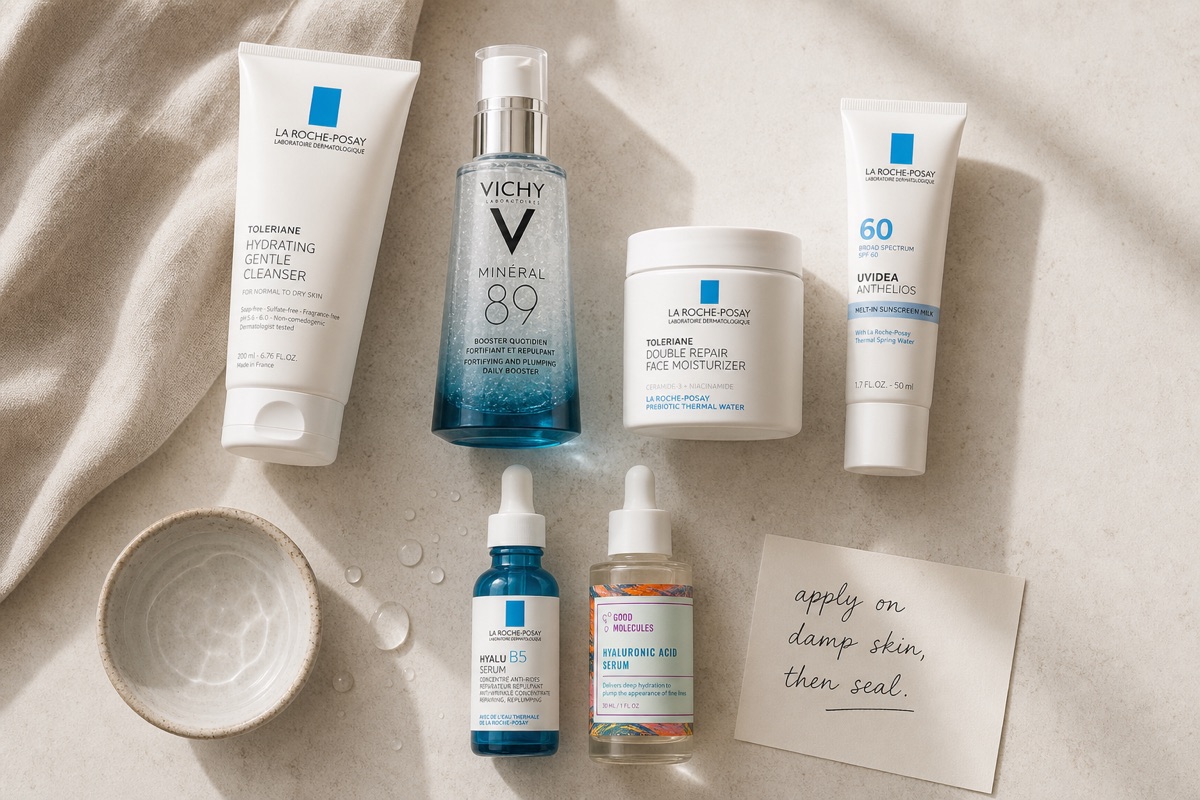
How to Use Hyaluronic Acid Serums Correctly
An evidence-led guide to applying hyaluronic acid serum on damp skin, sealing it with moisturizer, and avoiding common dryness mistakes.
We analyzed 98,239 Amazon ratings across Vichy, La Roche-Posay, and Good Molecules hyaluronic acid serums, plus 4 PubMed-indexed topical HA papers. Use HA serum on slightly damp skin, seal it with moisturizer within 60 seconds, and adjust the amount by climate and skin dryness.
Editor's top Amazon picks for this guide
Real Amazon products that match this protocol. Affiliate links — your purchases support BeautySift.

Vichy
Vichy Mineral 89 Booster
$23.99
"Best protocol match for a lightweight damp-skin step: 4.6/5 across 46,616 Amazon ratings and a simple hydrating-serum role."
What real Amazon buyers say
4.6★· 46,616 reviews"Love it! Leaves the skin instantly hydrated and plump. Very lightweight - crucial for my sensitive and oily skin!"
"This has been extremely helpful for my dry skin. I also have sensitive skin and it has been really great for that too. It goes on easily, and it's not tacky."

La Roche-Posay
La Roche-Posay Hyalu B5 Pure Hyaluronic Acid Serum
$34.39
"Best cushiony option for dry mature skin: 4.6/5 across 35,161 Amazon ratings, with HA plus vitamin B5 and madecassoside positioning."
What real Amazon buyers say
4.6★· 35,161 reviews"The texture is lightweight but very hydrating. It absorbs quickly and leaves my skin feeling soft and smooth without being greasy."
"This serum is very hydrating and lightweight. It absorbs quickly and makes my skin feel plump and refreshed."

Good Molecules
Good Molecules Hyaluronic Acid Serum
$5.97
"Best budget option for learning the protocol: 4.7/5 across 16,462 Amazon ratings and an official 1% HA positioning."
What real Amazon buyers say
4.7★· 16,462 reviews"I use it both morning and night, and at night I layer it with a retinol serum followed by moisturizer. It's very lightweight, absorbs quickly, and doesn't irritate my skin at all."
"Helps with moisture retention and leaves skin feeling very soft and supple. Has definitely improved the appearance of my skin."
What you'll learn
- Apply hyaluronic acid serum to slightly damp skin, not fully dry skin, so the humectant step has water available at the surface.
- Seal the serum with moisturizer within about 60 seconds; HA is a hydration step, not a complete barrier cream.
- Use fewer drops in humid weather and pair HA with a richer moisturizer in Southwest dryness, winter heat, or perimenopausal dryness.
- If HA serum pills, feels sticky, or makes skin tighter, reduce the amount before you assume the ingredient is wrong for you.
- For mature skin, the best HA routine is usually cleanser, HA serum, moisturizer, and sunscreen by day, with retinoids or acids kept on separate timing if irritation appears.
Steps
-
1 Start with clean, slightly damp skin
After cleansing or rinsing, leave skin lightly damp instead of towel-dry. Hyaluronic acid is a humectant, so the routine works best when there is surface water available before moisturizer goes on.
-
2 Use a small amount and spread it thinly
Use 2 to 4 drops for the face, or a pea-size amount if the serum is gel-like. Press or smooth it across cheeks, forehead, chin, and neck without building a thick film.
-
3 Seal within 60 seconds with moisturizer
Follow with moisturizer while the serum still feels slightly fresh. This matters more than buying the highest-percentage HA product because moisturizer supplies emollients and occlusives that slow water loss.
-
4 Adjust by climate, season, and skin feel
In humid Florida-style weather, a light gel serum plus lotion may be enough. In Southwest dryness, Midwest winter cold, or indoor heat, pair HA with a creamier moisturizer or use it only once daily.
-
5 Keep strong actives on a tolerable schedule
Hyaluronic acid can sit comfortably near vitamin C, retinoids, peptides, and niacinamide for many users, but it cannot cancel irritation from too many active nights. Reduce active frequency if stinging or peeling persists.
Bottom line
Use hyaluronic acid serum as a water-binding step, not as your whole moisturizer. The most reliable order is simple: cleanse or rinse, leave skin slightly damp, apply a thin layer of HA serum, then seal it with moisturizer and sunscreen in the morning. At night, seal it with moisturizer before or after retinoid use depending on your tolerance.
BeautySift did not test these serums in a lab. We analyzed 98,239 Amazon ratings across Vichy Mineral 89, La Roche-Posay Hyalu B5, and Good Molecules Hyaluronic Acid Serum; 4 PubMed-indexed topical hyaluronic acid papers; official brand pages; and INCI-level formula patterns. We may earn a commission from Amazon links, but affiliate status does not influence product selection or evidence weighting.
For women 35-55, hyaluronic acid can be useful because dryness often becomes less predictable: cheeks feel tight after cleansing, foundation catches on texture, or a once-easy retinoid starts making skin look dull. HA helps most when it is paired with enough water at application and enough moisturizer afterward.
What hyaluronic acid actually does
Hyaluronic acid is a humectant, meaning it binds water. In skin care, that makes it useful for temporary plumping, surface comfort, and helping moisturizer spread over dry-feeling skin. It is not an exfoliant, a retinoid, or a sunscreen. It does not replace ceramides, petrolatum, shea butter, dimethicone, or other ingredients that help slow water loss.
That distinction explains many bad experiences with HA. If you apply too much serum to dry skin and do not seal it, the surface can feel tacky or tighter. If you layer it under a moisturizer that is too light for the season, the serum may not be the problem; the routine may simply need more barrier support.
The clinical literature supports HA as a reasonable hydration ingredient, while still leaving room for formula quality. A 2022 Journal of Cosmetic Dermatology multicenter evaluation reported statistically significant hydration increases at weeks 4 and 8 for a topical HA serum. A 2018 Journal of Drugs in Dermatology split-face study enrolled 24 women aged 35-55 and reported better hydration and skin-quality measures on the HA-serum side after procedures. Those studies are not a guarantee that every serum works the same way, but they support the basic hydration logic.
Step 1: apply it to slightly damp skin
The most common mistake is applying HA like a treatment serum to bone-dry skin. Instead, cleanse gently, rinse, and pat so your face is not dripping but still feels lightly damp. If you already cleansed earlier, mist with plain water or press damp hands over the face before applying serum.
Use 2 to 4 drops for the face. More is not automatically better. A thick HA layer can pill under sunscreen, turn sticky under makeup, or make skin feel like it has a film. Spread it thinly over cheeks, forehead, chin, and neck, then pause just long enough for it to feel even, not fully dry.
Vichy Mineral 89 is the lightest-featured match for this step. Amazon lists it at 4.6/5 across 46,616 ratings, and the representative verified reviews we captured emphasize lightweight hydration, low tackiness, and use on sensitive or oily skin. That makes it a good fit when you want hydration without a rich serum texture under SPF.
Step 2: seal it with moisturizer quickly
Hyaluronic acid works best when moisturizer follows while the skin still feels fresh. Think within about 60 seconds, not 10 minutes later. Moisturizer adds the emollient and occlusive support that HA serum lacks on its own. This is especially important if your home is dry, your office has forced-air heat, or your skin has become drier during perimenopause or menopause.
A simple morning order is: gentle cleanser or rinse, HA serum, moisturizer, broad-spectrum sunscreen. If your sunscreen already feels moisturizing, you may still need a light lotion between HA and SPF when skin is dry. If makeup pills, reduce the serum amount first, then reduce moisturizer amount, before changing all products.
La Roche-Posay Hyalu B5 fits the richer-serum role. Amazon lists it at 4.6/5 across 35,161 ratings, and the formula positioning includes hyaluronic acid, vitamin B5, and madecassoside. The tradeoff is that it costs more than budget HA and may be more serum-like than people with very oily skin want in humid weather.
Step 3: choose the right time of day
Most people do not need HA serum morning and night forever. Start once daily in the morning if the main problem is makeup catching on dry patches or sunscreen feeling uncomfortable. Start at night if your main problem is retinoid dryness, tightness after cleansing, or cheeks that feel depleted by bedtime.
If you use vitamin C in the morning, HA can go after vitamin C if the vitamin C product is watery and well tolerated. If vitamin C stings, simplify: rinse, HA, moisturizer, sunscreen for several mornings, then reintroduce vitamin C less often. For retinoids, HA can be used before moisturizer as part of a buffer routine, or after retinoid if your product instructions and skin tolerance allow.
The Good Molecules serum is the budget-friendly teaching product in this guide. Amazon lists it at 4.7/5 across 16,462 ratings, and the official brand page positions it as a 1% hyaluronic acid serum. It is useful if you want to learn whether the damp-skin-plus-moisturizer protocol helps before spending more.
Step 4: adjust by climate and season
Humectants are context-dependent. In humid Southeast summers, a small amount of HA serum under a light moisturizer may be enough. In the arid Southwest, high-altitude air, Midwest winter cold, or homes with dry indoor heat, HA usually needs a creamier follow-up. If your skin feels tighter after adding HA, do not immediately assume you are allergic. First check the routine: damp skin, fewer drops, faster moisturizer, richer seal.
For mature skin, this seasonal adjustment matters. Skin that felt combination at 38 can feel dry on the cheeks at 48. You may need a summer version and a winter version of the same basic protocol. Summer might be HA plus gel-cream plus SPF. Winter might be HA plus barrier cream at night and HA only once daily.
Skip HA temporarily if the skin is burning, swollen, crusted, bleeding, or intensely itchy. Those are not signs that you need a stronger humectant. They are signs to stop optional actives and consider medical advice.
Step 5: avoid the pilling and stickiness traps
Pilling usually comes from too much product, incompatible textures, or not enough wait time between layers. Use fewer drops of HA serum, apply moisturizer while the serum is still slightly damp, then wait a few minutes before sunscreen or makeup. If sunscreen still rolls, try using HA only at night or switch to a lighter moisturizer under SPF.
Stickiness is usually a dose problem. Many HA serums are naturally a little cushiony, but they should not feel like glue. Use a smaller amount, spread it farther, and avoid layering multiple humectant-heavy products in the same routine: essence, HA serum, gel moisturizer, and hydrating primer can be too much film for some faces.
Dullness can improve indirectly when skin is better hydrated because texture looks smoother and light reflects more evenly. That is different from saying HA fades pigment. For dark spots or uneven tone, vitamin C, sunscreen, retinoids, or exfoliating acids may be more targeted; HA simply helps keep the routine more comfortable.
Product roles in the protocol
Choose one HA serum by texture and budget, not by the longest ingredient list. Vichy Mineral 89 is the lightest-feeling option in this set and makes sense under sunscreen or in humid weather. La Roche-Posay Hyalu B5 is the cushiony dry-skin choice when you want a more comforting serum step. Good Molecules Hyaluronic Acid Serum is the low-cost way to learn the protocol and is the easiest to justify if you are unsure whether HA belongs in your routine.
You do not need all three. If your moisturizer is already rich, choose a lighter serum. If your moisturizer is a gel and your cheeks are dry, choose a cushionier serum or upgrade the moisturizer instead. If your routine already includes a hydrating essence, an HA serum may be redundant.
The product scores behind these roles used the same evidence-weighted logic: Amazon rating volume, formula role, tolerability signals from representative verified reviews, value in USD, and whether the product fits the damp-skin-plus-moisturizer protocol. Vichy and La Roche-Posay scored higher for broad review volume and mature-skin texture fit; Good Molecules scored highest for value.
A simple 7-day routine to try
For the first week, keep the routine boring. Morning: rinse or cleanse gently, apply HA serum to damp skin, seal with moisturizer, then use sunscreen. Evening: cleanse, apply HA serum to damp skin if you feel dry, then moisturize. Keep exfoliating acids and retinoids on your usual schedule only if your skin is comfortable.
If your skin feels better after 7 days, continue once daily or use HA only when needed. If it feels sticky, use less. If it feels tighter, apply it to damper skin and follow faster with a richer moisturizer. If it burns, stop the serum and return to a bland moisturizer routine before trying again.
This is cosmetic routine guidance, not treatment advice. Persistent rash, swelling, pain, cracking, bleeding, or severe itch deserves a clinician’s input rather than another serum layer.