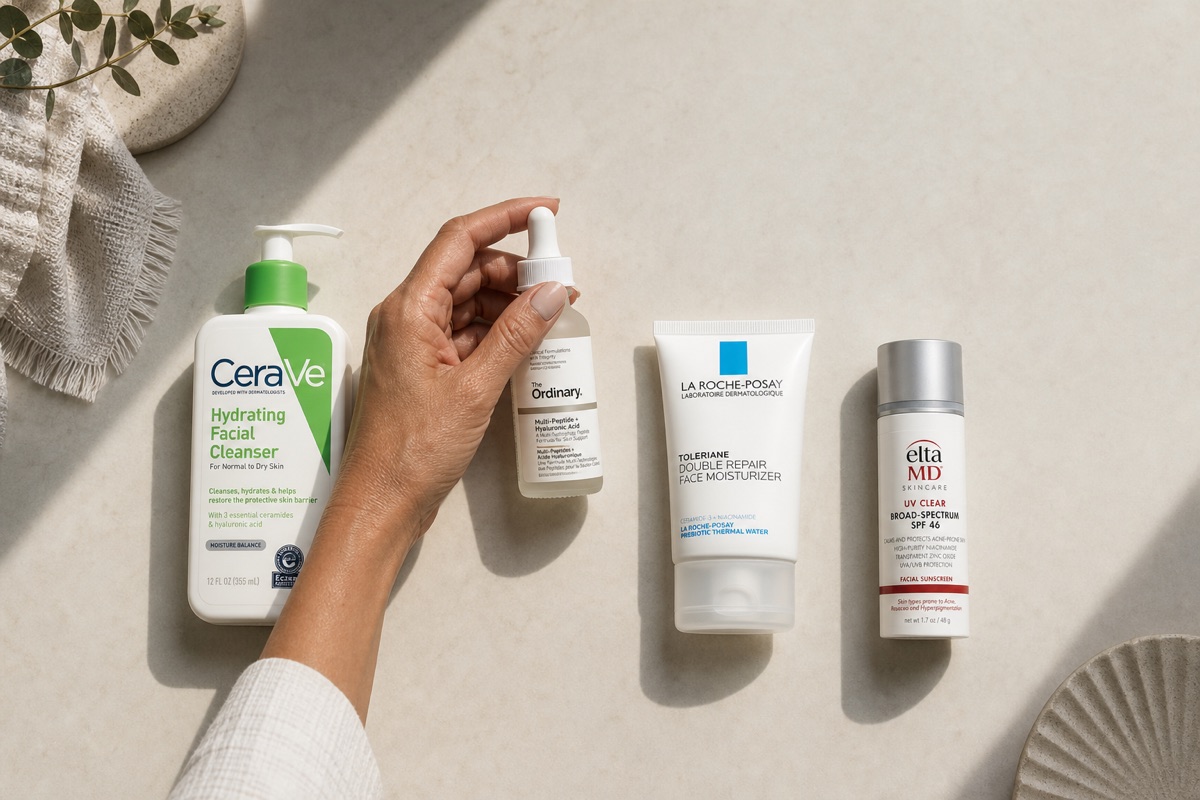
How to Use Peptide Serums Correctly After 35
A practical, evidence-led peptide serum guide for women 35-55, including timing, layering, product examples, and what not to expect.
Based on a 12-week PubMed palmitoyl pentapeptide study in 93 women ages 35-55, FDA cosmetic-claim guidance, and 3,773 Amazon ratings across 3 peptide serums, use peptides on clean, slightly damp skin before moisturizer, once daily to start, then judge firmness and fine lines after 8-12 weeks.
Editor's top Amazon picks for this guide
Real Amazon products that match this protocol. Affiliate links — your purchases support BeautySift.

The Ordinary
The Ordinary Multi-Peptide + Hyaluronic Acid
$19.90
"Best low-cost daily peptide lane: 4.7/5 across 2,285 visible Amazon ratings and a lightweight serum texture that fits before moisturizer."
What real Amazon buyers say
4.7★· 2,285 reviews"The texture is lightweight and smooth, and it absorbs nicely without feeling heavy. My skin feels instantly more hydrated and looks noticeably plumper after application."
"Their products feel so nice and hydrating. None of them are oily. Some are a little tacky when layering but I think that means you have to wait a little longer between layers."

Naturium
Naturium Multi-Peptide Advanced Serum
$24.88
"Best hydrating peptide step for simple routines: 4.6/5 across 940 visible Amazon ratings and a formula positioned for firmness and smoothing."
What real Amazon buyers say
4.6★· 940 reviews"My skin is soft, glowy, and hydrated. Very easy to use(I use after wash and toner), DEFINITELY a great value."
"This is such a hydrating yet lightweight serum- no greasiness and absorbs really well! It layers beautifully under different moisturizers (no pilling or stickiness)"

MAELOVE
MAELOVE Peptide Squad Collagen Renewal Serum
$54.90
"Best copper-peptide blend in this protocol: 4.6/5 across 548 visible Amazon ratings, with copper peptides, Argireline, Matrixyl 3000, hyaluronic acid, and niacinamide named on the Amazon listing."
What real Amazon buyers say
4.6★· 548 reviews"It absorbs quickly and leaves my skin feeling soft, plump, and more firm. After consistent use, I've noticed my skin looks more even and my fine lines appear less noticeable."
"The texture is lightweight and smooth, absorbs quickly, and layers beautifully under moisturizer and sunscreen without pilling."
What you'll learn
- Peptide serums work best as consistency products: apply after cleansing and before moisturizer, then judge visible texture and firmness over 8 to 12 weeks.
- Use peptides once daily at first if your routine already includes retinoids, exfoliating acids, vitamin C, or benzoyl peroxide.
- Do not expect a peptide serum to lift sagging skin like a procedure; the FDA distinguishes cosmetic appearance claims from drug-like structural claims.
- For women 35-55, peptides are most useful when dryness, fine lines, and loss of bounce are priorities but the skin barrier is too reactive for stronger actives every night.
- Choose a formula that fits your routine: lightweight hydrator for layering, budget peptide serum for daily use, or copper-peptide blend when you want a richer anti-aging lane.
Steps
-
1 Apply after cleansing, before moisturizer
Use peptide serum on clean skin while it is still slightly damp, then seal with moisturizer. Most peptide serums are water-based, so they sit earlier than creams, oils, and sunscreen. This order improves comfort and reduces pilling without asking the serum to replace your moisturizer.
-
2 Start once daily for the first two weeks
If your routine already includes retinol, exfoliating acids, benzoyl peroxide, or strong vitamin C, begin with peptide serum once daily rather than morning and night. A simple morning lane is cleanser, peptide serum, moisturizer, sunscreen. A simple evening lane is cleanser, peptide serum, moisturizer.
-
3 Separate from your most irritating actives if skin is reactive
Peptides are generally positioned as lower-irritation actives, but the full routine still matters. If your skin stings, flakes, or feels tight, keep peptides on recovery nights and move exfoliating acids or retinoids to different nights until the barrier is calm.
-
4 Use enough product, but do not flood the face
Two to four drops, or one pump if the product uses an airless pump, is enough for most faces and necks. Press it over cheeks, forehead, jawline, and neck; avoid chasing a wet shine. Too much serum increases stickiness and pilling under sunscreen or makeup.
-
5 Measure the right outcome at 8 to 12 weeks
The Robinson palmitoyl pentapeptide study followed 93 women ages 35-55 for 12 weeks, so a fair home timeline is measured in weeks, not days. Track hydration, smoother-looking fine lines, and makeup sitting better before escalating to stronger actives.
Quick answer
Use peptide serum after cleansing and before moisturizer, usually once daily at first. Based on Robinson et al.’s 12-week PubMed study of 93 women ages 35-55, FDA cosmetic-claim guidance, and 3,773 visible Amazon ratings across the three featured peptide serums, the best routine is simple: damp skin, thin layer, moisturizer, sunscreen in the morning, and an 8- to 12-week evaluation window.
Peptides are not instant tightening products. They are better understood as consistency actives: supportive, usually lower-drama, and most useful when dryness, fine lines, and loss of bounce make skin look older than you feel. For many US women in their late 30s, 40s, and early 50s, that makes peptides a good bridge between basic moisturizer and more aggressive routines built around retinoids or acids.
What peptide serums can and cannot do
The strongest human evidence we found for a peptide-like cosmetic active is the Robinson et al. PubMed study on palmitoyl pentapeptide. It followed 93 Caucasian women ages 35-55 for 12 weeks in a double-blind, split-face design and found significant improvement versus placebo for wrinkles and fine lines by image analysis and expert grading. That is relevant to this audience because the age range directly overlaps BeautySift’s core reader.
But the result does not mean every peptide serum will firm every face. It studied a specific palmitoyl pentapeptide at 3 ppm in a moisturizer base, not every modern cocktail containing Matrixyl, Argireline, copper peptides, growth-factor-adjacent marketing language, or collagen-support claims. The 2020 PubMed ex-vivo copper-ion study is also useful but narrower: it used human skin explants, not a consumer face-serum trial, and it measured elastin, pro-collagen 1, and TGF-beta1 changes in a controlled model.
That is why the FDA guidance matters. In the US, a cosmetic can claim to improve the appearance of wrinkles, but it should not promise drug-like structural change. Translate that into shopping language: peptides may help skin look smoother, plumper, and more resilient, especially when your barrier is hydrated. They should not be expected to lift jowls, erase etched lines, or replace sunscreen, retinoids, procedures, or prescription treatment.
Step 1: Put peptides in the watery-serum slot
Most peptide serums belong after cleanser and before moisturizer. If you use toner or essence, apply those first, then peptide serum, then moisturizer. Morning routines end with broad-spectrum sunscreen; evening routines end with moisturizer or a barrier cream if you are dry.
A good order for a beginner is:
- Gentle cleanser.
- Hydrating toner or essence, if you already use one.
- Peptide serum.
- Moisturizer.
- Sunscreen in the morning.
Slightly damp skin helps many water-based peptide serums spread evenly. It also prevents overuse. Two to four drops, or one pump, is usually enough for the face and neck. If the serum leaves a tacky film, wait a minute before moisturizer rather than adding another active on top.
The Amazon reviews we captured support that routine logic without pretending to be clinical proof. For The Ordinary Multi-Peptide + Hyaluronic Acid, a verified Amazon reviewer wrote that the texture is lightweight, smooth, and absorbs without feeling heavy. For Naturium Multi-Peptide Advanced Serum, another verified reviewer specifically described using it after washing and toner. Those are user-experience signals, not randomized outcomes, but they help identify where the product fits in a real bathroom routine.
Step 2: Start once daily, not every possible time
Peptide serums often look gentle on paper, so the common mistake is adding them morning and night while also starting retinol, exfoliating acid, and vitamin C. That makes it impossible to know what helped and what caused irritation.
Start once daily for the first 2 weeks. Morning is easiest if your night routine already contains retinol. Night is easiest if your morning routine already contains a low-pH L-ascorbic acid vitamin C serum. If your skin is very dry, use peptides on recovery nights between retinoid nights.
For a woman using retinol 2 or 3 nights weekly, a clean schedule could look like this:
- Morning: cleanse or rinse, peptide serum, moisturizer, sunscreen.
- Retinol nights: cleanse, moisturizer buffer, retinol, moisturizer.
- Recovery nights: cleanse, peptide serum, moisturizer.
This is not about peptides being incompatible with retinol. It is about reducing routine noise. If skin stays calm after 2 weeks, you can decide whether to use the peptide serum more often.
Step 3: Pair peptides with sunscreen and moisturizer
Peptide serums do not replace the two boring products that make anti-aging routines work: moisturizer and sunscreen. Moisturizer reduces the look of dehydration lines quickly. Sunscreen reduces ongoing UV damage that makes fine lines and laxity worse over time.
This is especially important in the 35-55 age range. Perimenopause and menopause can make skin feel drier, thinner, and less forgiving. A peptide serum layered under a comfortable moisturizer can make the routine easier to maintain, but daily sunscreen is still the nonnegotiable morning finish.
If peptides pill under sunscreen, the fix is usually technique, not abandonment. Use less serum, apply to slightly damp skin, wait until it feels set, then apply moisturizer and sunscreen. Avoid layering three or four gel serums under a silicone-heavy sunscreen if you plan to wear makeup.
Step 4: Know when to separate peptides from strong actives
Many peptide serums layer well, but your skin does not care whether the ingredient category is trendy. It cares about total irritation load.
Separate peptides from exfoliating acids if your skin stings after application, if your cheeks feel hot, or if moisturizer suddenly burns. Keep glycolic, lactic, or salicylic acid on a different night until the barrier is calm. If you use benzoyl peroxide for adult acne, place peptide serum at the opposite time of day or ask your dermatologist how to sequence it.
Vitamin C is more nuanced. A gentle vitamin C derivative may layer comfortably with peptides. A low-pH L-ascorbic acid formula may make the routine feel crowded, especially on dry or sensitive skin. If you are unsure, keep vitamin C in the morning and peptides at night, or alternate mornings.
Copper peptides deserve extra caution because users often combine them with every active they own. The 2020 PubMed copper-ion study is interesting for collagen and elastin markers in an ex-vivo model, but it does not prove that stacking a copper-peptide serum with acids, retinoids, and low-pH vitamin C will be better. Patch test first, then build slowly.
Step 5: Pick the right peptide-serum lane
We used product-comparison scoring logic to choose three protocol examples: user sentiment from Amazon snapshots, formula role, texture fit, value, and evidence relevance. The scoring is not based on BeautySift testing.
The Ordinary Multi-Peptide + Hyaluronic Acid is the budget-friendly daily lane. Its Amazon snapshot showed 4.7/5 across 2,285 visible ratings at $19.90, and the brand positions it as a multi-technology peptide serum for visible signs of aging. It is the most practical pick if you want to learn whether peptides suit your skin before spending more.
Naturium Multi-Peptide Advanced Serum is the easy layering lane. Its Amazon snapshot showed 4.6/5 across 940 visible ratings at $24.88, and the brand positions it around firming and smoothing. The user-review language we captured focused on hydration, lightweight feel, and layering under moisturizers, which fits the protocol in this guide.
MAELOVE Peptide Squad Collagen Renewal Serum is the copper-peptide blend lane. Its Amazon snapshot showed 4.6/5 across 548 visible ratings at $54.90, and the Amazon listing names copper peptides, Argireline, Matrixyl 3000, hyaluronic acid, and niacinamide. It is the most active-feeling option of the three, so sensitive users should patch test and avoid adding it on the same week as a new retinoid or acid.
Step 6: Track the right signs of progress
Peptides are slow-score products. Do not judge them after three applications unless they irritate you. The Robinson PubMed study used a 12-week window in 93 women ages 35-55, so your tracking should be similarly patient.
At week 2, look for tolerability: no stinging, no new rough patches, no pilling that makes sunscreen difficult. At week 4, look for comfort: less tightness after cleansing, smoother makeup wear, and fewer dehydration lines by afternoon. At weeks 8 to 12, decide whether fine lines look softer or skin looks a little bouncier in consistent lighting.
Use the same mirror, same time of day, and same lighting. A bathroom selfie under warm bulbs will not compare fairly with a car-window selfie in afternoon sun. Also remember that sleep, alcohol, allergy season, weight changes, and hot flashes can all change facial puffiness and dryness.
Common mistakes that make peptides disappointing
The first mistake is expecting a lift. Peptides can support the appearance of smoother, better-hydrated skin; they cannot reposition tissue. If sagging is your main concern, think of peptides as supportive skincare, not a procedure substitute.
The second mistake is using too many products. If you add peptide serum, acid toner, retinol, vitamin C, and a new sunscreen in the same week, you have no clean read on results. Add one product, give it 2 weeks for tolerability, then adjust.
The third mistake is skipping moisturizer. A peptide serum without moisturizer can leave mature or perimenopausal skin feeling tight, which makes fine lines look worse. Seal it in.
The fourth mistake is ignoring sunscreen. If UV exposure continues unchecked, a peptide serum is trying to make skin look smoother while daily damage keeps moving the goal posts. In US climates with intense sun, like Florida summer humidity or high-altitude Southwest dryness, that sunscreen step matters even more.
A simple peptide routine for women 35-55
If you want the least complicated version, use this for 8 weeks:
Morning: rinse or cleanse, peptide serum, moisturizer, broad-spectrum sunscreen.
Evening: cleanse, moisturizer. If you already tolerate retinol, keep it on its usual nights and use peptide serum in the morning. If you do not use retinol, you can use peptide serum at night instead.
After 8 weeks, decide whether the serum earned its space. Keep it if your skin feels more comfortable, makeup sits better, or fine lines look softer in consistent lighting. Stop it if it pills under sunscreen, causes irritation, or makes the routine too complicated to sustain.
Peptides are best when they make your routine more consistent, not more chaotic.