Kojic Acid Products for Beginners: A Starter Guide
A beginner-friendly kojic acid guide for dark spots and uneven tone, with evidence-based steps, product examples, and irritation guardrails.
We analyzed 5 Amazon US product snapshots, FDA sunscreen guidance, and 4 PubMed-indexed kojic acid studies. For beginners, use one kojic acid product 2-3 nights weekly, moisturize, and wear SPF 30+ daily; the 2023 melasma meta-analysis reported kojic-acid irritation at 5.3%.
Editor's top Amazon picks for this guide
Real Amazon products that match this protocol. Affiliate links — your purchases support BeautySift.

Good Molecules
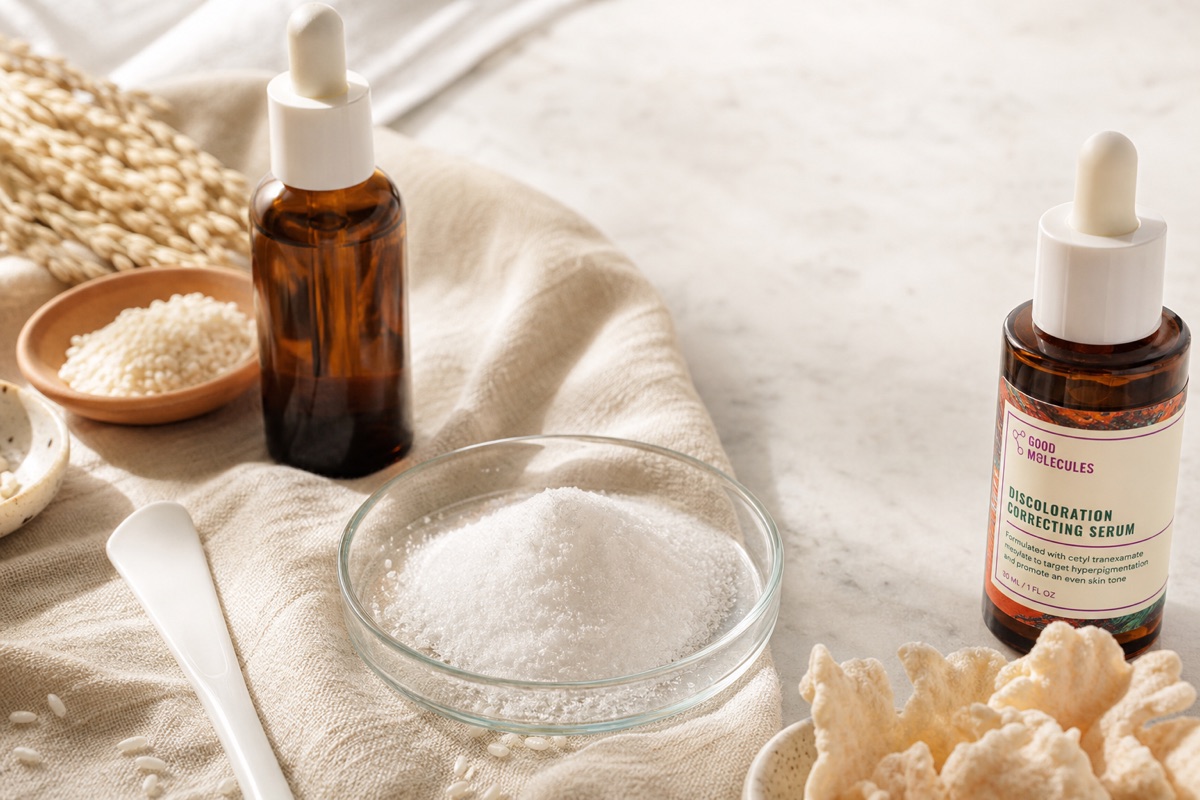
Good Molecules Discoloration Correcting Serum
$11.94
"Best first brightening serum for beginners who want a low-cost, fragrance-free-feeling dark-spot step before trying stronger kojic acid bars."
What real Amazon buyers say
4.4★· 14,787 reviews"I literally just started using the Good Molecules Discoloration Correcting Serum and so far I’m really loving it. The formula feels super lightweight on my skin, absorbs quickly, and doesn’t leave me greasy or sticky at all."
"This product helps lighten my skin helps with discoloration. It is monies worth. If you have sensitive skin, you could use it, and it also keeps your face moisturized."

Naturium
Naturium Tranexamic Topical Acid 5%
$19.99
"A multi-active discoloration serum that pairs tranexamic acid with kojic acid, niacinamide, and licorice for users ready for a more targeted step."
What real Amazon buyers say
4.2★· 3,278 reviews"2nd time to purchase! Made my face brighter and less pimple marks!"
"I like the feel of the product. My research shows the ingredients should be effective but dark spots are hard to get rid of. I’ve only been using it a month and that isn’t long enough for results."

Good Molecules
Good Molecules Brightening & Dark Spots Bar
$8
"A soap-free, pH-balanced bar positioned around 2% kojic acid and 2% tranexamic acid; best for short-contact cleansing rather than leave-on layering."
What real Amazon buyers say
4.3★· 2,853 reviews"It has no discernible smell (I don't tolerate fragrance), does not strip moisture (I'm quite dry at the moment, winter here still), lathers nicely"
"I decided to try this soap bar from Good Molecules as a targeted facial cleanser, mainly to help with post-acne marks and overall skin clarity... and it turned out to be a really solid addition to my routine."

Kitsch
Kitsch Kojic Acid Soap
$11.99
"A hydrating-positioned kojic acid and turmeric bar with a high Amazon rating count; use as a short-contact body or face wash, not a leave-on mask."

La Roche-Posay
La Roche-Posay Glycolic Acid Serum with Tranexamic Acid, Kojic Acid and Vitamin B5
$37.59
"A more active discoloration serum for users who tolerate acids; better after a beginner has already proven they can use kojic acid without stinging."
What you'll learn
- Kojic acid has the best evidence as part of a discoloration routine, not as a standalone cure for melasma or sun spots.
- Beginners should start with one kojic acid product two or three nights weekly, then increase only if skin stays calm.
- Daily broad-spectrum sunscreen is the routine anchor; FDA and AAD guidance both stress consistent use and reapplication during exposure.
- Patch testing matters because published contact-dermatitis data show kojic acid can trigger allergy in a small subset of users.
- If you already use retinoids, AHAs, benzoyl peroxide, or prescription pigment treatments, separate kojic acid at first.
Steps
-
1 Choose one kojic acid lane
Pick either a leave-on serum or a short-contact cleanser, not both in the same first week. A single-product start makes irritation easier to trace and keeps the routine realistic for dry, hormonally shifting, or retinoid-exposed skin.
-
2 Patch test for two to three days
Apply a small amount along the jaw or behind the ear once daily for two or three days. Stop if you see swelling, persistent itching, rash, or burning that lasts beyond a few minutes.
-
3 Use it two or three nights weekly
For weeks 1 and 2, use kojic acid on dry skin two or three nights weekly, followed by moisturizer. If there is no stinging, peeling, or tenderness, move to every other night in weeks 3 and 4.
-
4 Protect the results every morning
Use broad-spectrum SPF 30 or higher every morning and reapply at least every two hours during direct sun exposure. Without sunscreen, new UV exposure can keep dark spots looking stubborn.
-
5 Separate strong actives until tolerance is clear
Do not start kojic acid in the same week as a new retinoid, glycolic toner, peel pad, benzoyl peroxide treatment, or strong vitamin C serum. Add one new active at a time so you can identify the cause of irritation.
Quick answer
For a first kojic acid routine, the safest path is one product, low frequency, and daily sunscreen. We analyzed 5 Amazon US product snapshots, 4 PubMed-indexed kojic acid studies, FDA sunscreen guidance, and AAD sunscreen guidance. The evidence supports kojic acid as a useful discoloration support ingredient, especially in combination formulas, but not as a one-step fix for melasma, sun spots, or post-breakout marks.
BeautySift did not test these products in a lab or run a first-party panel. We reviewed public evidence, ingredient positioning, Amazon rating snapshots, and visible customer-review excerpts. We may earn a commission from Amazon links; affiliate status does not influence scoring or placement.
Why kojic acid is useful, but easy to overdo
Kojic acid is a pigment-support ingredient used in products for uneven tone, post-breakout marks, melasma-prone discoloration, and sun-related spots. It is often paired with tranexamic acid, niacinamide, glycolic acid, alpha arbutin, or licorice because discoloration rarely responds to one cosmetic ingredient alone.
The best-known clinical signal is not kojic acid by itself. In Lim’s 1999 Dermatologic Surgery split-face study of 40 women with epidermal melasma, a 2% kojic acid, 10% glycolic acid, and 2% hydroquinone gel led to more than 50% clearance in 24 of 40 patients, or 60%, versus 19 of 40 patients, or 47.5%, on the side that used the same gel without kojic acid. That supports kojic acid as an add-on brightening ingredient, not proof that any over-the-counter bar will erase dark spots on its own.
A broader 2023 J Cosmet Dermatol meta-analysis by Chang and colleagues reviewed 45 efficacy studies involving 2,359 patients and adverse-event data from 55 studies involving 4,539 patients. In that analysis, kojic acid showed MASI or mMASI improvement with a standardized mean difference of -0.9, and the reported irritation incidence for kojic acid was 5.3%. That number is helpful for beginners because it suggests kojic acid can be tolerable, but it is not zero-risk.
The 5-step beginner protocol
Start by choosing one kojic acid lane. A leave-on serum gives more contact time and usually makes sense for specific facial discoloration. A bar or cleanser gives shorter contact and can be easier for body marks, underarms, elbows, or users who get nervous about leave-on actives. Do not begin with a kojic bar in the shower, a kojic serum at night, a glycolic toner, and a new retinoid in the same week.
Patch test for two to three days. Apply a tiny amount near the jaw or behind the ear, then wait. A brief tingle can happen with acidic formulas, but persistent burning, swelling, rough patches, or itching are stop signs. Nakagawa’s 1995 Contact Dermatitis patch-test series included 220 women with suspected cosmetic-related dermatitis; among the 8 who had used kojic-acid skin care, 5 reacted to kojic acid and to their own 1% kojic-acid products. That is not a reason to fear the ingredient, but it is a reason to patch test.
For weeks 1 and 2, use kojic acid two or three nights weekly. Apply a serum to dry skin before moisturizer, or use a bar as a short-contact cleanse and rinse thoroughly. For weeks 3 and 4, increase to every other night only if your skin is calm. If you see peeling, tightness, or new sensitivity, step back to once or twice weekly.
Use sunscreen every morning. The AAD says dermatologists recommend broad-spectrum, SPF 30 or higher, water-resistant sunscreen; its sunscreen FAQ notes SPF 30 blocks 97% of UVB rays. The FDA advises broad-spectrum sunscreen and reapplication at least every two hours during sun exposure. A brightening routine without sunscreen is like mopping while the faucet is still running.
Separate strong actives until tolerance is clear. If you use retinol, alternate nights. If you use vitamin C, keep it in the morning and kojic acid at night only after your skin is stable. If you use glycolic acid, lactic acid, salicylic acid, benzoyl peroxide, or prescription pigment therapy, ask a dermatologist or keep your routine intentionally simple.
How to choose between beginner products
Good Molecules Discoloration Correcting Serum is the most beginner-friendly first step in this group because it is affordable, simple to place after cleansing, and supported by a large Amazon US rating snapshot: 4.4/5 across 14,787 ratings in May 2026. It is not primarily a kojic acid product, but it fits the starter protocol because it lets beginners work on uneven tone without jumping directly to stronger bars or acid-heavy formulas.
Naturium Tranexamic Topical Acid 5% is the better pick if your goal is a more concentrated discoloration serum and your skin already tolerates niacinamide or tranexamic-acid-style products. Amazon’s May 2026 snapshot showed 4.2/5 across 3,278 ratings. It belongs in the “one active lane” category: do not pair it immediately with a new retinoid, peel pad, and exfoliating cleanser.
Good Molecules Brightening & Dark Spots Bar is the short-contact option. Amazon’s May 2026 snapshot showed 4.3/5 across 2,853 ratings, and the product is positioned around 2% kojic acid and 2% tranexamic acid. Short-contact use is the key phrase. Lather, cleanse, rinse, moisturize; do not let a kojic acid bar sit on dry cheeks as a makeshift mask.
Kitsch Kojic Acid Soap is a body-friendly option when the concern is uneven tone on areas such as arms, elbows, or body marks. Its Amazon snapshot showed 4.5/5 across 9,612 ratings. Because bars can be drying, beginners should avoid using it on the same body zones as fresh shaving irritation, scrubs, or strong deodorant acids.
La Roche-Posay Glycolic Acid Serum with Tranexamic Acid, Kojic Acid and Vitamin B5 is the step-up pick. Amazon’s listing snapshot showed 4.4/5 across 2,483 ratings. Glycolic acid can make formulas feel more active, so this is not the first choice for someone currently flaking from tretinoin or dealing with a damaged barrier.
What results are realistic after 8 to 12 weeks
The most realistic goal is softer contrast: spots look less sharp, post-breakout marks look less obvious, and overall tone looks more even. The 2025 J Cosmet Dermatol split-face pilot by Tantanasrigul and colleagues compared alpha-arbutin 5% plus kojic acid 2% with triple combination cream in 30 participants over a 12-week treatment period plus follow-up. The study did not show a significant mMASI mean-difference advantage between groups, but erythema and stinging were higher with the triple-combination side. That supports a beginner-friendly message: gentler combinations may be useful when tolerability matters.
BeautySift weighted these products by evidence fit rather than by the strongest marketing language. Serums scored higher for facial dark spots because they are easier to dose, easier to layer under moisturizer, and easier to stop if irritation starts. Bars scored higher for short-contact body use and value, but lower for precision because contact time varies in the shower. Acid-heavy formulas scored lower for first-week beginners but higher as step-up choices for users who already tolerate exfoliation.
For women in their late 30s, 40s, and 50s, the routine context matters as much as the product. Perimenopause and menopause can make skin feel drier, thinner, or more reactive, and many readers in this age group already use retinoids for texture or fine lines. That is why the beginner protocol is intentionally conservative. A slightly slower start is usually more useful than a fast start that causes peeling, then forces a two-week reset.
If you want a simple decision rule, choose Good Molecules Discoloration Correcting Serum for a first facial brightening step, Naturium if you specifically want a kojic-acid-containing multi-active serum, Good Molecules Brightening & Dark Spots Bar if you prefer short-contact cleansing, Kitsch for body areas, and La Roche-Posay only when your skin already tolerates glycolic-style formulas.
Melasma, especially in women 35-55, is more complicated than a single ingredient. Hormonal shifts, sun exposure, visible light, heat, and inflammation can all keep pigment patterns active. If you have symmetrical cheek, forehead, or upper-lip patches that return quickly after sun exposure, consider a board-certified dermatologist rather than escalating through stronger cosmetics. The same applies if pigmentation changes shape, bleeds, itches, or appears suddenly; cosmetic brighteners are not a substitute for diagnosis.
When to stop
Stop kojic acid if you develop swelling, rash, persistent itching, cracked skin, or burning that lasts beyond a few minutes. Stop temporarily if your moisturizer stings, because that often means your barrier is irritated. Return to a bland routine: gentle cleanser, moisturizer, and sunscreen, and restart slowly only after skin feels normal for several days.
Do not use kojic acid on broken skin, fresh waxed areas, recent peel sites, or immediately after an in-office laser unless your clinician says it is appropriate. If you are pregnant, breastfeeding, treating melasma medically, or using prescription hydroquinone, tretinoin, or steroid-containing combinations, ask your clinician before adding another brightening active.