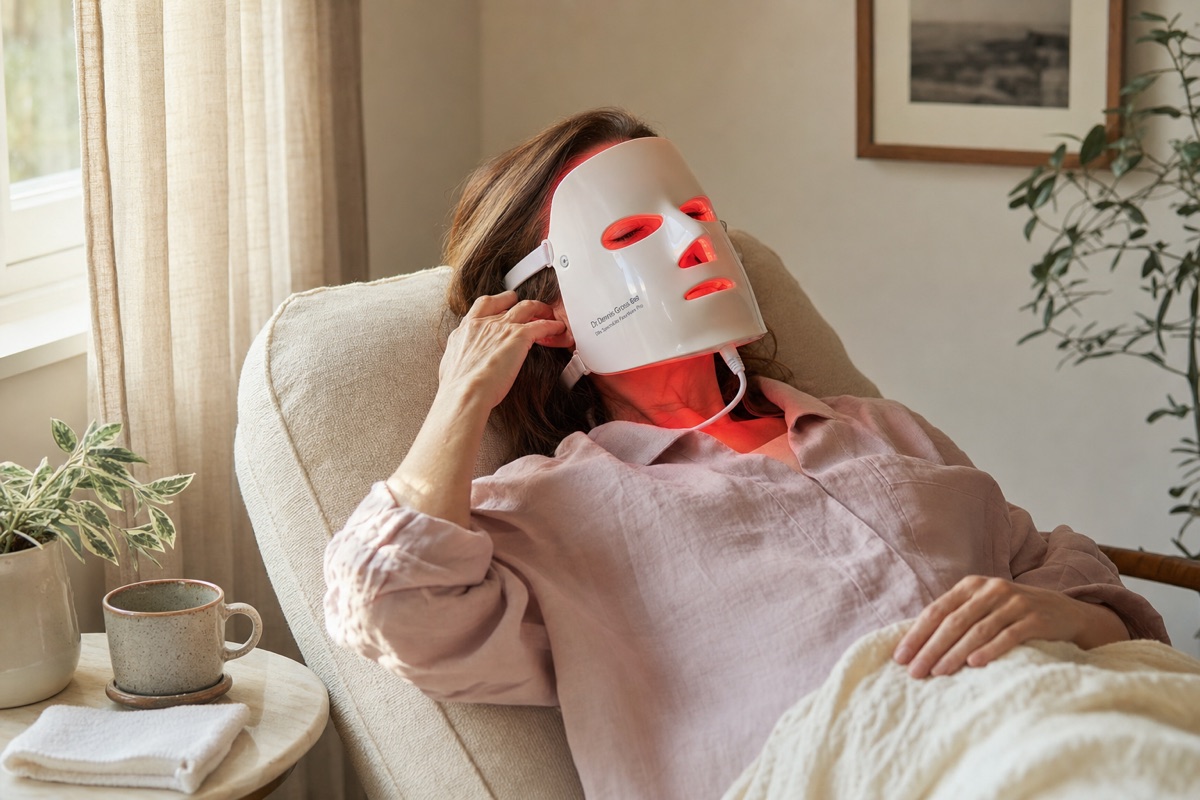
LED Mask Treatment Schedule: Frequency, Session Length, and Results Timeline
A practical 2026 LED mask schedule for fine lines and firmness, with evidence-based frequency, session length, safety notes, and realistic 3-12 week expectations.
Based on Lee et al. 2007 (n=76), Wunsch & Matuschka 2014 (n=136), FDA 510(k) K201931, and official Omnilux, CurrentBody, and Dr. Dennis Gross directions, most LED masks are used 3-5 times weekly for 3-10 minutes; expect subtle fine-line or firmness changes after consistent use for about 4-12 weeks.
Editor's top Amazon picks for this guide
Real Amazon products that match this protocol. Affiliate links — your purchases support BeautySift.

Dr. Dennis Gross
Dr. Dennis Gross DRx SpectraLite FaceWare Pro
"A short-session option for shoppers who want a 3-minute daily routine rather than a 10-minute mask schedule."

Aphrona
Aphrona Moonlight LED Facial Mask
"A rigid LED mask option with red and blue light modes; schedule should follow the device manual rather than generic overuse."

iRestore
iRestore LED Face Mask
"A red, blue, and infrared mask listing that fits shoppers comparing broader at-home LED coverage options."
What you'll learn
- Most at-home LED masks are consistency devices: use the exact manual first, then stay within a 3-5 times weekly rhythm unless directed otherwise.
- Session length is device-specific; credible consumer masks commonly run about 3-10 minutes, and longer sessions are not automatically better.
- Fine-line and texture changes should be judged after 4-12 weeks, while sagging and firmness claims need more conservative expectations.
- Do not use LED over irritated, broken, infected, or recently treated skin, and ask a clinician about photosensitivity or eye-related risks.
Steps
-
1 Start with the device manual, not a generic routine
Check the exact schedule, contraindications, and eye-protection guidance for your mask before the first session. FDA clearance and brand directions apply to specific devices, not every red-light mask on Amazon. If the manual says 3 minutes daily, do not stretch it to 10 minutes because another brand uses a longer treatment window.
-
2 Use a clean, dry face and skip irritating layers first
Cleanse, dry your face, and keep the pre-LED step simple. Avoid applying strong acids, retinoids, benzoyl peroxide, fragrance-heavy products, or photosensitizing topicals immediately before the mask unless your clinician or device manual says they are compatible. After the session, use moisturizer and daytime sunscreen as usual.
-
3 Choose a sustainable weekly frequency
For many consumer masks, a practical starting point is 3-5 sessions per week. Omnilux and CurrentBody both describe 10-minute treatments several times weekly, while Dr. Dennis Gross uses a 3-minute daily schedule. The evidence pattern is repeated exposure over weeks, not occasional long sessions.
-
4 Keep each session within the stated time
Most at-home mask sessions are short: commonly about 3-10 minutes depending on the device. More minutes do not prove better results and may increase dryness, warmth, or irritation for sensitive users. If your skin feels tight or reactive, reduce frequency before adding more products to compensate.
-
5 Track results at weeks 3, 6, and 12
Take the same front-facing photo in similar light before starting, then repeat around weeks 3, 6, and 12. At week 3, look for tolerance and habit consistency. Around weeks 6-12, judge fine lines, texture, and the look of firmness. Use modest expectations for sagging; LED may support the appearance of elasticity, but it is not a lifting procedure.
-
6 Pause for red flags and avoid medical overclaims
Stop and seek medical guidance if you notice eye discomfort, persistent redness, swelling, burning, rash, migraine flares, or unexpected sensitivity. Also ask a clinician before use if you take photosensitizing medication, have a photosensitive condition, are managing a skin disease, or recently had an in-office procedure.
The simple LED mask schedule
For most shoppers, the best LED mask schedule is the one you can repeat without irritating your skin. BeautySift analyzed peer-reviewed LED phototherapy studies, FDA device documentation, official US brand instructions, and accessible Amazon product pages. We did not test masks on a panel, and this guide is not medical advice.
Affiliate disclosure: we may earn a commission from Amazon links. Commission does not affect the schedule guidance or evidence weighting.
A practical beginner rhythm looks like this: clean dry skin, the device’s stated session length, 3-5 times weekly for many 10-minute masks, and photo check-ins at weeks 3, 6, and 12. If your mask uses a different protocol, follow that protocol instead.
Why the schedule matters more than intensity
LED masks are not designed as one-off treatments. Lee et al. studied 76 subjects using 8 sessions across 4 weeks with follow-up through 12 weeks, while Wunsch and Matuschka evaluated 136 volunteers across repeated red and near-infrared light sessions. The pattern is consistent exposure over time.
That does not mean every mask should be used the same way. Omnilux and CurrentBody describe 10-minute sessions several times weekly. Dr. Dennis Gross describes a 3-minute daily treatment for FaceWare Pro. These differences are why the manual outranks generic advice.
What to expect from weeks 3 to 12
At week 3, the main question is tolerance. Your skin should not be persistently red, hot, itchy, or dry from the device. If the habit is easy and your barrier feels normal, continue.
Around week 6, some users may start judging surface texture, glow, and the look of fine lines. Use same-lighting photos rather than daily mirror checks, because changes are usually subtle.
By week 12, you have a fairer window to decide whether the routine is worth keeping. Fine lines and roughness are more reasonable targets than true sagging. For sagging, the safer expectation is support for the appearance of firmness, not lifting.
Safety notes before you start
Do not use an LED mask over broken skin, active infection, a rash, or skin that is still recovering from a peel, laser, microneedling, or other procedure unless your clinician clears it. Ask a clinician first if you take photosensitizing medication, have a photosensitive condition, have eye disease, or the manual lists a contraindication that applies to you.
If your device includes eye shields or tells you to close your eyes, follow that instruction. Stop if you develop eye discomfort, persistent redness, burning, swelling, or headaches that feel related to use.
Related BeautySift reading
Guide: How to use a microcurrent device correctly -> /guides/how-to-use-microcurrent-device-correctly-2026
Guide: How to firm sagging skin without injectables -> /guides/how-to-firm-sagging-skin-without-injectables-2026
Guide: How to read a skincare ingredient list -> /guides/how-to-read-skincare-ingredient-list-2026