Mandelic Acid Products for Beginners: A Starter Guide
A beginner-friendly mandelic acid guide for sensitive, hormonal-acne-prone, and mature skin, with evidence-led steps and Amazon product examples.
We analyzed 5 Amazon US mandelic acid snapshots, 2 PubMed peel studies with 94 total patients, FDA AHA guidance, and official brand pages. Beginners should start with one low-frequency mandelic product 1-2 nights weekly, moisturize, and use daily sunscreen.
Editor's top Amazon picks for this guide
Real Amazon products that match this protocol. Affiliate links — your purchases support BeautySift.

Paula's Choice
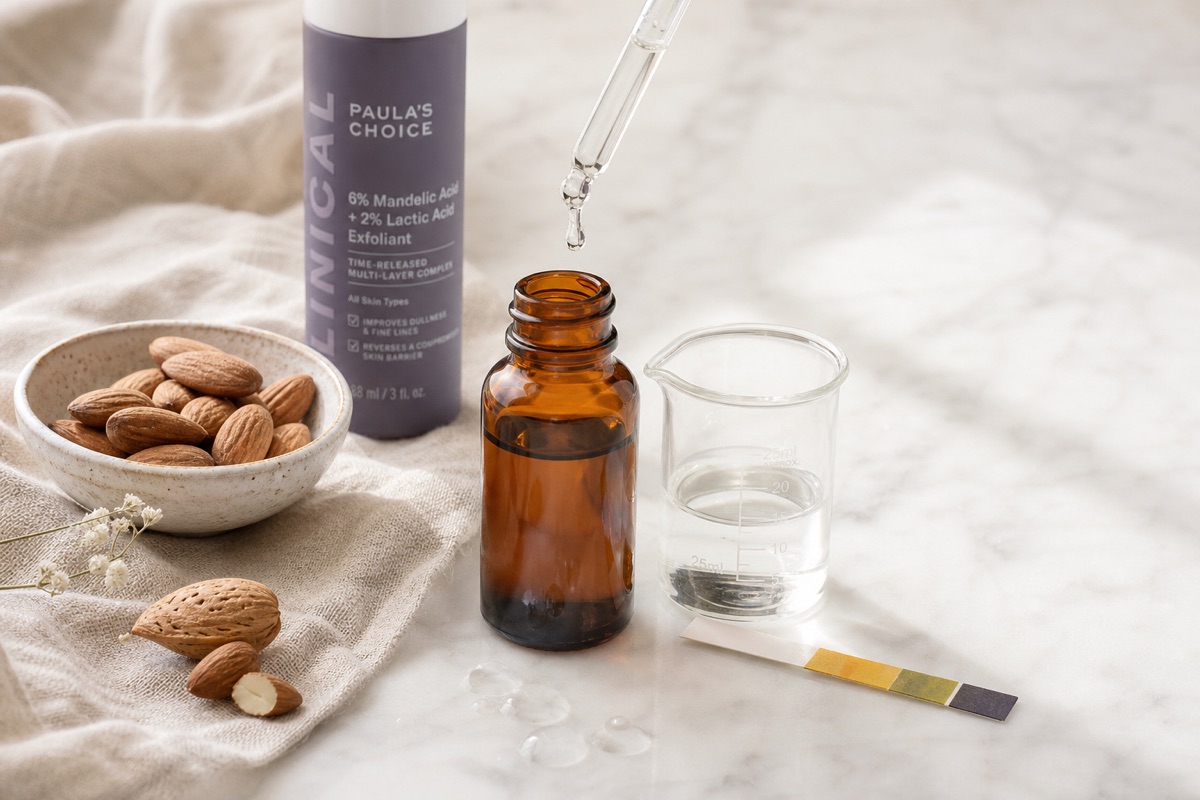
6% Mandelic Acid + 2% Lactic Acid Exfoliant
$25.90
"Best first leave-on for sensitive-skin beginners: disclosed 6% mandelic plus 2% lactic acids, fragrance-free positioning, and 4.5/5 across 818 Amazon ratings."
What real Amazon buyers say
4.5★· 818 reviews"This is the best mandelic acid product I've tried to date. Amazing for surface level texture, pore size and pigmentation."

The Ordinary
Mandelic Acid 10% + Hyaluronic Acid
$7.80
"Best budget serum: official 10% mandelic acid positioning, hyaluronic acid support, and 4.6/5 across about 4,200 Amazon ratings."
What real Amazon buyers say
4.6★· 4,200 reviews"I've been using this for a few weeks and I'm honestly impressed. It's gentle but still makes my skin look smoother and brighter."

Naturium
Mandelic Topical Acid 12%
$20
"Best step-up after tolerance is clear: official 12% mandelic positioning with niacinamide support and 4.5/5 across 860 Amazon ratings."
What real Amazon buyers say
4.5★· 860 reviews"Helps improve my overall skin texture and great for my rosacea just be sure to not use it every day."
What you'll learn
- Mandelic acid is still an alpha hydroxy acid, so beginners should treat it as an active, not a daily hydrating toner.
- The best starter schedule is one mandelic product 1-2 nights weekly for two weeks, then every other night only if skin stays calm.
- FDA AHA guidance makes sunscreen non-negotiable because AHAs can increase sun sensitivity during use and for one week afterward.
- Sensitive or hormonally shifting skin usually does better with lower strength, fragrance-free positioning, and a separate moisturizer.
- Do not introduce mandelic acid in the same week as a new retinoid, benzoyl peroxide treatment, peel pad, or strong vitamin C serum.
Steps
-
1 Pick one beginner-strength mandelic product
Choose one leave-on serum or exfoliant for the first month. BeautySift's evidence-weighted starter picks favor disclosed strengths, Amazon US review volume, and formula restraint: Paula's Choice 6% Mandelic + 2% Lactic for sensitive-skin beginners, The Ordinary 10% + HA for budget shoppers, and Naturium 12% as a step-up only after tolerance is clear.
-
2 Patch test before your first full-face night
Apply a small amount along the jaw or behind the ear once daily for two or three days. Do not continue if you see swelling, rash, persistent itching, or burning that lasts beyond a few minutes. This matters more after 35, when dryness, retinoid use, and hormonal skin swings can make irritation harder to separate from normal adjustment.
-
3 Use it 1-2 nights weekly for two weeks
Apply mandelic acid on dry skin at night, then follow with a plain moisturizer. Keep the first two weeks boring: no new retinoid, exfoliating pad, benzoyl peroxide, or strong vitamin C in the same routine. If skin stays comfortable, move to every other night; if it feels tight, return to once weekly.
-
4 Anchor the routine with daily sunscreen
Use broad-spectrum sunscreen every morning and be consistent with reapplication during outdoor exposure. FDA AHA guidance states alpha hydroxy acids can increase sun sensitivity and advises sunscreen, protective clothing, and limiting sun exposure while using AHAs and for one week afterward.
-
5 Evaluate after 8-12 weeks, not 8-12 days
Texture can feel smoother sooner, but post-breakout marks and uneven tone usually need a longer cosmetic window. PubMed-indexed mandelic acid peel studies by Garg and Dayal used supervised peel protocols, not casual daily serums, so home-use expectations should be slower and more conservative.
Quick answer
For a first mandelic acid routine, choose one product, use it 1-2 nights weekly, and protect your skin every morning. We analyzed 5 Amazon US mandelic acid product snapshots, 2 PubMed-indexed peel studies with 94 total patients, FDA AHA guidance, and official US brand pages. The best beginner path is cautious because mandelic acid is gentler-positioned than some AHAs, but it is still an exfoliating acid.
BeautySift did not test these products in a lab or run a first-party panel. We reviewed public product data, ingredient positioning, Amazon rating snapshots, and published evidence. We may earn a commission from Amazon links; affiliate status does not influence product selection or scoring.
What mandelic acid does for mature, sensitive, and breakout-prone skin
Mandelic acid is an alpha hydroxy acid used in skin care for smoother-looking texture, dullness, clogged-looking pores, and post-breakout discoloration. It is often described as a gentler AHA because its molecule is larger than glycolic acid, which can make it feel less aggressive for some users. That does not make it irritation-proof. For US women 35-55, the main issue is not whether mandelic acid is trendy; it is whether it fits a skin barrier that may already be dealing with retinoids, dryness, hormonal breakouts, or perimenopause-related sensitivity.
The clinical evidence we found is strongest for supervised peel protocols, not over-the-counter serums used casually at home. Garg et al. reported in Dermatologic Surgery 2009 that 44 patients compared glycolic acid peels with salicylic-mandelic acid peels for acne, post-acne scarring, and hyperpigmentation. Dayal et al. reported in Journal of Cosmetic Dermatology 2020 that 50 patients compared 45% mandelic acid peels with 30% salicylic acid peels for mild-to-moderate acne vulgaris. Those studies support mandelic acid as a credible exfoliating active, but they do not prove that more frequent home use is better.
For beginners, the lesson is conservative: pick a lower-risk format, increase slowly, and stop if your skin feels raw. The FDA’s Alpha Hydroxy Acids guidance states that AHAs can increase sun sensitivity and advises sunscreen, protective clothing, and limiting sun exposure during AHA use and for one week afterward. That guidance applies even if your mandelic product feels mild.
Step 1: Choose one product lane
Start with one mandelic product only. A common beginner mistake is buying a toner, serum, peel pad, and cleanser, then trying to identify which one caused stinging. That is especially unhelpful when skin is already drier in Midwest winter cold, dehydrated in Southwest dryness, or more breakout-prone around hormonal shifts.
For sensitive-skin beginners, the most balanced option in our evidence review is Paula’s Choice 6% Mandelic Acid + 2% Lactic Acid Exfoliant. The official Paula’s Choice US page identifies the product as a 6% mandelic plus 2% lactic acid leave-on AHA, and the Amazon US snapshot showed 4.5/5 across 818 ratings. It is not mandelic-only, so skip it if lactic acid has bothered you before, but its disclosed moderate acid blend makes it easier to understand than vague exfoliating claims.
For budget shoppers, The Ordinary Mandelic Acid 10% + HA is the cleanest first experiment. The Ordinary’s official US page identifies 10% mandelic acid, and the Amazon US snapshot showed 4.6/5 across about 4,200 ratings. The formula is more straightforward than cushiony, so dry skin should plan on a separate moisturizer.
For a stronger next step, Naturium Mandelic Topical Acid 12% belongs after your skin has already handled a lower-frequency acid routine. Naturium’s official US page identifies 12% mandelic acid positioning with niacinamide and fruit acids, and the Amazon US snapshot showed 4.5/5 across 860 ratings. It is not the gentlest first night; use it only once weekly at first.
Step 2: Patch test and build a slow schedule
Patch testing is not glamorous, but it is the cheapest way to avoid a face-wide barrier setback. Apply a small amount along the jaw or behind the ear once daily for two or three days. Stop if you see swelling, rash, persistent itching, or burning that lasts beyond a few minutes. A brief tingle can happen with acids; a burning sensation that keeps building is not a good sign.
For weeks 1 and 2, use mandelic acid 1-2 nights weekly on dry skin. Cleanse, wait until skin is dry, apply a thin layer, then moisturize. Do not sandwich it between other exfoliants. Do not combine it with a new retinoid. Do not add a peel mask the next morning because your skin looked fine after one use. The goal is boring consistency.
If skin stays comfortable for two weeks, increase to every other night. If your cheeks feel tight, foundation clings to flakes, or your usual moisturizer suddenly stings, move back to once weekly. Product-comparison scoring favors tolerability for beginners because a slightly slower acid routine is usually more useful than a strong routine you abandon after irritation.
Step 3: Pair mandelic acid with barrier support
Mandelic acid fits best in a simple night routine: gentle cleanser, mandelic acid, moisturizer. If your skin is very dry, apply moisturizer first, wait a few minutes, then apply the acid less often. That can reduce intensity, although it may also slow visible results.
Do not judge the product by overnight brightness alone. In the studies we cite, Garg et al. used peel comparisons in 44 patients, while Dayal et al. compared 45% mandelic acid peels with 30% salicylic acid peels in 50 patients. Those were structured clinical settings, not a nightly bathroom routine with a 5-10% serum. For over-the-counter use, smoother texture may be the earliest visible change, while uneven tone and post-breakout marks need a longer 8-12 week window.
Hormonal-acne-prone skin needs an extra caveat. Mandelic acid can support smoother-looking texture and post-breakout discoloration, but it is not an FDA OTC acne monograph active like benzoyl peroxide or salicylic acid. If breakouts are deep, painful, scarring, or persistent, treat mandelic acid as cosmetic support and get acne-specific guidance from a dermatologist.
Step 4: Do not skip sunscreen
Sunscreen is not optional when using mandelic acid. The FDA’s AHA guidance specifically warns that AHAs can increase sun sensitivity and recommends sunscreen, protective clothing, and limiting sun exposure during use and for one week afterward. That is a numeric timing claim from the FDA, not a brand marketing line.
Use your mandelic product at night and apply broad-spectrum sunscreen every morning. If you spend time outdoors, reapply according to the sunscreen label. This matters for discoloration goals because repeated UV exposure can make dark spots look more stubborn, even when the night routine is well chosen.
If sunscreen irritates your skin, solve that before increasing mandelic acid frequency. A routine that exfoliates but leaves you unprotected during Florida summer humidity, a beach vacation, or daily commuting sun is not a smart trade.
Step 5: Decide when to adjust, pause, or level up
After 8-12 weeks, look for practical signs: smoother makeup application, fewer rough patches, less dullness, or slower-looking post-breakout mark buildup. If skin is calm but progress is modest, you can consider moving from a 5-6% product to a 10% product, or from once weekly to every other night. Change one variable at a time.
Pause mandelic acid if your skin stings when you apply plain moisturizer, if you see peeling around the mouth and nose, or if your cheeks feel hot after cleansing. Restart only after your barrier feels normal for several days. Mature skin often does better with consistency than intensity, especially when retinoids, vitamin C, or prescription topicals are already in the routine.
Product selection notes
Paula’s Choice is the best first leave-on if you want a moderate, clearly disclosed acid blend and do not mind lactic acid. The Ordinary is the best value if you want a straightforward 10% mandelic serum with the largest Amazon rating base in our featured set. Naturium is the step-up option if your skin already tolerates acids and you want niacinamide in the same night product.
If you already own a strong glycolic toner, a prescription retinoid, or benzoyl peroxide, do not add mandelic acid on top of everything at once. Alternate nights and keep a small written routine log for the first month. That is not overcomplicated; it is how you avoid blaming the wrong product when irritation appears.
FAQs
How often should beginners use mandelic acid?
Start 1-2 nights weekly for two weeks. If there is no stinging, peeling, tenderness, or unusual dryness, increase to every other night. Daily use is not the right starting point for sensitive or hormonally reactive skin.
Can I use mandelic acid with retinol?
Yes, but alternate nights at first. Use retinol on one night and mandelic acid on another until your skin proves it can tolerate both. Do not begin a new retinol and a new mandelic product in the same week.
Is mandelic acid good for hormonal acne?
Mandelic acid can support smoother-looking texture and post-breakout mark routines, but it is not an FDA OTC acne drug active. If breakouts are painful, cystic, scarring, or persistent, a dermatologist can help choose acne-specific treatment.
Is mandelic acid safer than glycolic acid for sensitive skin?
Mandelic acid is often positioned as gentler because it has a larger molecular size than glycolic acid, but gentler does not mean risk-free. Strength, frequency, moisturizer use, and sunscreen habits still decide whether your skin tolerates it.
Should I use mandelic acid in the morning or at night?
Night is the easier beginner choice because it reduces layering conflicts with sunscreen and makeup. Sunscreen is still required every morning because the FDA says AHAs can increase sun sensitivity.