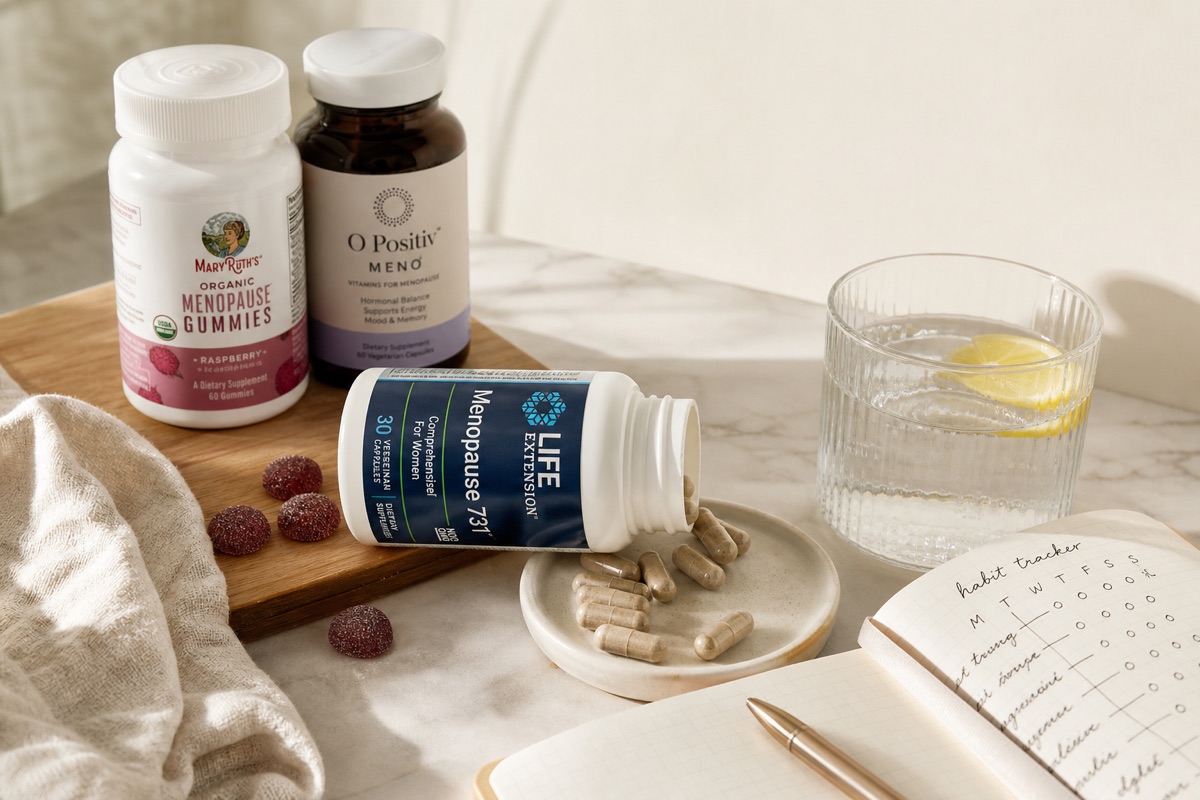
Menopause Vitamins Dos and Don'ts After 40
Evidence-led guide to menopause vitamins after 40, including what to consider, what to avoid, and how US women can shop more safely.
We analyzed 3 Amazon menopause-vitamin listings totaling 3,269 displayed ratings, FDA supplement guidance, FDA biotin safety warnings, and PubMed menopause-supplement reviews. After 40, use vitamins to fill specific gaps, not to replace clinician-led care or hormone evaluation.
Editor's top Amazon picks for this guide
Real Amazon products that match this protocol. Affiliate links — your purchases support BeautySift.

Life Extension
Menopause 731
$18
"Most evidence-specific featured option here: ERr 731 has PubMed-indexed menopause-symptom literature, including a 2024 systematic review, while Amazon showed 4.0/5 across 705 ratings."
What real Amazon buyers say
4.0★· 705 reviews"Hot flashes & night sweats are greatly reduced"

MaryRuth's
Organic Menopause Gummies
$22.46
"Best gummy-format example for shoppers who dislike capsules; Amazon showed 4.3/5 across 169 ratings, with herbal-evidence caveats from NCCIH."
What real Amazon buyers say
4.3★· 169 reviews"I've noticed my hot flashes are greatly reduced to one or two a day !"

O Positiv
MENO Vitamins for Menopause
$36.97
"Best modern hormone-free capsule example in this guide; Amazon showed 4.4/5 across 2,395 ratings, the largest featured rating base here."
What real Amazon buyers say
4.4★· 2,395 reviews"My hot flashes are not as intense, and my mood feels alot more balanced throughout the day."
What you'll learn
- Do use menopause vitamins to target a documented gap, a specific ingredient rationale, or a symptom-support goal you can track.
- Do not treat supplement labels as medical proof; the FDA states dietary supplements are regulated as foods, not premarket-approved drugs.
- Be cautious with high-dose biotin if you have lab work scheduled because the FDA warns it may interfere with certain tests.
- For hair thinning after 40, start with nutrition and medical context before assuming a hair vitamin can solve shedding on its own.
- For dryness, vitamins may support general nutrition, but barrier-focused skin care and clinician input matter when symptoms are persistent.
Steps
-
1 Step 1: Define the job before buying
Write down the main goal: hot-flash support, sleep disruption, hair thinning, dry skin, or filling a multivitamin gap. A supplement with one clear job is easier to evaluate than a crowded blend promising everything at once.
-
2 Step 2: Check the evidence level
Look for human clinical evidence on the specific ingredient family, not just a long ingredient list. ERr 731 has PubMed-indexed menopause-symptom reviews; biotin evidence for hair is strongest in deficiency contexts, according to Patel et al. 2017.
-
3 Step 3: Screen safety and lab-test issues
Before starting a menopause vitamin, check medications, upcoming blood work, thyroid testing, cardiac testing, pregnancy possibility, allergies, and liver-history concerns. The FDA specifically warns that biotin can interfere with certain lab tests.
-
4 Step 4: Start one product at a time
Use one supplement consistently for the label-directed window instead of stacking several new formulas. Track symptom frequency, sleep, shedding, dryness, digestion, headaches, and mood so you can identify benefits or side effects.
-
5 Step 5: Reassess with your clinician
Bring the supplement facts panel to an annual visit, dermatology appointment, or gynecology appointment, especially if hair shedding is sudden, dryness is painful, or hot flashes are affecting sleep. Vitamins should not delay medical evaluation.
Quick answer
After 40, the smartest menopause-vitamin strategy is selective, not maximal. We analyzed 3 Amazon US menopause-vitamin listings totaling 3,269 displayed ratings, FDA supplement guidance, FDA biotin warnings, NCCIH menopause evidence cautions, and PubMed reviews on ERr 731 and biotin. The evidence-led approach is to match one supplement to one defined job, track it, and avoid stacking formulas that duplicate nutrients or make medical symptoms harder to read.
BeautySift did not test these supplements, run blood work, or diagnose menopause symptoms. We aggregate public evidence, ingredient logic, US availability, and user-review snapshots. We may earn a commission from Amazon links, but affiliate status does not influence which products are featured or how cautions are weighted.
Why menopause vitamins get confusing after 40
Women in their late 30s, 40s, and early 50s often shop for menopause vitamins because several problems arrive at once: sleep disruption, heavier stress load, cycle changes, new dryness, and hair shedding. The marketing language can make every bottle sound like the missing link. The evidence is more modest.
The FDA’s consumer guidance says dietary supplements are regulated as foods, not premarket-approved drugs. That single fact should shape how you shop. A menopause vitamin can support nutrition or a specific ingredient strategy, but it should not be treated like a prescription treatment for hot flashes, sudden hair loss, depression, thyroid symptoms, or bleeding changes.
NCCIH’s menopause overview also cautions that complementary approaches vary in evidence strength. That does not mean every supplement is useless. It means the label needs to earn your trust with clear ingredients, realistic claims, and a safety fit for your health history.
Do: start with the symptom you can actually track
The first do is simple: name the job. If your main issue is hot flashes, a formula built around a menopause-studied ingredient is more logical than a generic hair-skin-nails gummy. If your main issue is hair shedding, a menopause hot-flash blend may not address the nutritional or medical context behind the shedding. If your main issue is dryness, a vitamin may support general nutrition, but skin-barrier care and vaginal or body dryness evaluation may matter more.
For this guide, we featured Life Extension Menopause 731 because ERr 731 has PubMed-indexed menopause-symptom literature, including a 2024 systematic review, and the Amazon US listing snapshot showed 4.0/5 across 705 ratings. That does not make it the only option, but it is a good example of a product with a specific ingredient rationale rather than a vague midlife wellness pitch.
Use a note in your phone with one weekly metric. Count hot flashes per day, night-wake frequency, handfuls of shed hair in the shower, or how often skin feels uncomfortably dry. Without a baseline, every product feels like a maybe.
Don’t: stack three bottles with overlapping ingredients
A common mistake after 40 is building a stack from separate shopping trips: a multivitamin, a hair vitamin, a menopause capsule, collagen powder, magnesium, and a sleep gummy. The problem is not that every ingredient is bad. The problem is that overlapping formulas make it harder to know what helped, what caused nausea, and whether you are doubling nutrients you did not mean to double.
The clean version is one change at a time. Start one menopause vitamin, use it as directed, and avoid adding another supplement for the first evaluation window. If the label contains biotin and your hair vitamin also contains biotin, you are no longer testing one product; you are testing a stack.
This matters for lab work. The FDA safety communication warns that biotin may interfere with certain lab tests, including tests used in emergency cardiac care. If your supplement contains high-dose biotin, tell your clinician and lab before testing. Do not assume a hair vitamin is irrelevant just because it is sold in the beauty aisle.
Do: separate hair-thinning support from hair-loss diagnosis
Hair thinning after 40 can be emotionally loaded, and supplement marketing often exploits that urgency. Patel et al. 2017 reviewed biotin use for hair loss and found the strongest support in deficiency contexts. That is a useful guardrail: biotin is not automatically a universal hair-growth fix for every woman with shedding.
If shedding is sudden, patchy, accompanied by scalp pain, or follows a medication change, illness, rapid weight change, or heavy bleeding, a supplement should not be your only plan. Ask about ferritin or iron status, thyroid markers, vitamin D, medication effects, and androgen-pattern thinning when appropriate. A hair vitamin can fit into that conversation, but it should not replace it.
For women who prefer a menopause-specific formula rather than a dedicated hair vitamin, O Positiv MENO is a representative hormone-free capsule option in our featured set. The Amazon US snapshot showed 4.4/5 across 2,395 ratings, the largest rating base among the three featured products here. Its role is symptom-support positioning, not a promise to reverse hair loss.
Don’t: use dryness as proof you need a vitamin
Dry skin and vaginal or body dryness are common reasons women search for menopause vitamins, but dryness has many layers. Some are nutritional. Some are hormonal. Some are routine-related. Some are medical. A supplement may support overall intake, but a dry-skin problem often needs topical barrier support, gentler cleansing, fragrance reduction, and sometimes medical guidance.
If your face stings with sunscreen, your shins look ashy, or your hands crack in Midwest winter cold, a capsule is rarely the fastest standalone fix. A moisturizer strategy can reduce discomfort while you decide whether a supplement has a role. If vaginal dryness, pain, bleeding, or recurrent irritation is part of the picture, that belongs with a clinician, not a shopping cart.
The best supplement habit is to keep claims in their lane. Vitamins may support normal nutrient status. Menopause botanicals may have symptom-support research of varying quality. They do not replace evaluation for persistent pain, severe dryness, bleeding, or sudden tissue changes.
Do: read the label like a safety document
Before buying, scan for the active ingredient, dose, serving size, allergens, caffeine-like stimulants, soy, black cohosh, ashwagandha, high-dose biotin, and duplicate vitamins. Also check whether the brand explains who should not use the product. A good label does not just sell benefits; it tells you when to pause.
MaryRuth’s Organic Menopause Gummies are included here as a gummy-format example because many shoppers dislike capsules. The Amazon US snapshot showed 4.3/5 across 169 ratings. The trade-off is that gummies often require closer review of serving size, added sugars, and whether the format can carry enough of the ingredients you actually want.
If you take prescription medications, have liver disease history, are being monitored for thyroid or cardiac markers, or have upcoming surgery, treat the supplement label as appointment material. Bring it to your clinician or pharmacist. The few minutes you spend checking interactions can prevent weeks of confusion.
The evidence-weighted protocol
Here is the BeautySift protocol in plain language. First, choose the target: hot flashes, sleep, hair, dryness, or nutrient coverage. Second, pick one product with a clear rationale. Third, record your baseline for one week. Fourth, start the supplement as directed and avoid adding new formulas at the same time. Fifth, reassess with your clinician if symptoms are severe, changing quickly, or affecting daily function.
The featured products are not a complete ranking and not medical advice. They are examples of three shopping lanes: a specific ERr 731 option with PubMed context, a gummy format for adherence, and a modern hormone-free capsule with a larger Amazon rating base. Our product-comparison weighting favors evidence specificity and safety transparency over the longest ingredient list.
The biggest don’t is using supplements to postpone care. Hot flashes that wreck sleep, sudden hair shedding, new heavy bleeding, persistent vaginal dryness, severe mood symptoms, or unexplained weight changes deserve clinician input. A vitamin can be part of a midlife routine; it should not be the only thing standing between you and answers.
FAQs
What is the most important rule for menopause vitamins after 40?
Pick one job and one product. The FDA says dietary supplements are regulated as foods, not premarket-approved drugs, so the safest strategy is targeted use, careful tracking, and clinician input when symptoms are severe or unclear.
Should I stop biotin before blood work?
Ask the clinician or lab that ordered the test. The FDA warns that biotin may interfere with certain lab tests, including tests used in emergency cardiac care. Tell the lab exactly what you take, including hair vitamins and gummies.
Can a menopause vitamin fix dry skin?
Not by itself in most cases. Vitamins may support general nutrition, but dryness often needs topical barrier repair, gentler cleansing, and sometimes medical evaluation. Pain, bleeding, recurrent irritation, or severe vaginal dryness should be discussed with a clinician.
Are menopause gummies a good choice?
They can be if they help you stay consistent and the label fits your goals. Compare serving size, added sugar, ingredient doses, and whether the gummy duplicates nutrients from another supplement you already take.