Morning vs Evening Body Retinol Routine: A Practical Guide After 35
An evidence-led guide to using body retinol in the morning vs evening, with sunscreen rules, frequency, irritation checks, and Amazon product examples.
Based on 15,175 Amazon ratings across 3 body-retinol lotions, AAD retinol guidance, FDA sunscreen guidance, and 2 PubMed retinoid papers, body retinol belongs in the evening for most users; mornings should focus on moisturizer and broad-spectrum SPF.
Editor's top Amazon picks for this guide
Real Amazon products that match this protocol. Affiliate links — your purchases support BeautySift.

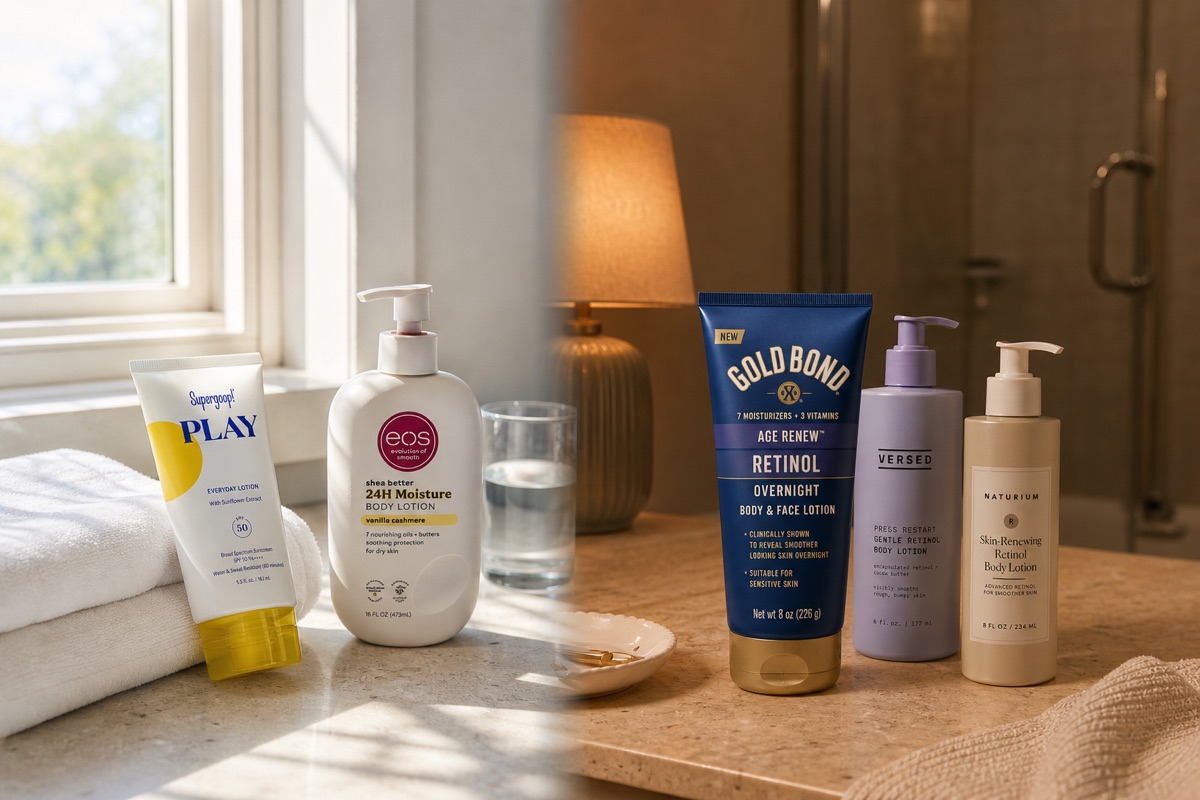
Gold Bond
Gold Bond Age Renew Retinol Overnight Body & Face Lotion
$11.97
"Best budget evening-lotion example: 4.5/5 across 12,125 visible Amazon ratings in the source snapshot."
What real Amazon buyers say
4.5★· 12,125 reviews"This is a great daily retinol for the body, doesn't irritate, leaves skin feeling soft and moisturized for a whole day."
"I have been using it for a FULL month, EVERY single night. I happened to be someone who noticed a difference with first use, with cumulative benefit seen and felt."

Versed
Versed Press Restart Retinol Body Lotion
$19.99
"Best lightweight body-retinol lane: 4.5/5 across 2,051 visible Amazon ratings and a formula positioned around encapsulated retinol, squalane, cocoa butter, and vitamin E."
What real Amazon buyers say
4.5★· 2,051 reviews"This is my favorite retinol body lotion! It’s hydrating, smoothing, and has only a very light scent."
"Not even being dramatic, my skin has never felt softer than when I use this overnight."

Naturium
Naturium Skin-Renewing Retinol Body Lotion
$25.99
"Best unscented retinol-body-lotion example: 4.5/5 across 999 visible Amazon ratings and official positioning around encapsulated retinol plus shea butter."
What real Amazon buyers say
4.5★· 999 reviews"I have been using it everyday for about 10 days and my skin is tighter, more radiant, and silky smooth."
"I’ve been using it every night for only two weeks, and the difference for my legs is night and day."
What you'll learn
- Use body retinol at night for most routines; the morning slot should prioritize moisturizer, clothing coverage, and broad-spectrum sunscreen.
- Start body retinol 2 or 3 evenings weekly, then increase only if the skin on your neck, chest, arms, or legs stays comfortable.
- Do not apply body retinol right after shaving, waxing, exfoliating, sunburn, or a procedure because those contexts raise irritation risk.
- For women 35-55, body retinol is best framed as a gradual texture and fine-line support step, not a quick fix for crepey skin.
- If you use body retinol on exposed areas, the next morning routine matters: broad-spectrum SPF and coverage are part of the protocol.
Steps
-
1 Keep retinol in the evening lane
Make evening your default body-retinol slot. The AAD recommends gradual retinoid use and sun protection, while the FDA warns that UV exposure contributes to visible skin aging; together, those sources make a night-first body routine the safer default. Apply after showering only when skin is dry and calm.
-
2 Use mornings for sunscreen and barrier support
The morning routine should be boring: moisturizer if skin feels dry, broad-spectrum sunscreen on exposed skin, and clothing coverage when practical. This matters most on the neck, chest, forearms, and backs of hands because those areas see daily incidental UV exposure.
-
3 Start with 2 or 3 nights weekly
Begin with 2 or 3 evening applications weekly, not nightly use. Amazon review snapshots across Gold Bond, Versed, and Naturium show large user bases for body-retinol lotions, but user tolerance varies. Increase only after several comfortable weeks without stinging, scaling, or persistent dryness.
-
4 Separate retinol from shaving and acids
Do not apply body retinol the same night you shave, wax, scrub, use glycolic or lactic acid body lotion, or treat sunburned skin. Retinol plus fresh exfoliation is a common irritation setup, especially on the chest, inner arms, neck, and thighs.
-
5 Assess results on a multi-month timeline
Judge the routine slowly. Kafi et al. studied 0.4% retinol over 24 weeks in naturally aged skin, so a body-retinol routine should be evaluated by consistency, comfort, and sunscreen adherence before expecting visible fine-line or texture change.
Bottom line
Use body retinol at night unless a product label specifically directs otherwise. The reason is practical, not mystical: the evening slot lets retinol sit under moisturizer without sunscreen, sweat, fragrance, and clothing changes complicating the routine. The next morning is still part of the protocol, but its job is protection: moisturize dry areas, apply broad-spectrum sunscreen to exposed skin, and avoid treating retinol like permission to skip coverage.
BeautySift did not test body-retinol lotions on a panel. We analyzed 15,175 visible Amazon ratings across Gold Bond Age Renew Retinol Overnight Body & Face Lotion, Versed Press Restart Retinol Body Lotion, and Naturium Skin-Renewing Retinol Body Lotion; American Academy of Dermatology retinol guidance; U.S. FDA UV-risk guidance; two PubMed retinoid papers; and official brand pages. We may earn a commission from Amazon links, but affiliate status does not change the evidence weighting.
For US women 35-55, the realistic goal is smoother-looking texture and better routine consistency on areas such as arms, legs, chest, and hands. Body retinol is not a same-week fix for crepey skin, sun damage, or deep laxity. Kafi et al. studied topical 0.4% retinol over 24 weeks in naturally aged skin, which is a useful reminder that vitamin A routines move on a multi-month timeline.
Morning vs evening: the clear answer
Evening wins for body retinol. AAD public guidance emphasizes gradual retinoid use and sun protection, while FDA UV guidance states that ultraviolet exposure contributes to skin aging and skin cancer risk. Those two points shape the routine: use retinol when you are done with the sun for the day, then treat the next morning as a sunscreen-and-barrier step.
Morning body retinol is not automatically dangerous if someone applies sunscreen perfectly, but it is usually less practical. Most people dress, commute, exercise, reapply fragrance, shave, or sweat during the day. Retinol on the body also covers larger surfaces than face serum, so missed sunscreen on the chest, forearms, or backs of hands becomes more likely.
Evening is also easier for comfort. Body-retinol lotions often contain moisturizers, but they still belong to an active category. Using them at night means you can wait until skin is dry after a shower, apply a controlled amount, and skip the daytime layering puzzle. If your skin feels tight the next morning, you can add a plain body moisturizer without wondering whether sunscreen, perfume, or an acid lotion caused the irritation.
What the evidence can and cannot say
Retinoids have stronger anti-aging evidence than many cosmetic actives, but most peer-reviewed work focuses on facial or small-area skin, not full-body cosmetic routines. Kafi et al. reported improvement in naturally aged skin in a 24-week randomized study of 0.4% retinol, and Mukherjee et al. reviewed retinoids for skin aging in Clinical Interventions in Aging in 2006. Those sources support retinol as a credible active, not a guarantee that every body lotion will change every line on every arm.
The FDA’s cosmetic guidance is also relevant. Anti-aging cosmetics can improve the appearance of skin, but they are not drugs. For this guide, that means we describe body retinol as a support step for smoother-looking texture and fine-line appearance. We do not frame it as a treatment for a medical condition, a substitute for prescription tretinoin, or a way to reverse UV damage.
Amazon user evidence adds routine fit. Gold Bond’s Amazon snapshot showed 4.5/5 across 12,125 ratings, Versed showed 4.5/5 across 2,051 ratings, and Naturium showed 4.5/5 across 999 ratings. Those counts do not prove clinical outcomes, but they help identify products with enough US-market user feedback to judge texture complaints, value, scent, pump issues, and irritation patterns.
A practical evening body-retinol protocol
Start with clean, dry skin. If you shower at night, wait until skin is no longer damp before applying body retinol. Damp skin can make actives feel more intense, and freshly shaved skin is more reactive. If you shaved your legs, waxed, exfoliated, used a scrub, or treated ingrown hairs that night, skip retinol and use a plain moisturizer instead.
Begin with two or three evenings weekly. That frequency is conservative enough for the chest, arms, and legs, but still consistent enough to build a habit. Keep the first several weeks boring: same product, same body zones, no new acid body lotion, no strong fragrance layered on top. If you want to use lactic acid or glycolic acid for roughness, put it on a different night.
Amount matters because body skin covers a large area. Use enough lotion to spread comfortably, but do not treat body retinol like a thick occlusive balm on the first week. For reactive zones, such as neck, chest, inner arms, or behind the knees, start once weekly or use a plain moisturizer first. Stronger is not smarter if the routine makes you peel, sting, or quit.
What mornings should look like after retinol
The morning after body retinol should be protective. If you applied retinol to your chest, forearms, shoulders, hands, or legs and those areas will be exposed, use broad-spectrum sunscreen. FDA UV guidance links UV exposure with visible aging risk, and AAD retinol guidance emphasizes sun protection with retinoid use. That is the morning job.
Moisturizer is optional but useful if skin feels dry. A plain, fragrance-free body lotion can help prevent the cycle many users describe with actives: smooth for a few nights, then tight, itchy, and flaky by the weekend. If your retinol lotion already leaves enough comfort, you may not need another body moisturizer everywhere. Focus on dry shins, elbows, hands, and chest.
Clothing coverage counts too. A UPF shirt, long sleeves for a sunny walk, or simply keeping retinol-treated shoulders covered can reduce the pressure on sunscreen perfection. This is especially relevant in Florida summer humidity, when sunscreen reapplication on the body is easy to skip, and in Southwest dryness, where skin can already feel tight before an active enters the routine.
Product roles: budget, lightweight, and unscented
Gold Bond Age Renew Retinol Overnight Body & Face Lotion is the strongest budget example in this protocol. Its Amazon snapshot showed $11.97 and 4.5/5 across 12,125 ratings, giving it the largest visible review base of the three featured products. Gold Bond’s official US page positions it as an overnight retinol lotion with peptide complex, which fits the night-first routine. Skip it if pump packaging annoys you; at least one visible Amazon reviewer praised the daily feel but criticized the pump straw and amount left in the bottle.
Versed Press Restart Retinol Body Lotion is the more beauty-routine-friendly lane. Its Amazon snapshot showed $19.99 and 4.5/5 across 2,051 ratings, and Versed’s official US page positions the formula around encapsulated retinol, cocoa butter, squalane, and vitamin E. It makes sense for users who want a lighter lotion for arms, chest, or legs rather than a heavy body cream. Skip it if you need a large value size for full-body nightly use; several body-retinol routines become expensive when the tube is small.
Naturium Skin-Renewing Retinol Body Lotion is the unscented, richer-feeling lane. Its Amazon snapshot showed $25.99 and 4.5/5 across 999 ratings, and Naturium’s official US page positions it around encapsulated retinol and shea butter. It fits users who dislike perfume in body care or want a more cushiony evening moisturizer. Skip it if you are trying to keep the routine under a drugstore price ceiling.
When morning use might make sense
Morning use can make sense in narrow situations: a product label directs daytime use, the area is always covered by clothing, your skin is highly tolerant, and you are reliable with sunscreen on exposed zones. Even then, it is not our default recommendation because daytime routines are harder to control.
If you insist on morning application, keep the area covered or apply broad-spectrum sunscreen after the lotion has absorbed. Do not use morning body retinol before a beach day, outdoor workout, yard work, or a long drive with exposed forearms. FDA UV guidance is enough reason to keep the protection step non-negotiable.
Most people get a cleaner routine by moving retinol to the evening and using morning for what mornings do best: hydration, sunscreen, and clothes. This split also makes troubleshooting easier. If irritation appears, you can look first at the evening active instead of sorting through sunscreen, sweat, fragrance, and detergent variables.
When to pause body retinol
Pause body retinol if skin burns, cracks, peels in sheets, itches persistently, or develops a rash. Pause after waxing, laser hair removal, chemical peels, aggressive exfoliation, sunburn, or any procedure where your clinician gave post-care instructions. Body skin is sturdier than the face in some places, but the chest and neck can be surprisingly reactive.
Pregnancy and nursing deserve a separate caution. Over-the-counter retinol body lotions are cosmetic products, but vitamin A derivatives are commonly avoided during pregnancy unless a clinician says otherwise. If you are pregnant, trying to become pregnant, or nursing, ask your clinician before using retinol on large body areas.
Also pause if the routine becomes too complicated. A sustainable body-retinol plan after 35 is not a ten-step body regimen. It is an evening active a few nights weekly, plain moisturizer when needed, and sunscreen the next morning on exposed skin.