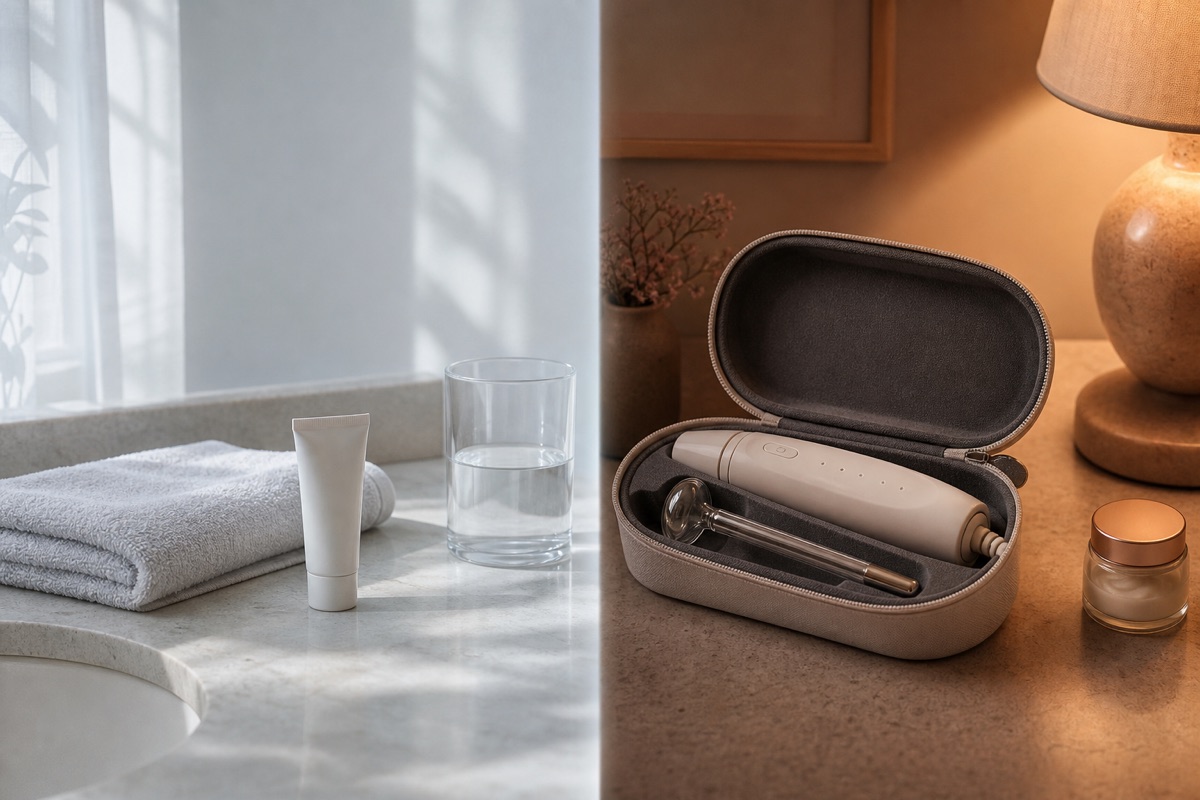
Morning vs Evening High-Frequency Wand Routine: A Practical Guide
An evidence-led morning versus evening high-frequency wand routine for hormonal chin breakouts, mature skin, and cautious US beauty-tech users.
Based on Frommherz et al. 2022, FDA 510(k) guidance, and 34,241 Amazon ratings across 3 NuDerma wand listings, evening is usually the safer high-frequency wand slot because it separates device use from sunscreen, makeup, and daytime irritation; morning use should stay brief and occasional.
Editor's top Amazon picks for this guide
Real Amazon products that match this protocol. Affiliate links — your purchases support BeautySift.

Pure Daily Care
Pure Daily Care NuDerma Handheld Skin Therapy Wand
$69.95
"Best fit for a conservative evening-first routine because it has four simple neon applicators, the lowest price in this comparison, and 4.4/5 across 21,198 Amazon ratings."
What real Amazon buyers say
4.4★· 21,198 reviews"Purchased 2 months ago. I am extremely critical and have high standards. I absolutely love this wand and would buy it again in a heartbeat."
"Immediately after, my skin felt great and it just looked radiant... I couldn't quite put my finger on it but it de-puffed my face and it kind of evened out my tone"

Pure Daily Care
NuDerma Professional Skin Therapy Wand
$99.95
"A better match for users who want more attachment shapes for jawline, chin, neck, and spot work after they already know their skin tolerates brief sessions."
What real Amazon buyers say
4.4★· 7,339 reviews"Since incorporating the NuDerma Wand into my daily skincare routine, I've noticed a significant enhancement in my skin's tightness and overall clarity."
"So I have been using this every day for a week and I've been using it on several different things. I have seen pimples (I get one once in a while) go away faster"

Pure Daily Care
Pure Daily Care NuDerma Clinical Portable Skin Therapy Wand
$169.95
"A higher-priced portable option for committed users who want fusion neon and argon applicators, though its 4.3/5 Amazon rating trails the lower-cost models."
What real Amazon buyers say
4.3★· 5,704 reviews"The device feels sturdy, is easy to use, and comes with a nice variety of attachments for different areas of the face and different skin concerns."
"I would not say this is an instant miracle product, but with regular use, my skin does seem to look a little more even and balanced."
What you'll learn
- Evening is the default high-frequency wand slot for most adults because it lets you cleanse, dry the skin, use the device briefly, and recover with moisturizer before sunscreen and makeup return the next morning.
- Morning high-frequency use is not automatically wrong, but it should be occasional, short, and limited to calm skin that will not be covered immediately with irritating actives or heavy makeup.
- The best evidence for high-frequency and acne is mechanistic: Frommherz et al. 2022 reported in vitro P. acnes reduction, but human hormonal-acne outcomes remain under-studied.
- For women 35-55, barrier tolerance matters as much as blemish control because hormonal breakouts often appear alongside dryness, slower recovery, and retinoid sensitivity.
Steps
-
1 Make evening your default slot
Use the wand after cleansing and drying the skin at night, before moisturizer. Evening gives you the cleanest routine window: no sunscreen film, no makeup, less rushing, and more time to notice whether redness or stinging settles. This timing is especially sensible for adults using retinoids, benzoyl peroxide, or acids because you can keep those actives on alternate nights until your barrier proves it can tolerate the device.
-
2 Reserve morning use for narrow situations
Morning use should be brief and occasional, not a second daily treatment. Consider it only on clean, dry, calm skin when you are targeting one small jawline or chin area and can wait before applying sunscreen or makeup. Skip morning use if your skin is flushed, freshly exfoliated, sunburned, tight from retinoids, or if the treated area will be covered by occlusive makeup within minutes.
-
3 Separate the wand from irritating actives
Do not stack a high-frequency session directly with retinol, exfoliating acids, strong benzoyl peroxide, or a drying acne routine until you know your skin response. A safer first month is wand plus bland moisturizer on device nights, then retinoid or acne active on separate nights. This matters for midlife skin because hormonal acne and barrier dryness can show up at the same time.
-
4 Track results without overclaiming
Take baseline, week-4, week-8, and week-12 photos in the same lighting. Track whether individual spots look less angry, whether you pick less, and whether the routine is easy enough to repeat. Do not treat Amazon sentiment or brand language as clinical proof; use them as consumer-experience signals alongside the limited PubMed evidence.
Quick answer: For most US women 35-55 using high-frequency wands for hormonal chin or jawline breakouts, evening is the safer default. We analyzed Frommherz et al. 2022, FDA 510(k) guidance, Pure Daily Care first-party information, and 34,241 Amazon ratings across three NuDerma listings. Morning use is best kept brief, occasional, and limited to calm skin.
Affiliate disclosure: we may earn a commission from Amazon links. Commission does not affect product selection, evidence weighting, or safety guidance.
Why timing matters with high-frequency wands
A high-frequency wand sounds like a quick step: plug in the glass electrode, glide or tap as directed, and move on. The timing is not that simple for adult skin. Women in their late 30s, 40s, and 50s often deal with two issues at once: hormonal breakouts around the chin and jaw, plus dryness, redness, or slower recovery from strong actives.
That combination changes the morning-versus-evening decision. Morning routines usually include sunscreen, makeup, commuting, workouts, and less time to observe irritation. Evening routines are more controlled. You can cleanse thoroughly, dry the skin completely, use the device briefly, moisturize, and stop adding products if your skin feels prickly.
The evidence also argues for restraint. Frommherz et al. 2022, indexed on PubMed, found significant in vitro reduction of several skin microorganisms, including P. acnes, after high-frequency exposure. That is useful mechanism evidence. It is not the same as a human clinical trial proving that every at-home wand clears perimenopausal or hormonal acne. FDA 510(k) guidance also matters because clearance is device- and indication-specific; it is not a blanket approval of every acne or anti-aging claim in a consumer listing.
The short answer: evening first, morning rarely
Evening is the better default slot for high-frequency wand use. It gives you fewer conflicts with sunscreen, makeup, strong daytime actives, and hurried application. It also gives your skin several quiet hours to settle before you evaluate whether the device is helping or simply adding irritation.
Morning use is not automatically unsafe, but it has a narrower role. A short morning session may make sense if your skin is calm, you are treating one small area, and you can wait before applying sunscreen or makeup. It is a poor fit if your skin is already tight from retinoids, freshly exfoliated, sunburned, flushed from a workout, or covered with a drying acne spot treatment.
The conservative BeautySift protocol is simple: evening for planned sessions; morning only for occasional, low-intensity spot use when the skin barrier is calm. That recommendation is based on routine compatibility and risk management, not on a clinical trial directly comparing morning and evening high-frequency use. We did not find a peer-reviewed human study that assigns at-home high-frequency wand users to morning versus evening treatment and reports acne outcomes.
What the evidence can support
The strongest acne-relevant citation we found is Frommherz et al. 2022 in Anais Brasileiros de Dermatologia. The study reported significant reductions in bacterial and fungal species after high-frequency exposure, including decreased P. acnes colony-forming units. That supports the long-standing esthetician rationale for using high-frequency devices around blemish-prone areas.
The limitation is central to the routine decision. In vitro results do not account for sunscreen residue, makeup, skin oil, hormones, inflammation, picking, barrier health, retinoid sensitivity, or whether a person holds the electrode too long in one spot. These variables are exactly why evening is more practical: it reduces the number of competing factors around the device step.
Amazon rating data adds consumer sentiment, not clinical proof. The NuDerma Standard listing snapshot showed 4.4/5 across 21,198 Amazon ratings; the NuDerma Professional showed 4.4/5 across 7,339 ratings; and the NuDerma Clinical showed 4.3/5 across 5,704 ratings. Those numbers suggest that many US shoppers find the devices usable and worth reviewing, but they do not prove acne clearance rates.
A morning routine if you use the wand early
Morning wand use should be the exception. If you choose it, keep the session narrow: cleanse, rinse well, pat dry, wait until the skin is fully dry, treat only the target area as the manual allows, then pause before layering products. Do not use the wand over wet skin, facial oil, open lesions, a picked blemish, or a patch that already burns when you apply moisturizer.
After a morning session, choose a bland moisturizer if needed, then sunscreen. Sunscreen still matters because post-breakout marks can darken with UV exposure, and adults with hormonal chin acne often deal with discoloration long after the spot flattens. If makeup stings, pills, or looks patchy over the treated area, that is a signal to move the wand back to evening.
Avoid combining a morning wand session with a fresh acid toner, benzoyl peroxide layer, strong vitamin C serum that already tingles, or exfoliating pad. If your morning routine is already active-heavy, adding an electrical device increases the chance that you will blame the wrong product when irritation appears.
An evening routine for most users
Evening is more forgiving. Remove makeup and sunscreen thoroughly, cleanse without leaving skin tight, and let the face dry completely. Insert the electrode before turning on the device, start at the lowest comfortable intensity, and keep contact brief. The goal is consistency and tolerance, not maximum buzzing.
For hormonal chin or jawline breakouts, focus only on the relevant zone. Do not drag the electrode over the eyelids, fresh procedures, active rash, broken skin, or a blemish you have picked. Remove metal jewelry near the treatment area. Stop if you feel burning, persistent stinging, headache, unusual redness, swelling, or eye discomfort.
After the session, apply a simple moisturizer. If you use retinol, prescription tretinoin, benzoyl peroxide, salicylic acid, or exfoliating acids, place those on alternate nights for the first month. This is the most important difference for women 35-55: a routine that worked at 32 may feel much harsher when perimenopausal dryness, slower barrier recovery, and hormonal breakouts overlap.
Where the three product options fit
We selected three Amazon-available high-frequency wands that match a cautious routine protocol and do not require non-US retailers. The NuDerma Standard is the easiest starter fit because it has the lowest listed price in our snapshot at $69.95, four straightforward neon applicators, and 4.4/5 across 21,198 Amazon ratings. For someone deciding whether evening sessions are sustainable, that is the most practical entry point.
The NuDerma Professional is the step-up choice. Its $99.95 Amazon snapshot and 4.4/5 rating across 7,339 ratings make it a better match for users who want more attachment shapes for jawline, spot, neck, and broader face use. It is not necessary if you only plan to treat the chin for a few minutes at night.
The NuDerma Clinical Portable is the upgrade option at $169.95 in our Amazon snapshot. It has fusion neon and argon positioning and more premium packaging, but its 4.3/5 across 5,704 Amazon ratings trails the two lower-cost options. Based on an evidence-weighted comparison, it makes more sense for committed device users than for someone still learning whether morning or evening timing works.
A four-week timing protocol
Week 1 is for tolerance. Use the wand in the evening only, on one small area, at low intensity, following the manual’s time limits. Do not use it on the same night as a retinoid, exfoliating acid, or benzoyl peroxide unless your clinician has told you that combination is appropriate.
Weeks 2 and 3 are for consistency. If the skin stays calm, continue evening use at the frequency your manual allows. Keep your morning routine simple: cleanse or rinse, moisturize if needed, and apply sunscreen. If a new breakout appears, do not automatically add a morning wand session. First ask whether you slept in makeup, over-exfoliated, picked, changed sunscreen, or started a new active.
Week 4 is for evaluation. Compare photos in the same lighting. Look for fewer angry-looking spots, less picking, and less post-breakout irritation. If the wand routine makes your skin drier, redder, or more reactive, reduce frequency or stop. If your acne is cystic, scarring, painful, or suddenly worse, the device should not delay a dermatologist appointment.
How to pair with retinoids, acids, and sunscreen
Retinoids and high-frequency wands are both common in adult acne routines, but they do not have to happen on the same night. If you use a prescription retinoid or strong over-the-counter retinol, alternate: device night, recovery night, retinoid night, recovery night. Adjust based on dryness rather than a social-media schedule.
Salicylic acid and benzoyl peroxide deserve the same caution. They can be useful for blemish-prone skin, but stacking them immediately after a device session can make mature skin feel tight or raw. A bland moisturizer after wand use is less exciting than an active serum, but it is often the smarter first-month choice.
Sunscreen belongs in the morning regardless of device timing. The wand does not replace UV protection, and post-inflammatory marks are often more frustrating than the original blemish. If the treated area feels tender the next morning, use a gentle sunscreen that you already tolerate rather than testing a new formula that day.
Safety boundaries before you start
Do not use a high-frequency wand over open wounds, active infection, unexplained rash, severe inflammation, freshly injected areas, recent laser or peel sites, or the eyelids. Ask a clinician before use if you have an implanted electronic device, seizure disorder, active skin condition, pregnancy-related concerns, or any medical history that makes electrical devices uncertain.
Read FDA language carefully. A 510(k) clearance is specific to a device and intended use; it does not mean every similar-looking consumer wand is FDA approved for acne treatment. It also does not mean a high-frequency wand can replace prescription care for hormonal acne.
The best routine is the one your skin can repeat without drama: low intensity, short sessions, clean dry skin, moisturizer afterward, and no aggressive layering until your barrier has proven it can handle the device.
Related reading
High-Frequency Wands for Beginners: A Starter Guide