Morning vs Evening Hybrid Chemical-Mineral SPF Routine for Women Over 35
An evidence-led guide to using hybrid chemical-mineral sunscreen in the morning, what belongs at night, and how to layer SPF with mature-skin routines.
Based on FDA sunscreen guidance, 91,947 Amazon ratings across 3 hybrid SPF products, EltaMD active-filter labeling, and 2 PubMed sunscreen reviews, hybrid chemical-mineral SPF belongs in the morning only; evening is for cleansing, barrier repair, retinoids, and pigment-support steps.
Editor's top Amazon picks for this guide
Real Amazon products that match this protocol. Affiliate links — your purchases support BeautySift.

EltaMD
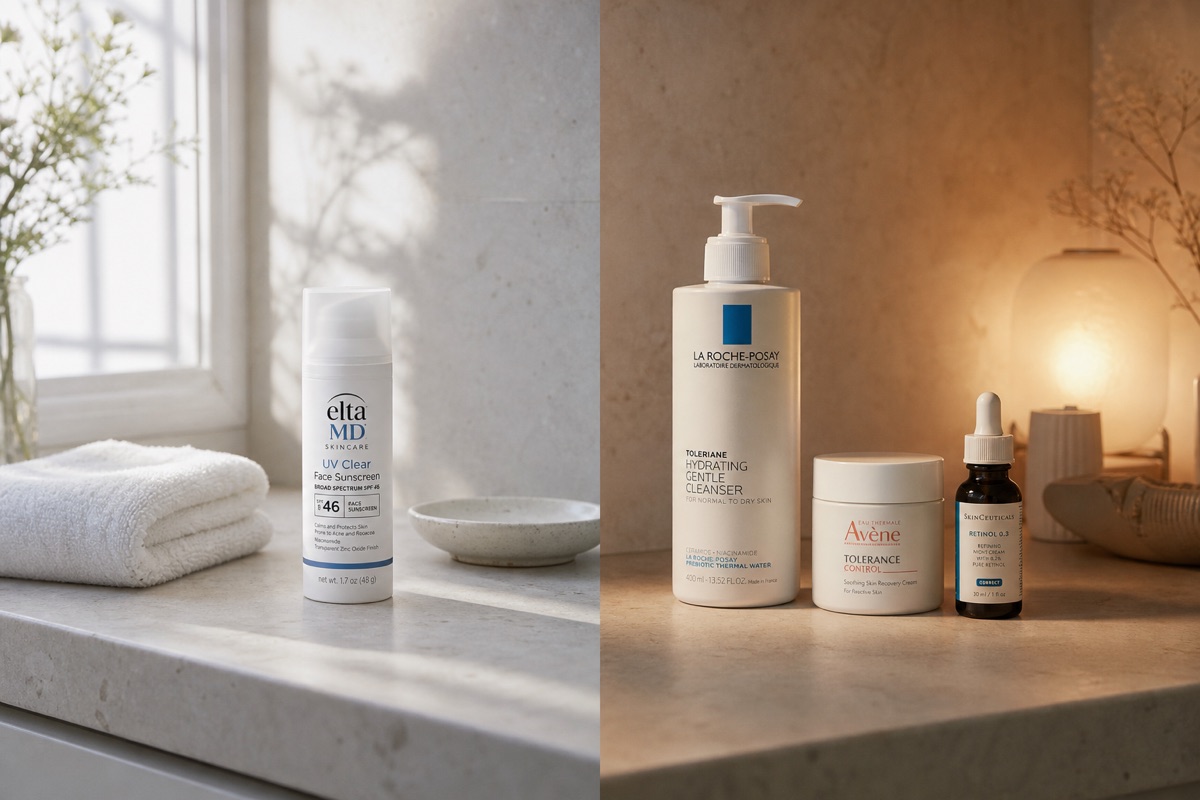
EltaMD UV Clear Face Sunscreen SPF 46
$36
"Best evidence-weighted morning pick for reactive, pigment-prone routines: EltaMD lists octinoxate 7.5%, zinc oxide 9.0%, and 5% niacinamide; Amazon showed 4.6/5 across 47,566 ratings."
What real Amazon buyers say
4.6★· 47,566 reviews"This stuff is worth the price. We use it daily. It goes on clean, not greasy. Smells great and provides excellent sun protection."
"I have very sensitive skin especially anything that has SPF in any amount over 15. Since I have had a few issues with skin cancer on and around my face I needed something that had a greater SPF rating. This has worked great!"

DRMTLGY
DRMTLGY Universal Tinted Moisturizer SPF 46
$31
"Best hybrid SPF for a sheer tint step: Amazon listing identifies zinc oxide and octinoxate, plus niacinamide and hyaluronic acid; snapshot showed 4.1/5 across 37,763 ratings."
What real Amazon buyers say
4.1★· 37,763 reviews"Just received the product. Its fabulous. So light perfect color on my pale skin. Arrived rapidly well packaged."
"I've been using this tinted moisturizer for a couple of weeks and overall I'm pretty happy with it. The texture is lightweight and blends easily into the skin, which makes it great for everyday wear."

DRMTLGY
DRMTLGY SmrtSun Broad Spectrum SPF 45
$28
"Best non-tinted hybrid option for fragrance-free morning layering: Amazon listing identifies hybrid zinc oxide UV protection with hyaluronic acid and niacinamide; snapshot showed 4.2/5 across 6,267 ratings."
What real Amazon buyers say
4.2★· 6,267 reviews"This is a great product that I use every single morning. It dries great, leaving no residue or stickiness."
"It's fragrance free. The complaints from people about the smell are simply the result of zinc oxide and other such ingredients- it's impossible to avoid a smell and to me it just smells a bit like chalk."

SkinMedica
SkinMedica Total Defense + Repair SPF 34
$56
"Prestige hybrid-style morning option for shoppers prioritizing cosmetic elegance under makeup; Amazon snapshot showed 4.3/5 across 351 ratings."
What you'll learn
- Hybrid chemical-mineral SPF belongs in the morning because sunscreen is regulated and labeled for UV exposure, not overnight skin repair.
- Evening is the better window for double cleansing, moisturizer, retinoids, exfoliating acids, and pigment-support treatments that should not be diluted by sunscreen.
- For women 35-55, the main routine risk is not choosing chemical versus mineral filters; it is under-applying SPF and forgetting FDA-style reapplication during outdoor exposure.
- Hybrid SPF can make daily sunscreen more wearable by pairing zinc oxide coverage with organic filters that reduce cast and improve spread.
Steps
-
1 Use hybrid SPF as the final morning skincare step
Apply moisturizer or treatment serums first, then apply hybrid chemical-mineral SPF as the last skincare layer before makeup. FDA guidance supports broad-spectrum SPF use for UV exposure, and 21 CFR 201.327 governs US broad-spectrum and water-resistance labeling. Do not save SPF for nighttime; it has no overnight repair role.
-
2 Give sunscreen time to settle before makeup
Wait several minutes before foundation or concealer if your formula pills. Amazon review patterns for EltaMD, DRMTLGY, and SkinMedica repeatedly mention texture, residue, and makeup compatibility, which are practical adherence factors for daily sunscreen use.
-
3 Reapply during real sun exposure
Use the FDA baseline: reapply at least every 2 hours during sun exposure and after swimming, sweating, or toweling when the product label requires it. A morning application is not a full-day shield for driving, errands, lunch outdoors, or late-afternoon walks.
-
4 Move active repair steps to the evening
At night, cleanse off SPF, makeup, sweat, and pollution, then use barrier-support moisturizer and any retinoid or pigment-support product your skin tolerates. This keeps sunscreen film from competing with nighttime actives and makes irritation easier to read.
Quick Answer
Based on FDA sunscreen guidance, 91,947 Amazon ratings across 3 hybrid SPF products, EltaMD active-filter labeling, and 2 PubMed sunscreen reviews, hybrid chemical-mineral SPF belongs in the morning only; evening is for cleansing, barrier repair, retinoids, and pigment-support steps.
Why morning and evening should not do the same job
Hybrid chemical-mineral sunscreen is a daytime protection product. The simple rule: apply it in the morning, reapply during real UV exposure, and remove it at night. The evening routine should not include SPF unless you are removing a daytime layer that is still on your skin.
That sounds basic, but it solves a common routine mistake for women 35-55: trying to make one product do both protection and repair. Perimenopause, lower oil production, retinoid use, and cumulative sun exposure can make skin feel drier, more reactive, and more prone to visible discoloration. A hybrid SPF can be a useful morning compromise because zinc oxide gives mineral-filter support while organic filters can improve slip and reduce cast. It still does not replace nighttime moisturizer, retinoid, or pigment-support care.
FDA sunscreen guidance recommends broad-spectrum SPF 15 or higher and reapplication at least every 2 hours during sun exposure. The same FDA framework, 21 CFR 201.327, governs broad-spectrum and water-resistance labeling for US OTC sunscreen products. That regulatory context is why this guide treats SPF as a morning-and-reapplication step, not an evening treatment.
What hybrid chemical-mineral SPF actually means
A hybrid chemical-mineral sunscreen uses at least one mineral filter, usually zinc oxide or titanium dioxide, plus one or more organic filters, such as octinoxate or other US-permitted sunscreen actives. The practical goal is not ideological purity; it is wearable broad-spectrum protection that people will use enough of.
EltaMD UV Clear is a useful example because the official EltaMD page lists octinoxate 7.5%, zinc oxide 9.0%, and 5% niacinamide. In the Amazon snapshot we analyzed, EltaMD UV Clear Face Sunscreen SPF 46 showed 4.6/5 across 47,566 ratings. That combination of disclosed filters, high review volume, and mature-skin-friendly niacinamide positioning makes it a logical reference point for this routine.
The PubMed 2019 review on inorganic UV filters reports that zinc oxide provides broad UVA-UVB coverage and that human health risks are low given lack of percutaneous absorption. A separate PubMed 2021 sunscreen review explains why UVA 320-400 nm and UVB 280-320 nm matter differently: UVB is closely tied to SPF and sunburn, while UVA protection is central to photoaging context. For shoppers, that means the label should say broad spectrum, not just a high SPF number.
Morning routine: the order that usually works
Start with a gentle cleanse or water rinse, depending on your skin. If your face feels dry in the morning, do not force a foaming cleanse just because it feels more complete. Mature skin often does better when the morning routine preserves barrier comfort.
Next comes treatment, if you use one. Vitamin C, niacinamide, peptide serum, or a simple hydrating serum can sit under hybrid SPF as long as the layers do not pill. Keep this step thin. The more silicone, oil, and gel layers you stack under sunscreen, the higher the odds that SPF will roll up when you apply makeup.
Then moisturize if your skin needs it. In humid Florida summer weather, a hybrid SPF with hydrating ingredients may be enough. In Southwest dryness or Midwest winter cold, a lightweight moisturizer under SPF may prevent tightness by noon. Let the moisturizer settle before sunscreen.
Hybrid SPF is the final skincare step. Apply it before makeup, not after powder. The FDA source we cite supports reapplication during sun exposure; it does not support stretching one morning layer across a full day of commuting, errands, window exposure, and an outdoor lunch.
How to choose a morning hybrid SPF by skin behavior
We used the product-comparison framework to think about texture, tolerability, value, accessibility, and evidence strength rather than ranking by brand familiarity. EltaMD UV Clear scores highest for a sensitive, discoloration-prone morning routine because its official page discloses octinoxate 7.5%, zinc oxide 9.0%, and 5% niacinamide, while Amazon showed 47,566 ratings averaging 4.6/5.
DRMTLGY Universal Tinted Moisturizer SPF 46 is the stronger pick if you want sheer coverage. The Amazon listing identifies zinc oxide and octinoxate, plus niacinamide and hyaluronic acid, and the snapshot showed 4.1/5 across 37,763 ratings. Its tradeoff is tint: a universal shade can simplify a routine for some skin tones and look off on others.
DRMTLGY SmrtSun Broad Spectrum SPF 45 is the non-tinted DRMTLGY option we would consider for people who want a fragrance-free morning layer without complexion coverage. The Amazon listing identifies hybrid zinc oxide UV protection with hyaluronic acid and niacinamide; the snapshot showed 4.2/5 across 6,267 ratings.
SkinMedica Total Defense + Repair SPF 34 is a prestige alternative, not the value pick. Amazon showed 4.3/5 across 351 ratings and a $56 snapshot. The smaller rating base means the evidence signal is weaker than EltaMD or DRMTLGY, but user comments we reviewed repeatedly focused on smooth application and makeup compatibility.
Reapplication is the step most routines miss
The morning-versus-evening question matters, but reapplication is the daily behavior that changes protection most. FDA guidance says to reapply sunscreen at least every 2 hours during sun exposure. If you apply SPF at 7 a.m., drive to work, sit by a window, walk outside at lunch, and then run errands at 5 p.m., one morning layer is not the same as full-day protection.
For makeup wearers, reapplication is inconvenient. A practical routine is to apply a full, even layer of hybrid SPF in the morning, then use a sunscreen stick, powder, cushion, or another compatible SPF layer later if you will be outside. Do not rely on the SPF number in foundation unless you apply it as generously as sunscreen, which most people do not.
If your hybrid SPF pills during reapplication, the problem may be the layers underneath. Try fewer morning serums, a lighter moisturizer, or a longer wait before makeup. If it stings your eyes by midday, avoid the immediate eye margin and use sunglasses or a mineral stick around the orbital bone.
Evening routine: remove, repair, and keep actives legible
Evening is when sunscreen leaves the routine. Cleanse thoroughly enough to remove SPF, makeup, sweat, and pollution, but do not turn removal into over-scrubbing. A cleansing balm or oil followed by a gentle cleanser can help if you wear water-resistant SPF or long-wear makeup. If you use a non-water-resistant daily SPF and little makeup, one gentle cleanse may be enough.
After cleansing, choose one treatment lane. Retinoid night? Use retinol, retinal, adapalene, or a prescription retinoid as directed, then moisturize. Pigment-support night? Use azelaic acid, tranexamic-acid serum, or another product your skin already tolerates. Barrier night? Skip actives and use moisturizer with humectants, emollients, or ceramides.
This separation helps you read your skin. If you put SPF, vitamin C, exfoliating acid, retinoid, and a rich moisturizer into one blurred routine, you cannot tell what caused dryness or pilling. A morning protection lane and an evening repair lane make the routine easier to troubleshoot.
Common routine mistakes we would fix first
The first mistake is using too little sunscreen because hybrid textures feel more like moisturizer. A smooth lotion can make under-application easy. Use enough to cover the face, ears, neck, and exposed chest evenly, and do not forget the sides of the neck.
The second mistake is treating nighttime skincare as more important than daytime protection. Retinoids, peptides, and pigment products may support visible aging concerns, but repeated unprotected UV exposure works against them. The PubMed 2021 sunscreen review’s UVA and UVB discussion is the reason we prioritize broad-spectrum protection before debating which night serum comes next.
The third mistake is choosing based only on filter philosophy. Mineral-only, chemical-only, and hybrid formulas can all fail if you hate the texture. For many US shoppers over 35, the best sunscreen is the one that feels comfortable under makeup, does not emphasize dry patches, and can be reapplied when life requires it.
A simple 24-hour hybrid SPF routine
Morning: rinse or gently cleanse, apply a thin hydrating or antioxidant serum if you use one, moisturize only if needed, then apply hybrid SPF as the final skincare step. Wait before makeup. If your product is tinted, check the jawline and neck in daylight.
Midday: reapply if you are getting meaningful sun exposure. Follow FDA-style timing during outdoor exposure: at least every 2 hours, and sooner after sweating, swimming, or toweling when the label calls for it. For office-only days with minimal UV exposure, use judgment, but do not confuse low exposure with all-day sunscreen durability.
Evening: remove SPF, then choose repair. A retinoid, pigment-support product, or barrier moisturizer belongs here, not under an extra nighttime SPF layer. If your skin is irritated, make the evening routine boring until the barrier feels normal again.