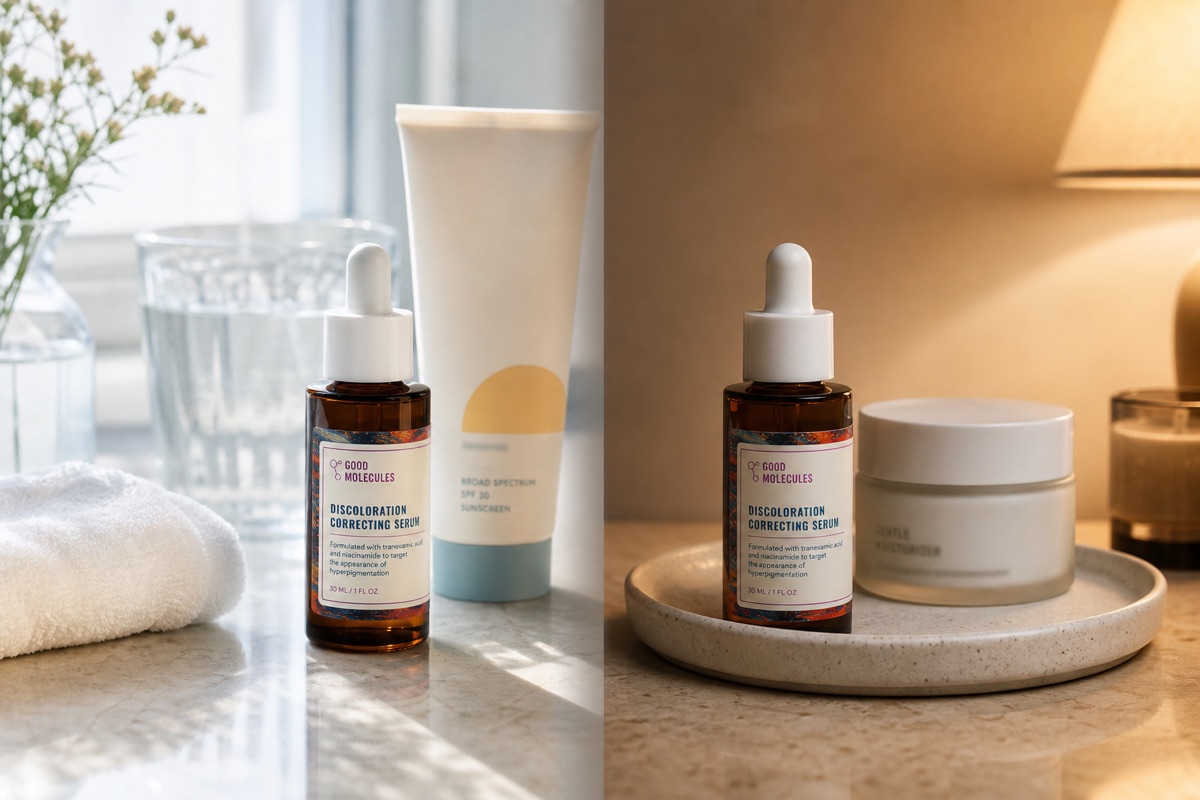
Morning vs Evening Tranexamic Acid Serums: A Routine Guide
An evidence-led guide to using tranexamic acid serums in morning or evening routines for dark spots, melasma-prone uneven tone, and mature skin.
Based on 7 PubMed clinical reviews/trials and 30,000+ Amazon ratings across selected US products, tranexamic acid serums can fit morning or evening routines. Use them once daily at first, pair every morning with broad-spectrum SPF, and judge tone changes over 8-12 weeks.
Editor's top Amazon picks for this guide
Real Amazon products that match this protocol. Affiliate links — your purchases support BeautySift.

Good Molecules
Good Molecules Discoloration Correcting Serum
$25
"Budget-friendly tranexamic acid and niacinamide serum with the largest Amazon review base in this set: 4.4/5 across 14,809 ratings."
What real Amazon buyers say
4.4★· 14,809 reviews"The formula feels super lightweight on my skin, absorbs quickly, and doesn't leave me greasy or sticky at all."
"This right here!!! I've tried so many other products that do not work. I've been using this for 3 weeks and let me tell you all the compliments I've been getting about my skin looking brighter and more even toned."

Anua
Anua Niacinamide 10 + TXA 4 Serum
$21.85
"Niacinamide plus tranexamic acid option for morning or evening use, with 4.5/5 across 14,793 Amazon ratings."
What real Amazon buyers say
4.5★· 14,793 reviews"This serum is really popular for a reason. It helps brighten the skin and improve the look of dark spots and acne marks over time."
"The texture is lightweight, absorbs quickly, and leaves no sticky residue. I use it morning and night, and pairing it with sunscreen during the day makes the results even better."

The INKEY List
The INKEY List Tranexamic Acid Serum
$18
"Simple 2% tranexamic acid dark-spot serum from a US-available brand, with 4.4/5 across 436 Amazon ratings."
What real Amazon buyers say
4.4★· 436 reviews"Great product exactly what I was looking for. Great for sensitive skin, the value of the product is good. Has great ingredients that show results after consistent use. Has no scent which is great! Blends great with your skin."
"It's nice and smooth not sticky. Haven't had a skin reaction from it."

Eucerin
Eucerin Sun Tinted Age Defense Face Sunscreen Lotion SPF 50
$10.23
"Tinted SPF 50 support step for morning hyperpigmentation routines; Amazon snapshot showed 4.4/5 across 3,474 ratings."
What you'll learn
- Morning tranexamic acid makes sense if your serum layers cleanly under sunscreen and you can reapply SPF during outdoor exposure.
- Evening tranexamic acid is often easier for beginners because it avoids makeup pilling and lets you separate it from vitamin C or exfoliating acids.
- The strongest topical TXA data is in 8- to 12-week melasma studies, not overnight dark-spot correction, so track photos monthly.
- Daily broad-spectrum sunscreen is non-negotiable; FDA guidance says to reapply at least every 2 hours when outdoors, swimming, or sweating.
Steps
-
1 Start once daily, not twice daily
Apply a thin layer of tranexamic acid serum once daily for the first 2 weeks. Morning is fine if it does not pill under sunscreen; evening is better if your skin is reactive, dry, or already using vitamin C in the morning.
-
2 Choose morning only when sunscreen is locked in
Use tranexamic acid after cleansing and before moisturizer, then finish with broad-spectrum SPF. If you are outdoors, follow FDA sunscreen guidance and reapply at least every 2 hours, especially during sweating or swimming.
-
3 Choose evening when your routine is crowded
Use tranexamic acid after cleansing and before moisturizer at night when you also need morning vitamin C, tinted sunscreen, or makeup. Avoid stacking it on the same night as strong exfoliating acids until your skin is calm.
-
4 Measure progress over 8 to 12 weeks
Topical TXA studies commonly run 12 weeks, so use monthly photos in the same light rather than judging daily. If irritation, peeling, or new sensitivity persists, pause and simplify to cleanser, moisturizer, and sunscreen.
Quick answer
Use tranexamic acid serum in the evening if you are building a dark-spot routine from scratch, then move it to the morning only if it layers smoothly under moisturizer and broad-spectrum sunscreen. The evidence supports patience: Sharma et al. followed 100 melasma patients for 12 weeks, and Ebrahimi and Naeini studied a 12-week split-face routine in 23 women. Those timelines are a better benchmark than a 7-day before-and-after claim.
For US women 35-55, the bigger question is not whether morning or evening is more “active.” It is whether the step survives real life: sunscreen reapplication, makeup, dryness from retinoids, and fluctuating sensitivity around perimenopause. Our routine bias is simple: sunscreen is the morning anchor; tranexamic acid can sit either before it or at night, depending on your tolerance.
What tranexamic acid can and cannot do
Tranexamic acid is best understood as a discoloration-support ingredient, not a bleaching shortcut. Dermatology literature describes it as a plasmin-pathway inhibitor that may help interrupt UV-linked pigmentation signaling. The strongest consumer-relevant evidence is in melasma studies, where pigment is stubborn, recurrent, and highly sun responsive.
The evidence is encouraging but not absolute. In the 2019 Sharma randomized study of 100 patients, 5% topical tranexamic acid solution and 3% hydroquinone cream produced similar 12-week MASI reductions: 27% for TXA and 26.7% for hydroquinone, according to the PubMed abstract. In the 2014 Ebrahimi and Naeini split-face RCT, 5% topical TXA gel improved MASI and melanin index, but it was not superior to vehicle. A 2024 meta-analysis covering 28 randomized trials found stronger pooled evidence for oral TXA than topical TXA, which is why over-the-counter serums should be positioned as supportive, not prescription-level treatment.
That nuance matters if your brown patches worsened after age 40. Sun exposure, hormonal shifts, irritation, acne marks, and visible light can all keep pigment active. A serum may help the routine, but skipping SPF can erase progress.
Morning use: best when SPF compliance is strong
Morning tranexamic acid is logical because daytime is when pigment triggers stack up: UV exposure, visible light, heat, and inflammation from rubbing or mask friction. If your serum is lightweight and non-sticky, apply it after cleansing, then moisturizer if needed, then sunscreen. Wait long enough for each layer to settle so your SPF forms an even film.
The FDA’s consumer sunscreen guidance recommends broad-spectrum SPF 15 or higher and reapplication at least every 2 hours when outdoors, swimming, or sweating. For a hyperpigmentation routine, we would usually go higher than the minimum and choose an elegant SPF you will actually use. A tinted formula can be useful because iron oxides may help with visible-light coverage, though the FDA source itself focuses on broad-spectrum UV protection and reapplication behavior.
Morning is especially useful if you forget evening skincare or if your skin tolerates niacinamide well. Anua Niacinamide 10 + TXA 4 Serum and Good Molecules Discoloration Correcting Serum both pair TXA-style discoloration support with niacinamide, a common brightening and barrier-support ingredient. In our Amazon snapshot, Anua had 4.5/5 across 14,793 ratings, while Good Molecules had 4.4/5 across 14,809 ratings. Those are user-sentiment signals, not clinical outcomes, but they show broad US shopper adoption.
Skip morning TXA if your sunscreen pills, your foundation separates, or your skin feels tight by noon. A perfect active step that disrupts SPF is the wrong tradeoff.
Evening use: best for beginners and sensitive skin
Evening is the lower-friction starting point. You can cleanse, apply tranexamic acid, moisturize, and stop. There is no sunscreen film to disturb and no makeup wear test. This is helpful for mature skin because dryness, retinoid use, and barrier changes can make a once-simple routine feel less predictable.
Start with 3 to 4 nights per week if you are already using retinol, glycolic acid, lactic acid, or a vitamin C serum. If your skin stays calm for 2 weeks, move to nightly use. If you want to keep retinol, alternate: tranexamic acid Monday, retinol Tuesday, tranexamic acid Wednesday, recovery Thursday. This spacing is conservative, but it reduces the chance that you blame TXA for irritation caused by the whole stack.
The INKEY List’s US product page identifies its Dark Spot Serum as a 2% tranexamic acid product. The Amazon listing snapshot we analyzed showed 4.4/5 across 436 ratings. That smaller review base is less persuasive than Anua or Good Molecules, but the formula’s simplicity makes it a reasonable starter if you want one focused step instead of a multi-active serum.
A practical 8-week AM/PM protocol
Week 1-2: Use tranexamic acid once daily at night. Apply a pea-size to nickel-size amount depending on texture, then moisturizer. Keep mornings boring: gentle cleanse or rinse, moisturizer if needed, sunscreen.
Week 3-4: If your skin is calm, decide whether the serum belongs in the morning or evening. Move it to the morning only if it layers smoothly under SPF. Keep it at night if you wear makeup most days, use retinol, or notice midday tightness.
Week 5-8: Stay consistent and take photos every 4 weeks in the same lighting. Do not add three other brighteners at once. If you want a second pigment ingredient, choose one change at a time: niacinamide, azelaic acid, kojic acid, vitamin C, or alpha arbutin. The goal is a routine you can trace. When everything changes, you cannot tell what helped or irritated.
If a patch is rapidly changing, asymmetric, raised, bleeding, or new after 40, treat that as a dermatology question, not a serum-shopping problem. Cosmetic hyperpigmentation content should never replace medical evaluation.
Product fit: how we would place the featured options
Good Molecules Discoloration Correcting Serum fits a budget evening or morning routine when you want tranexamic acid plus niacinamide in a lightweight format. It earned the top product slot here because it had the largest Amazon review base in our snapshot and a low price for daily use. Use it at night first if your skin is easily irritated, then try morning once sunscreen layering is predictable.
Anua Niacinamide 10 + TXA 4 Serum fits someone who wants a hydrating, glow-focused serum and tolerates niacinamide well. Its 4.5/5 Amazon average across 14,793 ratings was the strongest rating snapshot in this set. Because the formula is positioned around niacinamide and TXA, it makes sense before moisturizer either morning or evening.
The INKEY List Tranexamic Acid Serum is the simplest pick for a beginner who wants a named 2% TXA product from a US-available brand. The review count is much smaller than Anua or Good Molecules, so we would not overstate consensus. Its best use is a controlled night routine where you can judge tolerance without changing too many variables.
Eucerin Sun Tinted Age Defense Face Sunscreen Lotion SPF 50 is not a TXA serum, but it belongs in the protocol because sunscreen decides whether pigment routines hold. A dark-spot routine without morning SPF is incomplete, especially for melasma-prone skin.
What to avoid while using tranexamic acid
Do not judge results in the first week. The most relevant PubMed trials commonly used 12-week endpoints, and the 2022 Br J Dermatol systematic review emphasized that melasma topical evidence varies by ingredient, study design, and comparator. A realistic routine is measured in months.
Do not layer every brightening ingredient on the same night. Kojic acid, exfoliating acids, vitamin C, retinoids, and benzoyl peroxide can all increase irritation in the wrong combination. Irritation can worsen the look of discoloration, especially on skin prone to post-inflammatory hyperpigmentation.
Do not use oral tranexamic acid based on a skincare article. Oral TXA is a prescription medical decision with clotting-related screening considerations. This guide covers topical cosmetic serums sold in the US.
How to troubleshoot the routine
If your dark spots look darker after starting a new routine, first audit irritation and sun exposure before blaming the tranexamic acid itself. Stinging, flaking, extra redness, or a shiny tight look usually means the total routine is too aggressive. Scale back to cleanser, moisturizer, sunscreen, and tranexamic acid every other night for 2 weeks. Once calm, reintroduce retinol or exfoliating acids one at a time.
If your skin is calm but the pigment is unchanged at week 8, check three basics. First, are you applying enough sunscreen and reapplying during outdoor time? The FDA’s 2-hour reapplication guidance matters most on high-exposure days. Second, are you using the serum consistently at least 5 days per week? Third, are you photographing in the same light? Bathroom lighting can make melasma and sun spots look better or worse depending on angle.
For deeper, patchy, or recurrent melasma, a dermatologist can discuss prescription options such as hydroquinone cycles, triple-combination cream, azelaic acid, chemical peels, lasers, or oral tranexamic acid screening. That does not make topical TXA useless; it just keeps expectations honest. Over-the-counter serums are best viewed as maintenance and support, especially when paired with daily photoprotection.