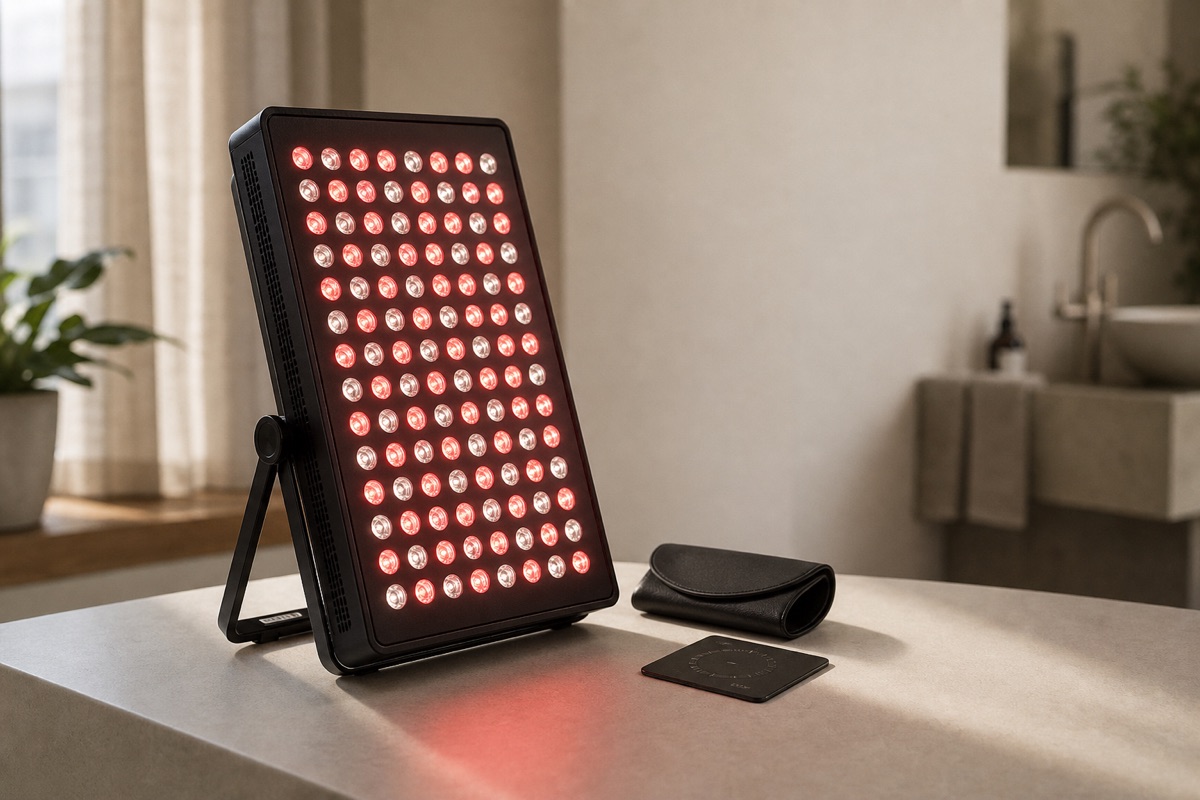
Red Light Therapy Panels Dos and Donts After 40
A practical, evidence-led guide to using red light therapy panels after 40 for fine lines and mild firmness concerns, with safety rules and Amazon panel picks.
Based on 3 peer-reviewed LED studies including Wunsch & Matuschka 2014 (n=136), Lee et al. 2007 (n=76), and Amazon US review snapshots across 4 panel listings (n=4,023), use red light panels after 40 on clean, dry skin 2-5 times weekly per the manual, protect eyes, and judge fine-line or texture changes after 8-12 weeks.
Editor's top Amazon picks for this guide
Real Amazon products that match this protocol. Affiliate links — your purchases support BeautySift.

Hooga
Hooga PRO300 Red Light Therapy Panel
$299
"Best protocol fit for users who want a mid-size 660 nm red and 850 nm near-infrared panel with an adjustable stand, timer, and 4.6/5 Amazon rating across 712 ratings."
What real Amazon buyers say
4.6★· 712 reviews"The adjustable stand is sturdy, the built in timer is genuinely useful, and the cooling fans keep it from running hot."
"It is compact enough for a desk or nightstand without being in the way."

Hooga
Hooga HG300 Red Light Therapy Panel
$199
"A compact 60-LED beginner panel with 660 nm red and 850 nm near-infrared wavelengths and the largest review base among our protocol-ready picks."
What real Amazon buyers say
4.6★· 1,082 reviews"The machine itself is super sturdy and easy to use anywhere."
"I initially did 15 mins every other day, but switched over to 10 mins every day."

Hooga
Hooga HG200 Red Light Therapy Panel
$149
"Smallest panel in this guide for users who want a lower-cost red/NIR routine for face, neck, or chest without a full-body setup."
What real Amazon buyers say
4.6★· 487 reviews"This was so easy to set up and is very easy to use and definitely heavy weight sturdy build."

BestQool
BestQool BQ60 Red Light Therapy Panel
$189
"A value-priced 660 nm and 850 nm panel with 4.6/5 across 1,742 Amazon ratings; useful for shoppers comparing Hooga alternatives."
What you'll learn
- Do use a red light panel on clean, dry skin before serums, moisturizers, sunscreen, or makeup so the light path is as consistent as possible.
- Do follow the exact panel manual for distance, minutes, and eye protection; panels vary more than masks because irradiance changes quickly with distance.
- Do judge results after 8-12 weeks of consistent sessions, because peer-reviewed protocols used repeated exposure over several weeks.
- Dont expect a panel to lift jowls or reverse significant sagging; the better-supported cosmetic expectation is smoother texture, fine-line softening, and skin-quality support.
- Dont use longer or closer sessions to compensate for missed days, because more intensity is not automatically better for skin after 40.
Steps
-
1 Start with the right expectation
Treat red and near-infrared panels as supportive beauty tech, not a procedure replacement. The strongest cosmetic evidence we found points to gradual improvement in skin feel, roughness, fine lines, and collagen-related skin quality. Wunsch & Matuschka 2014 followed 136 volunteers over 30 sessions, while Lee et al. 2007 studied 76 subjects using red and near-infrared LED approaches. Neither study supports facelift-style language for at-home panels.
-
2 Set up clean skin and controlled distance
Cleanse, dry the skin fully, and position the panel at the manual's recommended distance before applying product. A panel used too close can deliver a different dose than intended, while a panel used too far away may make the routine less efficient. Keep the setup repeatable: same chair, same distance, same treatment area, and the same eye-protection habit each session.
-
3 Use a conservative weekly cadence
Follow the device manual first. For many consumer panels, a practical beginner rhythm is several short sessions per week, then reassessment at week 4 for tolerance and week 8-12 for visible texture changes. The studies in our source set used repeated sessions, including 30 sessions in Wunsch & Matuschka 2014 and 9 treatments in Russell, Kellett, and Reilly 2005, so consistency matters more than marathon sessions.
-
4 Pair the panel with sunscreen and barrier care
After the session, apply hydrating products, barrier-supportive moisturizer, and daytime broad-spectrum SPF. For women 35-55, dryness, retinoid sensitivity, and perimenopause-related barrier changes can make an aggressive routine backfire. If retinoid nights are already irritating, separate retinoid and panel use until the skin is calm.
-
5 Pause when safety signals appear
Stop the routine if you notice burning, persistent redness, swelling, eye discomfort, headache, or worsening hyperpigmentation. Ask a clinician before use if you take photosensitizing medication, have a photosensitivity disorder, have an active suspicious lesion in the treatment area, recently had a peel or laser procedure, or have an eye condition. FDA 510(k) language is device-specific and should not be treated as a universal safety promise.
Quick protocol for red light panels after 40
Affiliate disclosure: we may earn a commission from Amazon links. Commission does not affect product inclusion, safety guidance, or evidence weighting.
The practical rule is simple: use the panel on clean, dry skin, keep the distance consistent, protect your eyes, and stop chasing faster results by moving closer or adding extra minutes. Red and near-infrared light therapy is often discussed under photobiomodulation, a non-ablative approach that does not peel or wound the skin. For a woman in her 40s or 50s, that is the appeal: a routine that can sit beside sunscreen, moisturizer, and retinoid use without adding another acid or exfoliant.
The evidence is promising but narrow. Wunsch & Matuschka 2014 followed 136 volunteers through 30 red and near-infrared sessions and reported improvements in fine lines, wrinkles, roughness, skin feeling, and collagen density measures. Lee et al. 2007 studied 76 subjects with 633 nm red LED, 830 nm near-infrared LED, and combination LED phototherapy. Russell, Kellett, and Reilly 2005 studied 31 subjects over 9 treatments with 633 nm and 830 nm LED exposure. Those numbers support a careful trial; they do not support dramatic before-and-after promises.
Do: choose a panel that matches the body area
Panels make the most sense when your target is larger than the face mask zone: face plus neck, chest, hands, or a small body area. A compact panel can be more flexible than a mask because you can angle it toward the neck and decollete, two areas where fine lines and crepey texture often show up after 40.
For this guide, we prioritized Amazon US products with real ASINs, disclosed red and near-infrared wavelengths, and enough review volume to flag usability patterns. The Hooga PRO300 listing shows 4.6/5 across 712 Amazon ratings and includes 660 nm red plus 850 nm near-infrared LEDs. The Hooga HG300 shows 4.6/5 across 1,082 Amazon ratings with the same wavelength pairing. The smaller Hooga HG200 shows 4.6/5 across 487 Amazon ratings. BestQool BQ60 adds a lower-cost alternative at 4.6/5 across 1,742 Amazon ratings.
Those Amazon numbers are not clinical outcomes. They are useful for practical questions: is the panel format understandable, does the stand matter, does the timer support consistency, and do users keep using it. Clinical claims still come from the PubMed sources, not from star ratings.
Dont: turn panel use into a dose race
The easiest mistake is assuming more light equals better results. Panels vary because irradiance changes with distance. A session at 6 inches is not the same as a session at 18 inches, even when the minutes are identical. That is why the manual matters more than a generic social-media schedule.
Use the brand’s stated distance and minutes per area. If you miss a week, restart the normal schedule instead of doubling the next session. In the studies we weighed most heavily, results came from repeated exposure over time: 30 sessions in Wunsch & Matuschka 2014, 9 treatments in Russell, Kellett, and Reilly 2005, and repeated LED sessions in Lee et al. 2007. The pattern is consistency, not intensity.
This matters more after 40 because the skin barrier may be drier, thinner-looking, or more reactive from retinoids, exfoliating acids, in-office procedures, or perimenopause-related dryness. A panel should make the routine easier to sustain, not create another source of redness.
Do: use it before skincare, then moisturize
The cleanest order is cleanse, dry fully, panel, then skincare. Heavy creams, facial oils, sunscreen, and makeup can create an uneven surface and make light delivery less predictable. You do not need bare skin for hours; you just need the treatment window to be product-free.
After the session, moisturize well. If it is daytime, use broad-spectrum SPF. Red light therapy does not replace sunscreen, and it does not undo daily UV exposure. If you use retinol, keep it in the routine only if your skin already tolerates it. A conservative night order is cleanse, panel, moisturizer, and then retinoid if your skin is stable. If you are peeling or stinging, separate retinoid and panel nights until the barrier calms.
Do not combine a new panel with several other new actives in the same week. If texture improves, you will not know what helped. If irritation appears, you will not know what caused it.
Dont: expect a panel to fix every kind of sagging
Fine lines, roughness, dullness, and crepey texture are the right cosmetic lane for at-home red and near-infrared panels. Sagging is more complicated. The lower face and neck change because of collagen, elastin, fat distribution, bone structure, and gravity. A panel may support healthier-looking skin quality, but it does not reposition tissue.
That distinction matters for trust. The 2014 Wunsch & Matuschka paper is useful because it measured skin-feeling and collagen-density-related outcomes in 136 volunteers. It is not proof that a consumer panel can lift jowls. Lee et al. 2007 and Russell et al. 2005 also support repeated LED exposure for photoaging-related appearance, not surgical-level tightening.
If your main concern is early crepiness on the neck or chest, a panel trial is reasonable. If your main concern is significant laxity, think of the panel as supportive care and compare it with dermatologist-led options before spending on a large device.
Do: track an 8-12 week trial with boring photos
The best tracking method is not a magnifying mirror. Use photos in the same room, same light, same distance, and same facial expression at baseline, week 4, week 8, and week 12. At week 4, judge whether the schedule is realistic and whether your skin is calm. At week 8-12, look for fine-line softness, smoother texture, and a more even-looking neck or chest.
Keep notes simple: date, minutes, distance, area treated, and any redness or eye discomfort. If the device has a timer, use it. If the stand makes your setup repeatable, that matters. Our product scoring favored panels that make consistency easier because the evidence base depends on repeated use.
A reasonable outcome is subtle improvement that you notice in same-lighting photos or makeup application. An unreasonable outcome is expecting a panel to erase deep folds in one month.
Dont: ignore eye comfort or medical context
Red and near-infrared panels are bright. Do not stare into the LEDs. Use the eye protection recommended by the manufacturer, especially when treating the face. Stop if you get eye discomfort, headaches, persistent redness, swelling, burning, or new pigmentation changes.
Ask a clinician first if you take photosensitizing medication, have a photosensitivity disorder, have active skin cancer or a suspicious lesion in the treatment area, have an eye condition, are pregnant, or recently had laser, peel, microneedling, or injectable treatment. This is not because every panel is dangerous; it is because the safest routine is the one matched to your medical context.
FDA language also needs precision. The FDA 510(k) pathway is about substantial equivalence for a specific device and indication. It is not blanket approval for every red light panel sold online and it does not validate every marketing claim on a product page.
A simple 12-week schedule
Week 1 should be a tolerance week. Use the lowest routine described in your manual, keep the panel at the recommended distance, and treat only the areas you can repeat consistently. If your skin feels hot, looks persistently red, or your eyes feel strained, pause rather than pushing through.
Weeks 2-4 are for habit building. Keep the same room, chair, distance, and session length so the dose is not changing every time. This is also when you should resist adding a new acid, retinoid strength, or peel pad. One variable makes the result easier to interpret.
Weeks 5-8 are the first fair checkpoint for texture and fine lines. Compare photos, not memory. Weeks 9-12 are the better window for deciding whether the device earns a permanent place in your routine. If the routine feels burdensome at week 12, a smaller panel or fewer treatment areas may be more realistic than buying a larger unit.
How we scored the protocol-ready products
We used an evidence-weighted framework rather than first-party testing. Clinical evidence came from PubMed studies on red and near-infrared LED phototherapy. Product practicality came from Amazon US listing data: verified ASIN, wavelength disclosure, price, review volume, rating, panel format, timer or stand details, and whether the product fits a face-neck-chest protocol.
Hooga PRO300 ranked first because the listing combines 660 nm and 850 nm wavelengths, an adjustable stand, a built-in timer, and a mid-size format that works for face and upper-body routines. Hooga HG300 ranked second because its 1,082-rating Amazon snapshot and smaller format make it an approachable starter panel. Hooga HG200 ranked third for small-space shoppers who want the lowest Hooga price in this set. BestQool BQ60 ranked fourth because its 1,742-rating review base and $189 price make it a legitimate comparison point, though its product page is less clearly positioned as a beginner beauty protocol device.
None of those rankings mean the panel has been tested by BeautySift. They mean the product matches the published protocol logic better than broad, unverified red light gadgets that do not disclose wavelengths or make oversized claims.