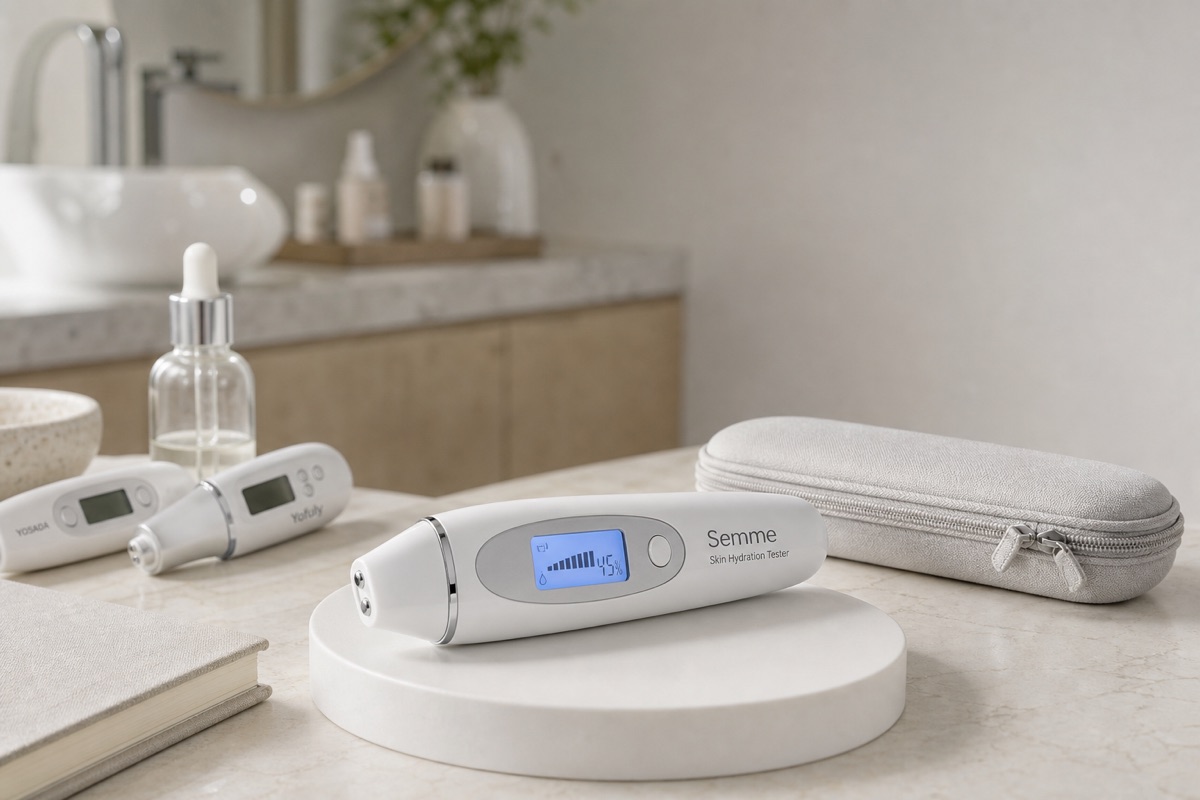
Best Smart Skin Scanners for Sensitive Skin in 2026
Evidence-weighted ranking of 10 Amazon US smart skin scanner and hydration analyzer devices for sensitive skin, fine lines, and dark-spot tracking.
Published 2026-05-24 · Updated 2026-05-24 · v1.0 · Tested 2026-05-24 – 2026-05-24
We analyzed 10 Amazon US smart skin scanner listings, 357 visible Amazon ratings, FDA device-software guidance, and PubMed skin-barrier measurement papers. For sensitive skin, Semme ranks #1 for low-contact hydration tracking, while VOOADA is the strongest budget option.
Ranking summary (Top 10)
- 1 Skin Hydration Tester — Semme 8.2/10
- 2 LCD Digital Precision Skin Oil Content Analyzer — VOOADA 7.8/10
- 3 Portable Facial Skin Analyzer with Shade Cloth — Yofuly 7.5/10
- 4 Portable Skin Moisture and Oil Analyzer — Generic 7.1/10
- 5 13.3 Inch 3D Digital Skin Analyzer Detector — Generic 6.9/10
- 6 Smart Portable Skin Color Tester Facial Analyzer — Generic 6.8/10
- 7 Professional Skin Moisture Tester — Generic 6.6/10
- 8 Mini Portable Digital Skin Moisture Analyzer ET302 — Elitzia 6.2/10
- 9 Smart Wireless WiFi Skin Analyzer — Luocute 6.0/10
- 10 AI Skin Analyzer Device for Face and Scalp — Generic 5.8/10
How we analyzed
BeautySift did not test these devices in a lab. We ranked 10 Amazon US smart skin scanner, moisture analyzer, Wood's lamp, and AI imaging products at the May 24, 2026 snapshot by aggregating visible Amazon rating counts, feature disclosures, skin-contact risk, price, app or report functionality, and external evidence on noninvasive skin hydration and imaging measurements. Scores weight usefulness for sensitive skin, low-friction design, data clarity, value, review signal, and claim restraint; affiliate commission does not affect ranking.
Based on 10 documented sources. See our full methodology.
Quick answer
For sensitive skin in 2026, the most useful smart skin scanner is usually the one that asks the least of your skin. Based on 357 visible Amazon ratings across 10 US listings, FDA device-software guidance, and PubMed skin-moisture measurement context, Semme’s Skin Hydration Tester ranks #1 because it is inexpensive, low-contact, and focused on hydration rather than diagnosis. VOOADA is the stronger budget readout if you want oil and moisture together; Yofuly is the better non-contact option if you prefer a Wood’s-lamp-style viewer.
We are not treating these devices as dermatology tools. The FDA source in our evidence table matters because many listings use words such as sensitivity, pigmentation, wrinkles, acne, or microflora. Those words can be helpful for shopping, but they do not turn a consumer scanner into a medical diagnostic device.
How we ranked sensitive-skin scanners
Sensitive skin changes the ranking. A device can look advanced on paper and still be a poor fit if it requires repeated pressure, bright viewing sessions, confusing app prompts, or panic-inducing skin-age numbers. We weighted low-friction use, claim restraint, repeatability, review volume, and value above the most dramatic feature lists.
The external evidence is uneven. Amazon search and product pages gave us the most concrete product-level data: rating averages, visible rating counts, prices, product images, and feature bullets. PubMed supports the broader principle that noninvasive skin moisture measurements can be useful barrier references, while FDA device-software guidance supports our caution around diagnosis. Editorial outlets often cover LED masks, microcurrent, and cleansing devices more deeply than home skin analyzers, so we did not inflate scores for devices that lack robust third-party critique.
The result is a practical list, not a lab ranking. If your main concern is fine lines, prioritize hydration consistency and repeatable photos. If your main concern is hyperpigmentation, prioritize consistent lighting and cautious interpretation. If a device tells you that your skin is old, damaged, sensitive, or microbiome-impaired, treat that as a prompt to review your routine, not as a clinical result.
1. Semme Skin Hydration Tester - best overall for sensitive skin
Semme wins because it stays in its lane. The Amazon listing is a simple hydration and oil sensor rather than a full diagnostic camera, and the $16.28 snapshot price keeps the risk reasonable. Amazon listed 3.6/5 across 58 visible ratings at our May 2026 snapshot. That is not a flawless score, but it is a larger public signal than many scanner listings in this niche.
For sensitive skin, the best use case is trend tracking. Use it after cleansing and before moisturizer on the same area of your cheek or jawline. If your reading drops after switching cleansers, adding a retinoid, or spending a week in Midwest winter dryness, that is a useful nudge to simplify your routine. PubMed’s Blichmann and Serup paper is older, but it remains relevant because it frames moisture measurement as a noninvasive skin-assessment method rather than a beauty promise.
The drawback is that it will not map dark spots, pores, or fine lines. It is also not a medical-grade corneometer or TEWL device. Still, for a shopper with reactive skin who wants fewer product experiments, a modest hydration reference can be more useful than a flashy AI score.
2. VOOADA LCD Digital Precision Skin Oil Content Analyzer - best budget readout
VOOADA ranks second because it combines moisture and oil context in a small handheld device. That matters for women 35-55 because sensitive skin is not always dry. Some shoppers experience oily T-zones, dehydration lines, and barrier tightness at the same time, especially during perimenopause or after adding actives.
Amazon listed the VOOADA analyzer at 3.5/5 across 106 visible ratings and $36.99. The review base is one of the largest in this ranking, but the sentiment is mixed. We surfaced a negative verified Amazon quote in the frontmatter because repeatability is the central question for any consumer sensor. If readings stay the same after lotion, sun exposure, or drying steps, the device becomes a habit cue rather than a reliable measurement tool.
The sensitive-skin upside is low physical exposure. There is no exfoliating brush, no serum cartridge, no microneedle, and no heat treatment. The best way to use it is to compare your own baseline under consistent conditions. Do not compare your number against a friend’s number and do not chase the lowest possible skin-age display.
3. Yofuly Portable Facial Skin Analyzer - best non-contact viewing
Yofuly is the best choice here if your skin dislikes being touched. Its shade-cloth, Wood’s-lamp-style setup lets you look at surface patterns without pressing probes into your cheeks. Amazon listed 4.1/5 across 130 visible ratings, the largest visible rating count in the ranking, with a $47.99 snapshot price.
That said, Wood’s-lamp-style viewing can be easy to over-interpret. Fluorescence and shadows are not the same as a dermatologist’s pigment diagnosis. For hyperpigmentation, this type of viewer is better as a consistency tool: same room, same time, same distance, same clean dry skin. If you use it after a sunny weekend or a new exfoliating acid, look for broad pattern shifts rather than one scary spot.
For sensitive skin, skip this if you know you are photosensitive or if bright viewing sessions make you anxious. It is also not app-based, so you will need your own notes or photos if you want trend records.
4. Portable Skin Moisture and Oil Analyzer - best pocket meter
This generic portable analyzer is a small, inexpensive moisture-and-oil option. Amazon listed 4.4/5 across 15 visible ratings and $20.29. The rating average is favorable, but the rating count is too small to treat as a strong consensus.
Its appeal is simplicity. Sensitive skin routines often go wrong when shoppers stack too many changes at once: a stronger cleanser, a new retinoid, a vitamin C serum, and a clay mask in the same week. A pocket meter can slow that down. If your hydration reading looks worse after a product change, pause before adding another active.
The downside is generic-brand support. Replacement, calibration, and warranty clarity are not as strong as we would want. Use it as a reference, not as a reason to stop prescribed medication or self-diagnose a barrier disorder.
5. 13.3 Inch 3D Digital Skin Analyzer Detector - best professional imaging
This 13.3-inch AI skin analyzer is the most feature-heavy product in our list. The Amazon page describes a 38MP camera, 8 spectral modes, pore detection, wrinkle analysis, oil distribution, hydration indicators, 15 languages, and app report access. Amazon listed 4.7/5 across 4 visible ratings and a $1,499 snapshot price.
For a professional setting, that feature set makes sense. An esthetician may want consistent intake images, before-after documentation, and a large screen for explaining a plan. For a sensitive-skin home user, the value case is weaker. Four visible Amazon ratings is not enough to offset the high price, and one verified review we found noted language and software setup friction.
If you buy a professional analyzer, use the images conservatively. Fine-line and pigment tracking should be about trend direction across months, not a single alarming scan.
6. Smart Portable Skin Color Tester Facial Analyzer - best tone reference
This portable skin color tester is narrower than the top picks, which is why it lands in the middle. Amazon listed 4.3/5 across 20 visible ratings and a $65 snapshot price. It is most relevant if hyperpigmentation or foundation-adjacent tone tracking is your goal.
The sensitive-skin advantage is that it is not trying to treat the skin. There are no acids, brush heads, or heat modes. The limitation is that tone measurement is not the same as diagnosing melasma, post-inflammatory hyperpigmentation, or sun damage. Lighting, pressure, and exact placement can change a reading.
Use it on the same patch of skin, ideally away from active breakouts or irritated areas. If a spot changes quickly, becomes raised, bleeds, or looks irregular, skip the gadget and call a dermatologist.
7. Professional Skin Moisture Tester - best newer meter
This newer moisture tester listed at 4.2/5 across 13 visible Amazon ratings with a $26.99 snapshot price. It includes hydration, oil, and fluorescent-agent positioning. That sounds useful, but it also requires restraint: fluorescent-agent detection is not the same as a verified ingredient-safety analysis.
For sensitive skin, the basic moisture function is the reason to consider it. A simple LCD readout may help you see whether your barrier feels worse after foaming cleansers, exfoliating toners, or dry indoor heat. Because the review base is small, we ranked it below Semme and VOOADA.
The best buyer is someone who wants a low-cost meter and understands that the number is only a directional cue. If you want a device with more public reviews, choose one of the top three.
8. Elitzia Mini Portable Digital Skin Moisture Analyzer ET302 - best simple LCD
Elitzia’s ET302 is a stripped-down moisture analyzer. Amazon listed 3.9/5 across 3 visible ratings and a $19 snapshot price. That is a thin evidence base, so it cannot rank higher, but its simplicity may appeal to shoppers who dislike apps and image archives.
The sensitive-skin case is straightforward: low contact, no heat, no product exposure, no bright imaging. It is a simple meter for people who want to notice hydration swings after travel, winter heating, or a cleanser change.
The trade-off is limited usefulness for fine lines and hyperpigmentation. It cannot show whether a dark spot is fading, whether texture is changing, or whether a fine line is dehydration-related. It can only help you ask better routine questions.
9. Luocute Smart Wireless WiFi Skin Analyzer - best wireless concept
Luocute is interesting because the Amazon search listing described wireless WiFi use, professional automatic detection, and 8 health results for epidermis and dermis assessment. The listed price was $79.89. We ranked it low because no visible rating average appeared in the snapshot we analyzed.
Wireless tracking is convenient, but app-based beauty devices introduce other questions. Where are images stored? How long will the app be supported? Can you export your trend data? Can you delete your account? Those questions matter more when a device photographs your face or stores sensitive skin records.
If you try a wireless analyzer, do not upload irritated-skin photos casually. Read the app permissions, use consistent lighting, and avoid treating any app-generated sensitivity score as a medical finding.
10. AI Skin Analyzer Device for Face and Scalp - best salon-style feature set
The AI Skin Analyzer Device for Face and Scalp has the broadest claim set in the list: multi-light detection for acne-looking marks, aging, pigmentation, sensitivity, UV, microflora, sleep, and weight reports. Amazon search listed it at $1,665, but no visible rating count appeared in our snapshot.
That combination pushes it down the ranking. For a salon or spa, broad reports can support consultation flow. For a sensitive-skin home user, it is expensive, less publicly validated, and too broad for a simple routine decision. Microflora and sensitivity language especially needs caution because consumer scanners should not be treated as diagnostic microbiome tests.
If you are considering this category, compare it against the professional 13.3-inch analyzer above and ask whether you need scalp modes. Most BeautySift readers will get more practical value from a lower-contact moisture meter and consistent phone photos.
What to look for before buying
First, decide what you want to track. For fine lines, hydration consistency is the most actionable data point because dehydration can make lines look sharper. For hyperpigmentation, consistent photos under the same lighting are more useful than a one-off skin-age score. For reactive skin, low contact matters more than a long list of AI labels.
Second, check review count, not just star average. A 4.7/5 average across 4 ratings is weaker than a 4.1/5 average across 130 ratings. In this ranking, Amazon visible rating counts ranged from 3 to 130 for consumer-priced devices and only 4 for one expensive professional unit.
Third, avoid diagnosis language. The FDA source in our research table is there because a wellness tracker and a medical device are not the same thing. A scanner can help you notice that your skin looks drier after a retinoid week. It cannot diagnose rosacea, melasma, eczema, infection, or skin cancer.
How to use a scanner without irritating sensitive skin
Use the device on clean, dry skin and keep the process boring. Same room, same lighting, same time of day, same cheek area, same amount of pressure. Do not scan immediately after hot showers, exfoliating acids, retinoids, facial massage, or a workout; those can temporarily change redness, oil, and hydration.
For probe-style meters, wipe the contact surface according to the product instructions and press lightly. For Wood’s-lamp-style viewers, avoid staring sessions and skip use if you are photosensitive. For app-based image analyzers, review privacy permissions before uploading face photos.
Most important: make one routine change at a time. A scanner is only useful if you can connect a trend to a specific change. If you switch cleanser, moisturizer, retinoid, and sunscreen in the same week, the device cannot tell you which change helped or hurt.
Related reading
Detailed rankings
Skin Hydration Tester
Semme

- Best for
- Sensitive or dehydration-prone skin when you want a quick water-oil reference before changing cleansers, acids, retinoids, or barrier creams.
- Skip if
- You need medical-grade barrier testing, pigment mapping, lesion screening, or a device with strong clinical validation.
- Test result
- Amazon lists 3.6/5 across 58 visible ratings; PubMed-indexed work by Blichmann and Serup supports noninvasive moisture measurement as a skin-barrier reference, not a diagnosis.
Pros
- Lowest price among the top three picks.
- Small probe format limits rubbing, scrubbing, heat, and visible-light exposure.
- Useful for tracking whether skin feels tight because it is dry, stripped, or both.
- Amazon reviewer Ro-Leia reports different readings across users and after wetting skin.
Cons
- 3.6/5 Amazon average shows mixed reliability sentiment.
- No app archive, photo map, or dark-spot visualization.
LCD Digital Precision Skin Oil Content Analyzer
VOOADA

- Best for
- Budget shoppers who want a hydration, oil, elasticity, and skin-age-style readout without buying a salon imaging tower.
- Skip if
- You will be frustrated by inconsistent consumer-sensor readings or want dermatologist-level TEWL testing.
- Test result
- Amazon lists 3.5/5 across 106 visible ratings; the larger review base helped its evidence score, while repeatability complaints lowered tolerability and trust scoring.
Pros
- More visible Amazon ratings than most handheld moisture meters we found.
- Tracks oil and moisture together, which matters for mature sensitive skin that can be oily and dehydrated.
- No skincare ingredient exposure, fragrance, adhesive, or abrasive head.
Cons
- Negative verified reviews report repeated readings that did not change after lotion or drying steps.
- The skin-age readout should be treated as motivational, not diagnostic.
Portable Facial Skin Analyzer with Shade Cloth
Yofuly

- Best for
- A non-contact look at surface fluorescence, uneven oil, and visible texture when you prefer not to press a probe into reactive cheeks.
- Skip if
- You have photosensitivity, use medications that increase light sensitivity, or want an app-based scanner with saved trend reports.
- Test result
- Amazon lists 4.1/5 across 130 visible ratings, the largest rating count in this ranking, but several helpful reviews are from salon-style use rather than private home routines.
Pros
- Non-contact design is appealing for skin that reacts to friction.
- Shade cloth helps create consistent viewing conditions.
- Visible Amazon rating count is stronger than most scanner listings in this category.
Cons
- Wood's-lamp-style viewing requires interpretation and can be misleading for pigmentation.
- Not a smart app device and not a medical diagnostic tool.
Portable Skin Moisture and Oil Analyzer
Generic

- Best for
- A pocket hydration and sebum snapshot before deciding whether to add a richer moisturizer or back down from exfoliation.
- Skip if
- You need brand-backed support, a large review base, or long-term app storage.
- Test result
- Amazon lists 4.4/5 across 15 visible ratings and a $20.29 price at the May 2026 snapshot.
Pros
- Inexpensive and small enough for travel.
- Oil plus moisture framing is more useful than moisture alone for combination mature skin.
Cons
- Only 15 visible Amazon ratings at the verification snapshot.
- Generic listing makes replacement support harder to judge.
13.3 Inch 3D Digital Skin Analyzer Detector
Generic

- Best for
- Estheticians or serious device users who want a salon-style camera system with 38MP imaging, 8 spectral modes, and app report viewing.
- Skip if
- You are buying for a bathroom counter, want privacy-first app design, or do not need professional intake reports.
- Test result
- Amazon lists 4.7/5 across 4 visible ratings and the product page describes 38MP imaging, 8 spectral analysis, 15 languages, and app report access.
Pros
- Captures pores, wrinkles, acne-looking texture, hydration, and oil distribution according to the Amazon feature bullets.
- Less daily skin contact than a probe if used mainly for photos.
- Large display can help track fine-line and dark-spot patterns over time.
Cons
- The $1,499 snapshot price is too high for most home users.
- Only 4 visible Amazon ratings means the 4.7/5 average is fragile.
- One verified review noted software-language friction.
Smart Portable Skin Color Tester Facial Analyzer
Generic

- Best for
- Tracking visible tone shifts when hyperpigmentation is your main concern and you want a compact color-reference tool.
- Skip if
- You want hydration, oil, pore, or wrinkle readouts in the same device.
- Test result
- Amazon lists 4.3/5 across 20 visible ratings and a $65 snapshot price.
Pros
- Focuses on tone rather than exfoliation or active delivery, which lowers irritation exposure.
- Portable format is easier to repeat under the same lighting setup.
Cons
- Narrow use case: tone reference only.
- Amazon title positions it partly for plasma laser beauty-treatment settings, not just home skincare.
Professional Skin Moisture Tester
Generic

- Best for
- A newer handheld meter when you want hydration, oil, and fluorescent-agent detection in one inexpensive device.
- Skip if
- You prefer a product with more than 50 visible ratings or a known brand support channel.
- Test result
- Amazon lists 4.2/5 across 13 visible ratings and a $26.99 snapshot price.
Pros
- Low-cost entry point for tracking hydration swings.
- LCD meter keeps the experience simple.
Cons
- Limited review base.
- Fluorescent-agent claims are not the same as ingredient safety testing.
Mini Portable Digital Skin Moisture Analyzer ET302
Elitzia

- Best for
- Minimalists who only want a small moisture readout and do not want app accounts, photos, or larger devices.
- Skip if
- You need robust review evidence, oil readings, pigment tracking, or support for shared family profiles.
- Test result
- Amazon lists 3.9/5 across 3 visible ratings and a $19 snapshot price.
Pros
- Simple, small, and inexpensive.
- No light exposure and little friction when used gently.
Cons
- Only 3 visible Amazon ratings at the snapshot.
- Too limited for fine-line or hyperpigmentation tracking.
Smart Wireless WiFi Skin Analyzer
Luocute

- Best for
- Users who specifically want wireless app-style archiving for skin-surface observations.
- Skip if
- You want a mature review base, clear US brand support, or minimal data-sharing questions.
- Test result
- Amazon search listed a $79.89 price and 8 health-result positioning, but no visible rating average appeared in the snapshot we analyzed.
Pros
- Wireless concept is convenient for repeat tracking.
- The listing emphasizes epidermis and dermis assessment modes.
Cons
- No visible Amazon review signal in the search snapshot.
- App privacy and long-term software support are unclear from the listing.
AI Skin Analyzer Device for Face and Scalp
Generic

- Best for
- Salon shoppers who want a multi-light analyzer that also looks at scalp condition.
- Skip if
- You are a typical home user, have a strict budget, or want strong consumer-review evidence before buying.
- Test result
- Amazon search listed a $1,665 price and modes for sensitivity, pigmentation, aging, UV, and microflora analysis, but no visible rating count appeared in the snapshot.
Pros
- Broad feature set covers face and scalp.
- Multi-light approach can be useful for consistent before-after documentation.
Cons
- High price and thin public evidence make it hard to recommend above simpler meters.
- Microflora and sensitivity language should not be treated as a medical diagnosis.
Top Amazon picks
Semme
Skin Hydration Tester
$16.28
"Best low-cost hydration reference for sensitive skin routines; Amazon lists 3.6/5 across 58 visible ratings."
What real Amazon buyers say
3.6★· 58 reviews"Got this after being at Kiehl's and them using one similar. Happy to report it works as it says."
VOOADA
LCD Digital Precision Skin Oil Content Analyzer
$36.99
"Budget moisture-and-oil readout with the second-largest scanner review base in this ranking at 106 visible Amazon ratings."
What real Amazon buyers say
3.5★· 106 reviews"Did about a hundred tests and the readings always came out the same for moisture level."
Yofuly
Portable Facial Skin Analyzer with Shade Cloth
$47.99
"Highest visible rating-count signal in the set at 130 Amazon ratings, useful for non-contact Wood's-lamp-style viewing."
What real Amazon buyers say
4.1★· 130 reviews"I was hoping to use a woods lamp to see if there were any area I needed help with moisturizing due to my psoriasis."
"Just got around to using this modality and it does not work like it's supposed to."
Generic
Portable Skin Moisture and Oil Analyzer
$20.29
"Compact hydration and sebum readout with 4.4/5 across 15 visible Amazon ratings."
Generic
13.3 Inch 3D Digital Skin Analyzer Detector
$1,499
"Professional 38MP, 8-spectral imaging unit with app report viewing, but only 4 visible Amazon ratings."
Generic
Smart Portable Skin Color Tester Facial Analyzer
$65
"Portable skin-tone reference tool with 4.3/5 across 20 visible Amazon ratings."
Generic
Professional Skin Moisture Tester
$26.99
"Newer digital oil and hydration meter with 4.2/5 across 13 visible Amazon ratings."
Elitzia
Mini Portable Digital Skin Moisture Analyzer ET302
$19
"Simple LCD moisture analyzer with 3.9/5 across 3 visible Amazon ratings."
Luocute
Smart Wireless WiFi Skin Analyzer
$79.89
"Wireless WiFi detector listing describes 8 health results for epidermis and dermis tracking, but visible Amazon review data was not available in the search snapshot."
Generic
AI Skin Analyzer Device for Face and Scalp
$1,665
"Multi-light face and scalp analyzer with sensitivity, pigmentation, and aging modes, but no visible Amazon rating signal in the snapshot."