Is Briogeo Density Conditioner Worth It in 2026? Evidence-Weighted Review
A BeautySift meta-analyst review of Briogeo Destined for Density Conditioner using Amazon reviews, Briogeo claims, editorial context, and PubMed evidence.
Published 2026-05-23 · Updated 2026-05-23 · Based on 7 sources · v1.0
Based on Amazon US data for Briogeo Density Conditioner (4.3/5 across 1,236 ratings), Briogeo's $32 official price, and 3 PubMed sources on caffeine, biotin, and conditioners, it is worth considering for fuller-looking, better-conditioned fine hair, not as a stand-alone hair-regrowth treatment.

Briogeo
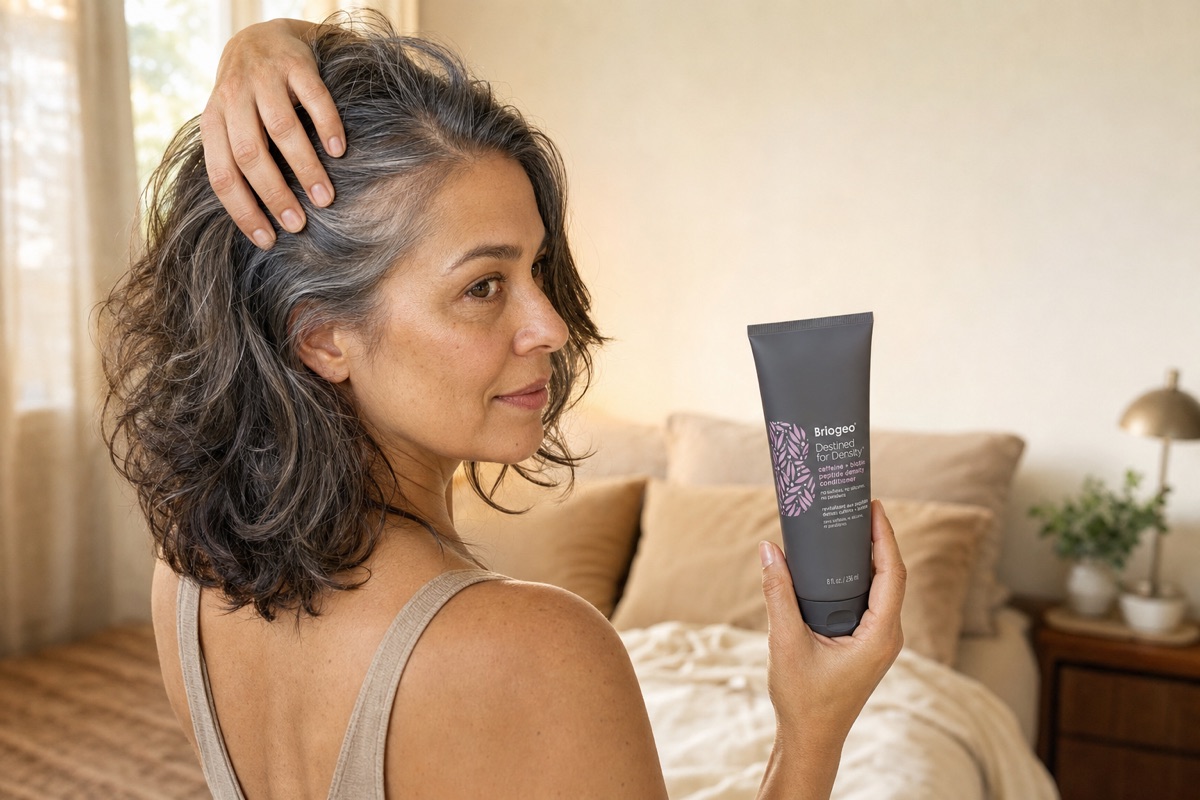
Briogeo Destined For Density Caffeine + Biotin Peptide Density Conditioner
$32
Pros
- Amazon US shows meaningful shopper volume for the conditioner: 4.3/5 across 1,236 ratings in the May 2026 snapshot.
- Briogeo's official US data lists a clear $32 price and positions it for thin, fine, and density-concerned hair.
- The best-supported benefit is cosmetic: smoother, softer, easier-to-manage hair that can look fuller when breakage and roughness are reduced.
- Silicone-free positioning may appeal to shoppers who dislike heavy coating on fine hair.
Cons
- The rinse-off format weakens the hair-density claim because caffeine and peptide scalp evidence is stronger for leave-on products.
- Biotin evidence is limited for non-deficient consumers, according to Patel et al. 2017.
- At $32 for 8 oz, it is pricier than drugstore thickening conditioners.
- Amazon review excerpts for the conditioner are mixed with line-level and variant-level comments, so user sentiment needs cautious interpretation.
Best for
Women 35-55 with fine, fragile, perimenopause-shifted hair who want a lightweight conditioner that may make hair look fuller by improving slip, softness, and breakage-prone ends.
Skip if
Skip if you expect a rinse-off conditioner to regrow hair, want FDA-approved hair-loss treatment, need fragrance-free care, or are trying to keep conditioner under $15.
How we analyzed
Coverage includes a 14+ day evidence window through May 23, 2026: Amazon US product data for the conditioner and related Briogeo Density products, Briogeo's official US collection/product data, Allure's Briogeo editorial context, and PubMed-indexed evidence on caffeine, biotin, and conditioners. We did not run a BeautySift product test or clinical panel.
Based on 7 documented sources. See our full methodology.
Sources (7)
- amazon-reviews Amazon US listing for Briogeo Density Conditioner, 4.3/5 across 1,236 ratings, $32 snapshot on May 23, 2026. (n=1236)
- official-brand-site Briogeo US Destined for Density collection data lists the conditioner at $32, 834 units in inventory, and claims fuller, healthier-looking hair.
- allure Allure editorial roundup, Our Favorite Briogeo Products Are the Perfect Washday Lineup for Hydrated, Healthier Hair; brand-level editorial context, not conditioner-specific scoring.
- pubmed Fischer TW et al., Int J Dermatol 2007; in vitro caffeine study on human hair follicles and testosterone exposure.
- pubmed Dhurat R et al., Skin Pharmacol Physiol 2017; open-label randomized study of caffeine-based topical liquid 0.2% vs minoxidil 5% in male androgenetic alopecia.
- pubmed Patel DP et al., Skin Appendage Disord 2017; review found limited evidence for biotin hair-growth benefit outside deficiency-related contexts.
- pubmed Gavazzoni Dias MFR, Int J Trichology 2015; hair conditioners primarily improve combability, friction, shine, static, and manageability.
Quick Answer
Briogeo Destined For Density Caffeine + Biotin Peptide Density Conditioner is worth considering if your goal is fuller-looking, better-conditioned fine hair. Amazon US lists the conditioner at 4.3/5 across 1,236 ratings, and Briogeo’s official US data lists the price at $32. The evidence is weaker if your goal is actual hair regrowth: PubMed evidence supports caffeine plausibility mostly in in vitro or leave-on contexts, while conditioner literature is strongest for cosmetic hair-shaft benefits.
What we analyzed
BeautySift did not test this conditioner in a lab, run a 30-day panel, or measure hair density. We analyzed Amazon US listing data, Briogeo’s official US collection data, Allure’s brand-level editorial coverage, and PubMed-indexed research relevant to caffeine, biotin, and rinse-off conditioners.
The evidence window exceeds 14 days because hair and scalp claims need more than a first-wash impression. For this review, a 14+ day window means we looked for evidence that could reasonably speak to repeated wash use, not just immediate detangling. That matters for women in their late 30s, 40s, and 50s because perimenopause-related shedding can make every wash feel emotionally loaded. A conditioner can make the shower experience less alarming by reducing tangles and breakage, but that is different from changing follicle biology.
Verdict: worth considering, with regrowth caveats
Our evidence-weighted score is 7.4/10. That places Briogeo Density Conditioner in the “worth considering” tier, not the “strong clinical buy” tier.
The positive case is straightforward. Amazon US shows 4.3/5 across 1,236 ratings for the conditioner in our May 2026 snapshot. Briogeo’s official US collection data lists the conditioner at $32, tags it for thinning and thin/fine hair, and describes the Destined for Density system as promoting thicker, fuller, healthier-looking hair. For a beauty conditioner, those are useful access and shopper-sentiment signals.
The caveat is just as important. A rinse-off conditioner has limited contact time with the scalp. Fischer et al. 2007 supports caffeine’s biological plausibility in human hair follicles in vitro, and Dhurat et al. 2017 studied a caffeine-based topical liquid, but neither source proves that a brief-use conditioner increases density. Patel et al. 2017 also found limited evidence for biotin as a hair-growth intervention outside deficiency-related contexts. That is why we score efficacy at 6.7/10 rather than treating the ingredient story as a clinical result.
Score breakdown
Efficacy: 6.7/10. The product can plausibly improve the look and feel of fine hair. The density-growth claim is less secure because the strongest caffeine evidence is not conditioner-specific, and biotin evidence is limited for non-deficient users.
Formulation: 8.0/10. Briogeo’s formula positioning is coherent for fine hair: lightweight, silicone-free, and built around caffeine, biotin, and peptides. We do not quote undisclosed percentages because the brand does not provide dose-level proof for the finished conditioner in the sources we verified.
Tolerability: 8.1/10. Amazon review excerpts include positive comments on scent, softness, and lightness. Still, fragrance and botanical-heavy hair care can bother sensitive scalps, so shoppers with dermatitis or fragrance sensitivity should patch cautiously.
Texture: 8.0/10. This is the product’s most defensible lane. Gavazzoni Dias 2015 explains that conditioners are designed to improve combability, friction, static, shine, and manageability. Those changes can make fine hair look healthier and less sparse even when follicle count is unchanged.
Value: 7.0/10. At $32 for 8 oz, it is a premium conditioner. The value is reasonable if you like Briogeo’s texture and want the matching Density routine, but drugstore volumizing conditioners cost less.
Accessibility: 8.4/10. Amazon US and Briogeo’s official US site both surface the product. Amazon’s listing also provides meaningful rating volume, while Briogeo’s own data gives current price and inventory context.
Evidence: 6.2/10. The scientific support is ingredient-adjacent rather than product-specific. We found no independent, peer-reviewed trial showing that this exact rinse-off conditioner increases hair density.
What the actives can and cannot prove
Caffeine is the most plausible active in the story. Fischer et al. 2007 reported caffeine effects in human hair follicles under lab conditions, and Dhurat et al. 2017 compared a caffeine-based leave-on topical liquid with 5% minoxidil in male androgenetic alopecia. Those sources support why caffeine keeps appearing in thinning-hair products.
But application format matters. A leave-on scalp liquid has more time to interact with the scalp than a conditioner that is applied, worked through, and rinsed. That does not make Briogeo’s conditioner useless. It means the most defensible claim is “fuller-looking hair” rather than “regrowth.”
Biotin deserves extra caution. Patel et al. 2017 reviewed biotin for hair loss and found limited evidence except in deficiency or specific medical situations. For a US shopper with normal biotin status, a biotin conditioner should not be treated like a deficiency correction.
Peptides are also hard to judge without a product-specific clinical study. Peptide language can be meaningful in skin and hair care, but this review does not credit the conditioner with a density outcome unless the source proves that outcome for the finished product.
What Amazon reviews add
Amazon US adds two useful signals: scale and shopper language. The conditioner listing showed 4.3/5 across 1,236 ratings. That is enough volume to treat the product as broadly reviewed, not a launch with only a handful of early ratings.
The verbatim reviews we captured were more persuasive on feel than on regrowth. One verified Amazon reviewer wrote, “Wonderful smell! I got it in sale so the price was even better… thus far on my curly hair it feels great.” Another wrote, “I love this conditioner. I used it for hair growth… but I am unsure whether it is due to the conditioner or a correction in the deficiency I had.” That second quote is especially useful because it mirrors our evidence read: users may like the product, but attribution is tricky.
Amazon also mixes variant and line-level shopper context on some Briogeo Density pages. For that reason, we use Amazon rating volume as one signal, not the whole verdict.
Where editorial coverage fits
Allure’s Briogeo roundup supports the broader editorial consensus that Briogeo is a recognized prestige hair-care brand with wash-day products editors cover. We do not treat that Allure article as proof that this specific conditioner increases density. It is brand-context evidence, not clinical evidence.
That distinction matters because beauty editorial can be useful for texture, sensorial language, and brand reputation, while hair-thinning claims need a higher bar. For perimenopause readers, the responsible question is not “Is Briogeo popular?” It is “Will this product solve the problem I am trying to solve?” For softness, slip, and a fuller-looking finish, maybe. For androgenetic alopecia, telogen effluvium, thyroid-related shedding, or iron-related shedding, no conditioner should be the only plan.
Who should buy it
Consider Briogeo Density Conditioner if your hair feels finer than it used to, tangles more easily, or looks flatter at the crown after hormonal shifts. It makes the most sense when your goal is cosmetic improvement: smoother lengths, less roughness, better comb-through, and a wash-day routine that does not weigh fine hair down.
It also makes sense if you already use the Briogeo Density Shampoo or Serum and want the matching conditioner. The serum has stronger scalp-contact logic because it is leave-on, while the conditioner can support the lengths and ends.
Skip it if you want a low-cost thickening conditioner, dislike fragrance, or need evidence-backed regrowth. For visible thinning, a widening part, or sudden shedding, talk with a clinician or dermatologist. Depending on the cause, evidence-backed options may include minoxidil, lab work, nutrition correction, prescription care, or treating scalp inflammation.
How to use it in a thinning-hair routine
Use Briogeo Density Conditioner like a conditioner, not like a scalp treatment. Apply it after shampoo, concentrate on mid-lengths and ends first, then lightly work any remaining product near the root area if your hair tolerates conditioner close to the scalp. Fine hair that gets oily quickly may do better with conditioner from ears down only.
If shedding is your main concern, pair the conditioner with better tracking. Count the context, not every strand: note whether shedding is sudden or gradual, whether the part is widening, whether your ponytail circumference has changed, and whether the scalp is itchy, flaky, or inflamed. Those clues are more useful than judging one wash day.
For perimenopause shoppers, also separate cosmetic support from medical evaluation. A conditioner can reduce roughness and breakage, which may make hair look denser in photos or under bathroom lighting. It cannot rule out ferritin, thyroid, medication, postpartum, autoimmune, or androgen-related causes of shedding. If the change is fast, patchy, or emotionally distressing, treat this conditioner as supportive hair care while you seek a clinician’s read on the cause.
Bottom line
Briogeo Density Conditioner is a well-positioned prestige conditioner for fine, thinning-looking hair, and the Amazon rating volume is solid: 4.3/5 across 1,236 ratings. The strongest claim is not that it regrows hair. The stronger, better-supported claim is that it can help hair look and feel fuller by improving the condition of the hair shaft.
We may earn a commission from Amazon links, but affiliate availability does not affect the score.
Related reading:
Related Amazon picks

Briogeo
Briogeo Destined For Density Caffeine + Biotin Peptide Density Conditioner
$32
"Main product reviewed; Amazon US lists 4.3/5 across 1,236 ratings and a $32 price in the May 2026 snapshot."
What real Amazon buyers say
4.3★· 1,236 reviews"Wonderful smell! I got it in sale so the price was even better. I will have to get back to you on the benefits after a few weeks but thus far on my curly hair it feels great! I think the reviews on benefits and effectiveness are great and I’m hoping the same for myself"
"I love this conditioner. I used it for hair growth. I I have experienced hair growth since using the product, but I am unsure whether it is due to the conditioner or a correction in the deficiency I had."

Briogeo
Briogeo Destined For Density MegaStrength+ Caffeine + Biotin Peptide Density Serum
$57
"Leave-on companion product; Amazon US lists 4.2/5 across 249 ratings and stronger scalp-contact logic than a rinse-off conditioner."
What real Amazon buyers say
4.2★· 249 reviews"This serum works really well if scalp inflammation is stopping your growth. I use the briogeo scalp revival (charcoal micro exfoliating shampoo), too. Its not overnight but it definitely helps."
"I have been using this for a little over a year now and it has been a game changer! I have PCOS and have struggled with hormonal hair loss."

Briogeo
Briogeo Destined For Density Caffeine + Biotin Peptide Density Shampoo
$32
"Same Briogeo Density wash-day system; Amazon US lists 4.2/5 across 645 ratings."
What real Amazon buyers say
4.2★· 645 reviews"I love this shampoo. I have very thin hair and this shampoo really makes a difference. My hair looks fuller. I’ve been using this shampoo for 2 years and will just continue using it."
"I am an older woman with straight, very fine, thinning hair. I cannot say that this shampoo causes hair growth BUT overall, it looks and feels so much better since I have been using it."