Hair Growth Supplements vs Biotin Supplements for Fine Lines and Thinning Hair
Evidence-weighted comparison of multi-ingredient hair growth supplements and standalone biotin for women over 40 managing thinning hair and fine lines.
We analyzed 173,332 Amazon US ratings across 6 representative supplements plus PubMed biotin reviews and an FDA safety communication. Multi-ingredient hair growth supplements fit perimenopause-related thinning better; standalone biotin is cheaper but mainly helps when biotin status is low.
| Criterion | 🏆 Winner Multi-ingredient hair growth supplements Multi-brand category $54.40 | Standalone biotin supplements Multi-brand category $19.33 |
|---|---|---|
| Hair-thinning fit How directly the category addresses shedding, density, breakage, and perimenopause-related user needs. | 8.3/10 | 5.7/10 |
| Fine-line relevance Whether the category plausibly supports skin appearance through collagen, hydration-support nutrients, or beauty-positioned actives; not a substitute for sunscreen or retinoids. | 6.6/10 | 4.4/10 |
| Ingredient evidence Strength of public evidence for the ingredient category, weighted toward PubMed reviews and transparent product positioning. | 7.1/10 | 5.8/10 |
| Amazon rating volume Representative Amazon US rating volume: 52,008 ratings for the hair-growth basket and 121,324 ratings for the biotin basket. | 7.8/10 | 9.2/10 |
| Value Representative basket averages from Amazon US price snapshots: $54.40 for hair-growth supplements and $19.33 for standalone biotin. | 6.2/10 | 9.0/10 |
| Tolerability and safety caveats Penalizes pill burden, nausea complaints, allergen complexity, high-dose biotin lab-test interference, and medical-condition uncertainty. | 6.9/10 | 6.8/10 |
| Typical user fit How well the category matches women 35-55 deciding between a broad hair-support formula and a simple single-ingredient supplement. | 8.5/10 | 6.1/10 |
| Overall score | 7.34 | 6.71 |
🏆 Winner: Multi-ingredient hair growth supplements
Multi-ingredient hair growth supplements win for perimenopause hair thinning because they lead hair-thinning fit 8.3 to 5.7 and typical user fit 8.5 to 6.1. The biotin basket has much larger Amazon rating volume, 121,324 ratings versus 52,008, and better value at a $19.33 representative average. But PubMed's 2017 biotin review found limited support for biotin outside deficiency or defined disorders, while hair-growth formulas address a wider mix of shedding, breakage, protein, botanical, and nutrient-support needs.
Best on a budget
Sports Research Biotin 10,000 mcg
Best for results
Nutrafol Women's Balance for women 45+ who want the most targeted perimenopause hair-thinning positioning; Viviscal for a lower-priced multi-ingredient alternative
Quick answer: choose the broader formula for thinning hair, not for wrinkles
For women 35-55 comparing hair growth supplements with standalone biotin, the better default is a multi-ingredient hair growth supplement if the main concern is perimenopause-related shedding, widening part lines, or ponytail shrinkage. The better budget option is standalone biotin if you want one ingredient, already know you tolerate high-dose biotin, and can tell your clinician before lab work.
The fine-line part needs a reality check. None of these supplements should be treated like sunscreen, retinoids, peptides, or an in-office collagen procedure. Some hair-growth formulas include ingredients marketed for skin support, such as collagen, hyaluronic acid, silica, or vitamin C. MaryRuth’s Liquid Multivitamin + Hair Growth, for example, is positioned on Amazon for hair and facial wrinkles and has 18,348 Amazon ratings in our snapshot. That does not make it a primary fine-line treatment. It means the broader formula has more skin-adjacent rationale than plain biotin.
Across the six-product Amazon basket we analyzed, standalone biotin had the bigger rating base: 121,324 Amazon ratings across Sports Research, Nutricost, and Solgar. The hair-growth basket had 52,008 ratings across MaryRuth’s, Viviscal, and Nutrafol Women’s Balance. Biotin also won on price, with a representative average of $19.33 versus $54.40 for the multi-ingredient hair-growth basket.
But the PubMed picture is more cautious. Patel et al.’s 2017 review of biotin for hair loss concluded that published support is limited and strongest when a person has biotin deficiency or a defined hair or nail disorder. That matters for perimenopause shoppers because shedding is often multi-factorial: hormones, iron status, thyroid status, stress, protein intake, medications, scalp inflammation, genetics, and styling practices can all overlap.
What counts as a hair growth supplement here?
In this comparison, “hair growth supplement” means a formula built around more than one hair-support pathway. The category can include vitamins, minerals, amino acids, botanical extracts, collagen or marine complexes, adaptogens, hyaluronic acid, or branded ingredients. The products are not identical, and the evidence quality varies by formula.
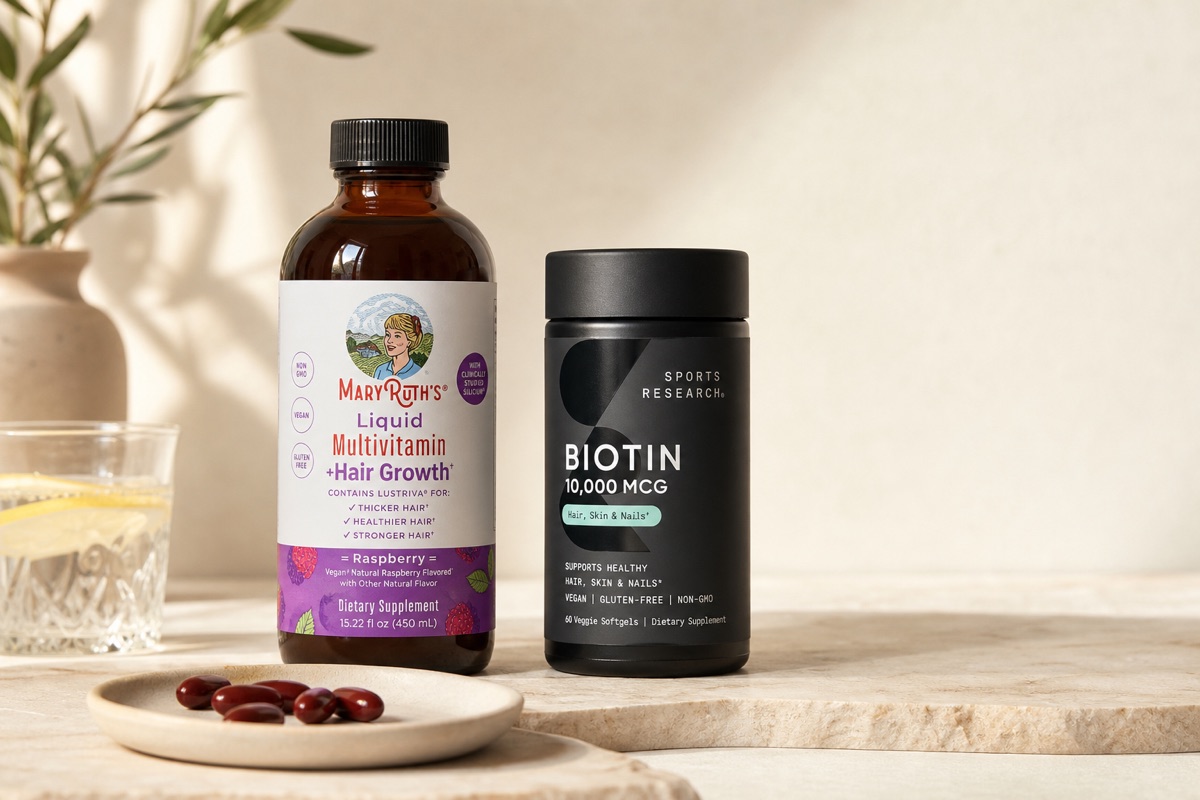
MaryRuth’s Liquid Multivitamin + Hair Growth is a liquid option with 4.5/5 across 18,348 Amazon ratings and a $29.21 price snapshot. Its strongest fit is the shopper who dislikes capsules or wants a multivitamin-style format that also addresses hair. Its weakness is that liquid supplements can be less convenient for travel, and broad formulas make it harder to know which ingredient helped or irritated you.
Viviscal Hair Growth Supplements for Women is the rating-volume leader on the hair-growth side: 4.3/5 across 30,005 Amazon ratings at a $45.99 snapshot. It is the more established mass-market choice for women who want a dedicated hair tablet without paying Nutrafol pricing. The tradeoff is that users with seafood sensitivities or strict dietary preferences need to inspect the label closely before buying.
Nutrafol Women’s Balance is the most specifically positioned for women 45+ in this set. It has 4.4/5 across 3,655 Amazon ratings and an $88.00 price snapshot. It fits the shopper who wants perimenopause-targeted language and is willing to pay for a more complex formula. It is not the budget pick, and its multi-capsule daily format can be a nonstarter for people who already take several supplements.
What counts as a biotin supplement here?
Standalone biotin supplements are simpler: the star ingredient is vitamin B7, often at 10,000 mcg. They are usually cheaper, widely stocked, and easy to compare across brands. The downside is that simplicity also narrows the expected benefit.
Sports Research Biotin 10,000 mcg has the largest rating base in this article, with 4.6/5 across 99,781 Amazon ratings and a $19.95 price snapshot. It is the most defensible budget-featured pick if you want one high-dose biotin softgel and no complex hair blend.
Nutricost Biotin 10,000 mcg is the lowest-price biotin pick here at $14.95, with 4.7/5 across 18,064 Amazon ratings. It fits shoppers who want a vegetarian capsule and a no-frills bottle. Solgar Biotin 10,000 mcg costs more at $23.09, with 4.7/5 across 3,479 Amazon ratings, but it appeals to shoppers who prefer a long-running supplement brand.
The caution is the same for all three: more biotin is not automatically better for hair. The FDA warns that biotin can interfere with certain lab tests. If you are in perimenopause and checking thyroid, sex hormones, vitamin D, ferritin, or cardiac markers, the supplement conversation belongs in the appointment, not after the blood draw.
Evidence comparison: why multi-ingredient formulas win for hair thinning
Our scoring gives hair growth supplements an 8.3 for hair-thinning fit versus 5.7 for standalone biotin. That is not because every hair-growth formula is clinically proven. It is because the category is built for a broader problem.
Perimenopause hair thinning rarely has one clean cause. A woman may be dealing with lower estrogen, increased androgen sensitivity, a low ferritin pattern, stress shedding, less protein intake, thyroid changes, GLP-1 medication weight loss, tight hairstyles, scalp irritation, or color-processing breakage. A single biotin pill does not address that complexity.
The 2019 Dermatology and Therapy review by Almohanna et al. is useful here because it frames hair loss through multiple vitamins and minerals rather than one hero nutrient. The review does not mean everyone should take a broad supplement. It does support the more practical view that nutrient-related shedding should be assessed broadly, especially when hair loss is new or diffuse.
Hair-growth supplements also tend to match user language better. Amazon reviewers for Viviscal and Nutrafol frequently describe shedding, density, ponytail size, and visible scalp coverage. Amazon reviewers for biotin often discuss nails first, then hair. That does not invalidate biotin; it clarifies the fit. If your nails are brittle and your hair concern is mild, biotin may be reasonable. If your part line is widening after 45, biotin alone is a thinner strategy.
Fine lines: neither category should be your main anti-aging plan
For fine lines, the winner is more conditional. Multi-ingredient hair growth supplements score 6.6 for fine-line relevance versus 4.4 for standalone biotin. That lead comes from broader beauty formulas that may include collagen-related, hydration-support, or antioxidant nutrients. It does not come from strong evidence that swallowing a hair supplement will smooth crow’s-feet.
Biotin is even less direct. Biotin supports normal metabolism, and deficiency can affect hair, skin, and nails. But a high-dose biotin bottle is not a fine-line supplement. If a shopper is choosing between biotin and a hair-growth blend partly because facial fine lines are on her mind, the better answer may be neither: spend first on daily sunscreen, a retinoid or retinal if tolerated, a barrier moisturizer, and a separate collagen peptide product only if the evidence and budget make sense for her.
MaryRuth’s product is the only featured item here whose Amazon title directly links hair growth positioning with facial wrinkles in our snapshot. That is why it ranks high for the bridge shopper who wants a liquid beauty supplement. But the article’s verdict stays conservative: treat any fine-line benefit as secondary and uncertain.
Price and value: biotin wins, but value is not only cost
On price, biotin wins clearly. Our biotin basket averaged $19.33, using Sports Research at $19.95, Nutricost at $14.95, and Solgar at $23.09. The hair-growth basket averaged $54.40, using MaryRuth’s at $29.21, Viviscal at $45.99, and Nutrafol Women’s Balance at $88.00.
That gap matters. Hair supplements often require 3 to 6 months of consistent use before shoppers judge shedding or density. A product that costs $88 per bottle can become a $264 to $528 trial before you know whether it is helping. If the price creates stress or inconsistent use, the theoretical formula advantage becomes less useful.
Biotin’s value score is therefore higher: 9.0 versus 6.2. But value should be tied to the job. A $15 biotin bottle is not a bargain if the actual issue is iron deficiency, thyroid imbalance, androgenic hair thinning, or traction breakage. A broader hair supplement is not a bargain if your diet is already sufficient and the real need is topical minoxidil, scalp treatment, or medical evaluation.
A practical split: start with the cheapest option only if your hair concern is mild, your labs and medications are stable, and you already know biotin will not complicate upcoming testing. If shedding is visible, sudden, or emotionally distressing, do not spend months guessing. Ask a clinician about ferritin, thyroid, vitamin D, medications, menopause status, and pattern hair loss.
Tolerability and lab-test caveats
Neither category is automatically gentle. Hair-growth supplements can contain many ingredients, which raises the chance of stomach upset, headaches, allergy concerns, or interactions. They may also require multiple capsules per day. That is why this category scores 6.9 for tolerability rather than higher.
Standalone biotin looks simpler, but high-dose use carries a specific caveat: lab-test interference. The FDA safety communication is the strongest safety source in this article. It warns that biotin can interfere with some diagnostic tests. For women in the 35-55 range, that is especially relevant because thyroid testing, hormone workups, and cardiac evaluation may all become more common.
The cleanest approach is to keep a supplement list in your phone and share it before lab work. Include the dose, not just the brand name. “Biotin 10,000 mcg daily” is more useful to a clinician than “hair vitamin.”
Product picks by side
Best multi-ingredient liquid: MaryRuth’s Liquid Multivitamin + Hair Growth. It is the best fit if swallowing pills is the barrier and you want one formula that sits between multivitamin and hair supplement. Amazon’s 18,348-rating base gives it more user volume than many newer beauty supplements, and its $29.21 snapshot keeps it below Viviscal and Nutrafol in this set.
Best established hair supplement: Viviscal Hair Growth Supplements for Women. It has the highest hair-growth rating volume we analyzed, 30,005 Amazon ratings, and the price is midrange rather than premium. It is the most practical alternative to Nutrafol if you want a dedicated hair product but not an $88 bottle.
Best age-45+ targeted formula: Nutrafol Women’s Balance. The fit is strongest for a shopper who specifically wants perimenopause or menopause hair-thinning positioning. The downside is obvious: it costs the most in this comparison and has lower Amazon rating volume than Viviscal.
Best budget biotin: Sports Research Biotin 10,000 mcg. It has 99,781 Amazon ratings, the largest user base in this article, and the formula is simple. That makes it the easiest biotin pick to compare. The tradeoff is that it remains a biotin supplement, not a comprehensive hair-thinning plan.
Best low-cost capsule: Nutricost Biotin 10,000 mcg. At $14.95 and 18,064 Amazon ratings, it is the straightforward value pick. Best supplement-brand biotin: Solgar Biotin 10,000 mcg, for shoppers who prefer a familiar vitamin brand and accept the higher $23.09 snapshot.
Who should choose which?
Choose a multi-ingredient hair growth supplement if your concern is thinning hair after 40, a shrinking ponytail, diffuse shedding, or a widening part line and you want a formula designed for hair rather than a single vitamin. Choose MaryRuth’s if liquid format matters, Viviscal if rating volume and midrange price matter, and Nutrafol Women’s Balance if age-45+ targeting matters more than price.
Choose standalone biotin if your budget is tight, your hair concern is mild, your nails are also brittle, or a clinician has suggested biotin. Choose Sports Research for the largest rating base, Nutricost for the lowest price, and Solgar for brand familiarity.
Skip both categories as a first move if shedding is sudden, patchy, itchy, scaly, painful, or accompanied by fatigue, unexplained weight change, or menstrual changes. Supplements can be part of a routine, but they should not delay evaluation for thyroid disease, iron deficiency, autoimmune hair loss, medication-related shedding, or androgenetic alopecia.
Bottom line
Hair growth supplements beat standalone biotin for the typical BeautySift reader comparing thinning-hair support in perimenopause. They match the problem better, offer broader ingredient coverage, and are more often positioned around shedding and density. Biotin wins on price, rating volume, and simplicity, but the PubMed and FDA sources keep the recommendation narrow: it is most useful when biotin is relevant and least useful as a one-pill answer to complex hair thinning or fine lines.
If fine lines are part of the decision, do not let supplement marketing replace the basics. Use sunscreen every morning, keep a retinoid or peptide routine if your skin tolerates it, and treat oral hair supplements as hair-support tools with possible secondary beauty benefits, not wrinkle treatments.
Related reading
Both winners on Amazon

MaryRuth's
MaryRuth's Liquid Multivitamin + Hair Growth
$29.21
"Liquid multi plus hair-growth positioning; 4.5/5 across 18,348 Amazon ratings and the lowest price among the multi-ingredient hair-growth picks here."
What real Amazon buyers say
4.5★· 18,348 reviews"I like liquid vitamins because my body more easily absorbs them. The taste was a pleasant surprise. I actually never thought about the skin and hair until I realized my hair felt fuller and healthier. I felt better in general."

Viviscal
Viviscal Hair Growth Supplements for Women
$45.99
"Highest hair-growth rating volume in this comparison: 4.3/5 across 30,005 Amazon ratings for a multi-ingredient supplement positioned for thinning hair."
What real Amazon buyers say
4.3★· 30,005 reviews"When I started using this product I was very skeptical, but to my happy surprise this stuff WORKS!! In a couple of months my hair pony tail has more than doubled in size!"

Sports Research
Sports Research Biotin 10,000 mcg
$19.95
"Largest Amazon rating base in the article: 4.6/5 across 99,781 ratings for a simple high-dose biotin softgel."
What real Amazon buyers say
4.6★· 99,781 reviews"I’ve been taking this biotin supplement for a few weeks now, and I’m genuinely impressed with the results! From the first bottle, I noticed positive changes that actually stick — which is rare for supplements."

Nutrafol
Nutrafol Women's Balance Hair Growth Supplements
$88
"Age-45+ positioning for women's hair thinning; 4.4/5 across 3,655 Amazon ratings, but the highest price in this comparison."

Nutricost
Nutricost Biotin 10,000 mcg
$14.95
"Lowest-price biotin pick in this set with 4.7/5 across 18,064 Amazon ratings and a straightforward vegetarian-capsule format."

Solgar
Solgar Biotin 10,000 mcg
$23.09
"Established supplement-brand option with 4.7/5 across 3,479 Amazon ratings; higher cost than Nutricost but familiar to vitamin shoppers."