How I Test Fragrance When My Skin Is Sensitive
A practical BeautySift guide to testing fragrance on sensitive skin, with blotter-first steps, patch-test habits, and signs it is time to stop.
Medical disclaimer: This article is for general education only and does not replace personal medical advice. If fragrance use causes a persistent rash, swelling, wheezing, blistering, eye symptoms, or severe burning, stop using it and speak with a dermatologist or another qualified clinician.
Affiliate disclosure: This article does not include affiliate product links at the time of publication. If retailer links are added later, BeautySift may earn a commission while editorial decisions remain independent.
I like fragrance, but I do not treat perfume like a harmless finishing touch when my skin is already reactive. The fastest way for me to ruin a good scent is to spray it directly onto a neck area that is warm, freshly exfoliated, or already a little itchy. When my skin is sensitive, I test fragrance the same way I handle strong skincare: with less bravado, fewer variables, and more patience than I think I need.
That approach is not about fear. It is about pattern recognition. Fragrance materials are common in daily life, and contact allergy to fragrance is a familiar topic in dermatology literature. A 2024 review focused on patch testing described fragrance contact allergy as common worldwide and emphasized how complicated fragrance exposure can be because perfumes, personal care products, and scented household items can all contribute to the picture (PMID: 39140486). A 2024 systematic review also examined sensitization to fragrance mix I and fragrance mix II in European dermatitis patients, which is the sort of evidence that reminds me not to shrug off repeated irritation as random bad luck (PMID: 38945918).
TL;DR
- I do not spray first and think later when my skin is reactive. I test slowly, usually away from my face and neck.
- My low-drama method is blotter first, fabric second if needed, and skin last after a small patch test on a calm area.
- If I notice burning, itch, or a rash that keeps returning, I stop the fragrance and treat that as a reason to get medical advice rather than keep experimenting.
Why I change my fragrance routine when skin is sensitive
Perfume often gets framed as a tiny extra, but it can sit on the exact areas that already give sensitive people trouble: the neck, chest, wrists, and inner elbows. Those areas are also easy to rub, shave, exfoliate, or expose to sun and sweat. When my barrier feels a little unreliable, I do not want fragrance landing on freshly compromised skin and then staying there for hours.
I also try to remember that irritation and allergy are not the same thing. A strong fragrance can feel stingy on over-exfoliated skin without meaning I am allergic to it. On the other hand, repeated exposure plus a repeating rash is not something I write off casually. The point of a careful testing routine is not to diagnose myself. The point is to reduce obvious triggers and notice whether the pattern is mild, brief, and mechanical or whether it looks like a problem that deserves proper patch testing with a clinician.

The order I trust: blotter, fabric, then skin
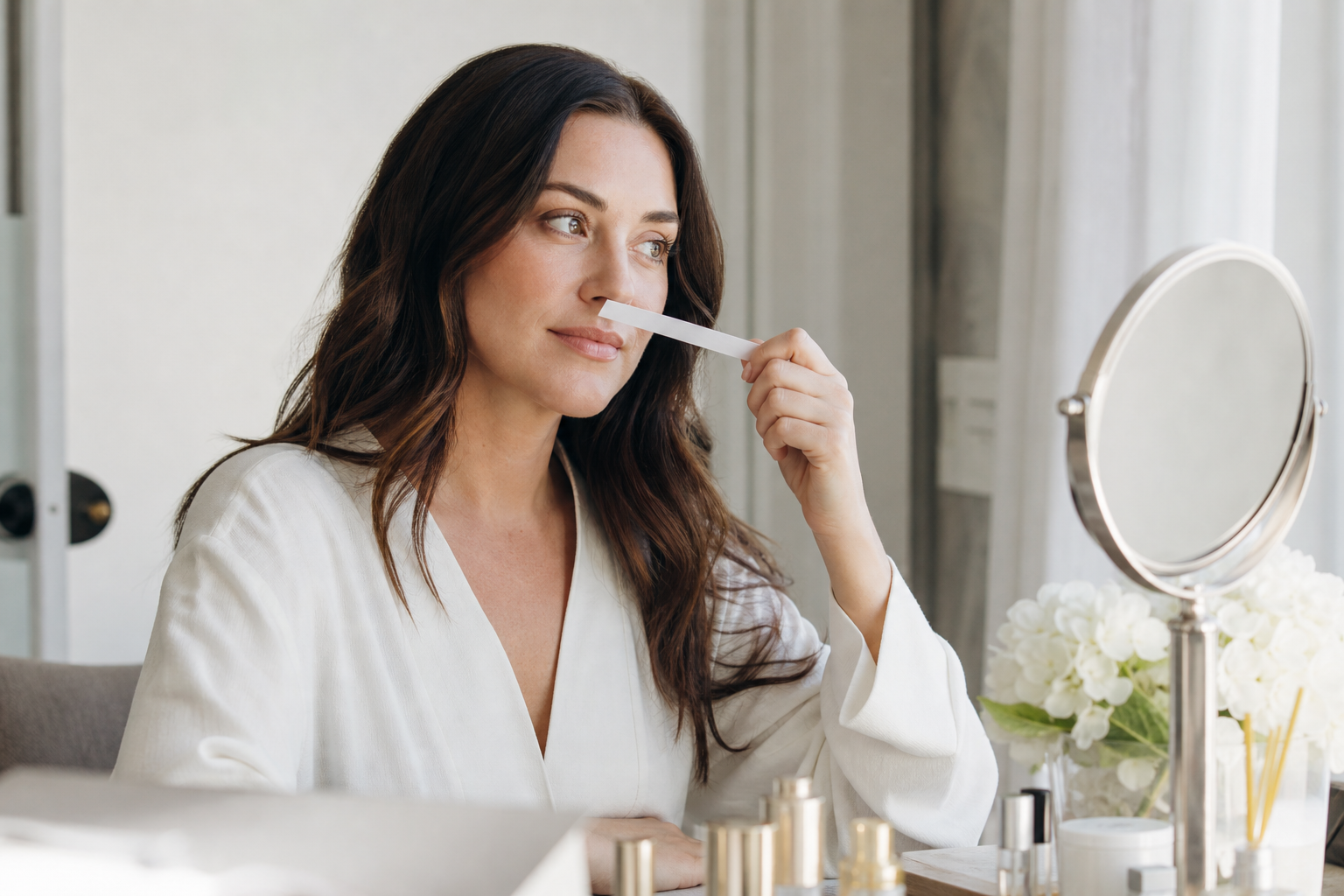
When I am testing a scent for the first time, I begin with a blotter strip or tissue. That sounds obvious, but it keeps me from making a fast emotional decision with my wrist. A strip lets me tell whether I even like the opening before my skin gets involved. If the top notes already feel too sharp, powdery, smoky, or headache-inducing, I can stop there.
If I still want to keep going, I sometimes test the scent lightly on clothing instead of skin. I choose an area that will not sit against my face all day, and I keep the spray modest. This helps me see whether I enjoy the dry-down around me without creating a direct skin exposure experiment. It is also the option I prefer on days when I have shaved, used acids, or spent too much time in the sun.
Skin comes last, not first. When I do test on skin, I pick a small area on the inner forearm that is not actively irritated. I use one spray at most, and I do not layer body lotion, body oil, and fragrance in the same spot. I want a readable result. If the area feels hot right away, I wash it off. If it looks normal at first, I still check again later because delayed reactions matter more to me than the first five minutes.
Where I do not test anymore
I have learned to stop testing fragrance on my neck, upper chest, and freshly moisturized wrists when my skin is in a sensitive phase. Those spots are convenient, but convenience is not the same thing as good judgment. The neck gets friction from hair and clothing. The chest gets sun. Wrists get handwashing, stacking with lotion, and absent-minded re-spraying. If I want to figure out whether a scent is compatible with my skin, those busy zones are not the cleanest places to run the experiment.
I also skip broken skin, recently shaved skin, and skin that is already red from something else. If I cannot tell whether I am reacting to the fragrance or to the fact that I used a body scrub the night before, the test is not useful. Sensitive-skin routines get clearer when I stop trying to make every step multitask.

What I watch for over the next 24 hours
My first checkpoint is immediate comfort. Did the area sting, itch, or feel strangely warm? Then I look later for redness, dry patches, bumpiness, or a rash outline that matches the application site. I pay attention to whether the reaction stays local or whether I start touching the area because it feels increasingly itchy. I do not need the reaction to be dramatic to take it seriously. Repeated low-grade irritation is enough for me to demote a fragrance from regular use.
If I am trying more than one scent, I spread out the tests. One fragrance one day is far more informative than three on the same afternoon. I also keep the surrounding routine boring: no acid body pads, no fragrant lotion under the test spot, and no “let me see if it was actually the detergent” detour in the same window. The less crowded the test, the more honest the result.
This is where the dermatology literature is helpful emotionally as much as scientifically. The patch-testing review on fragrance allergy explains why fragrance assessment can be messy in real life: exposure comes from multiple product types, natural complex substances can be harder to interpret than a single chemical, and relevant allergens are not always obvious from casual product use alone (PMID: 39140486). That complexity is exactly why I resist making sweeping assumptions from one hurried wear test.
How I read labels without pretending they tell me everything
I do read labels, but I do not pretend ingredient lists solve the whole problem. If a product is heavily fragranced and my skin has been reactive lately, that is enough for me to treat it cautiously. I also pay attention to product type. A scented body mist that lands on clothing is a different exposure pattern from a concentrated perfume oil that stays on one small skin area for hours.
The U.S. Food and Drug Administration notes that cosmetic products can contain ingredients that act as allergens for some people, and fragrance is one of the categories consumers often worry about. That does not mean every scented product is unsafe. It means sensitivity is individual, and it is reasonable to take recurrent irritation seriously instead of pushing through it just because a scent is expensive or popular.
My practical rules for enjoying fragrance without chasing a rash
- Do not test a new fragrance on a day when my skin is already angry.
- Use blotter first, then a small fabric test, then a small skin test only if the first two steps feel promising.
- Keep fragrance off freshly exfoliated, shaved, sunburned, or visibly irritated skin.
- Avoid mixing multiple new scented products in one test window.
- Stop quickly if I get repeat itching, warmth, or a site-specific rash.
- If reactions keep happening, seek proper medical patch testing rather than self-experimenting forever.
When I skip fragrance entirely
Sometimes the smartest fragrance routine is no fragrance routine. If my skin barrier has been acting up, if I am dealing with eczema-like patches, or if the weather has left my neck and chest chapped, I do not think of perfume as a reward I need to force back into the day. I would rather wait a week than spend the next two weeks guessing which product caused the setback.
I feel the same way when I cannot stop touching a test area. That is usually my sign that I have crossed from curiosity into irritation. At that point, I wash the area gently, stop testing, and make a note. Beauty is more enjoyable when I do not turn a scent test into a minor skin event.
My honest bottom line
When my skin is sensitive, I still enjoy fragrance, but I use a slower ladder than I used to. Blotter first. Clothing if needed. Skin last, on a small calm area, with no heroics. That system is less romantic than spraying perfume straight onto pulse points, but it gives me better information and fewer regrets.
If you keep getting the same itchy or rashy response, I would not keep trying to outsmart it with a different application trick. That is the moment to step back and get professional advice. Fragrance should be optional pleasure, not a recurring skin mystery.