How I Patch Test New Skincare Without Wrecking My Barrier
My cautious patch-testing routine for sensitive skin, including where I test, how long I wait, what counts as a fail, and when to see a dermatologist.

Medical disclaimer: This article is general education about patch testing new skincare at home. It is not a diagnosis or a substitute for medical care. If you develop marked swelling, blistering, hives, trouble breathing, or a rash that keeps spreading, stop the product and contact a clinician right away.
Affiliate disclosure: This article does not include sponsored placements, and the product examples below are for context rather than paid promotion. My goal is to explain a cautious testing method that can help reduce avoidable irritation.
I patch test because my skin has a bad habit of looking calm for one day and furious on day three. That delayed reaction changed the way I try new skincare. I no longer smear a fresh serum all over my face just because the ingredient list looks smart. I want a slow, boring process that gives my skin a fair chance without forcing me into a week of redness.
That approach matters because not every reaction is immediate, and not every sting means the same thing. Allergic contact dermatitis is a delayed immune reaction, while irritant reactions are often tied to barrier stress, concentration, or overuse. A PubMed review on allergic contact dermatitis notes that careful history and examination guide diagnosis, and dermatologist-run patch testing remains the gold standard when allergic contact dermatitis is suspected (PMID: 27886903). A separate practical review on patch testing says the same thing clearly: office patch testing is the standard for diagnosing allergic contact dermatitis, while technique and interpretation matter (PMID: 30269296).
My home patch test is not a medical patch test. It is simply a low-drama screening step to catch obvious trouble before I commit my whole face or neck. That distinction keeps me realistic. Home testing can reduce avoidable mistakes, but it cannot rule out every allergy or predict exactly how a product will behave when layered with the rest of a routine.
Why I patch test even when a formula looks gentle
Sensitive skin is not just about having a personality problem with fragrance. It often overlaps with a weaker or more reactive stratum corneum, which means the skin barrier has a lower tolerance for friction, surfactants, acids, or strong actives. A narrative review on dry, flaky, and sensitive skin describes the stratum corneum as the main protective barrier and explains how disruption can leave skin more reactive to outside triggers (PMID: 38140732). That is exactly why I do not trust marketing words like gentle, soothing, or dermatologist tested on their own.
I am extra cautious with retinoids, exfoliating acids, vitamin C formulas that use low pH, essential oils, and heavily fragranced creams. But I also patch test plain-looking moisturizers and cleansers, because bland packaging does not guarantee a bland formula. Even useful ingredients can become a problem when the base is too active, the preservative system does not agree with me, or I am already using too many things at once.

The exact spot I use first
I usually start on the side of my neck below the jaw or on a small area near the lower cheek, depending on the product category. For a face cream or serum, I want the test site to be facial skin or close to it, because the skin on my forearm is often less reactive than my face. For a cleanser, I test on a small facial area and rinse it off instead of leaving it on. For body products, I use the inner arm.
The test area should be small enough that a reaction stays contained, but relevant enough that it tells you something. I avoid freshly shaved skin, active eczema patches, broken skin, and the corners of the nose or mouth, where almost anything can sting. If my barrier already feels raw, I wait a few days. Testing a new active on irritated skin tells me more about my bad timing than about the product itself.
My 4-day patch testing routine
Day 1: I apply a rice-grain amount once to a small area. If it is a cleanser, I wash a fingertip-sized patch for about the same amount of time I would use on my face, then rinse and pat dry. I do not layer other actives on top of that spot.
Day 2: If the area looks calm the next morning, I repeat the exact same amount once more. I am watching for itching, delayed redness, tiny bumps, unusual warmth, or a shiny tight feeling that suggests irritation rather than simple dryness.
Day 3: If the site still looks normal, I apply the product to a slightly larger patch or use it once on a limited section of the face, such as one side of the chin. I still keep the rest of the routine simple.
Day 4: If everything remains quiet, I start regular use at a conservative frequency. For stronger actives, that might mean twice a week rather than nightly. Passing a patch test does not mean my skin wants daily exposure on day one.
This is slower than the back-of-package instructions, but slower is exactly the point. A rushed test is how I end up confusing irritation from overuse with a true compatibility problem.
What I count as a fail
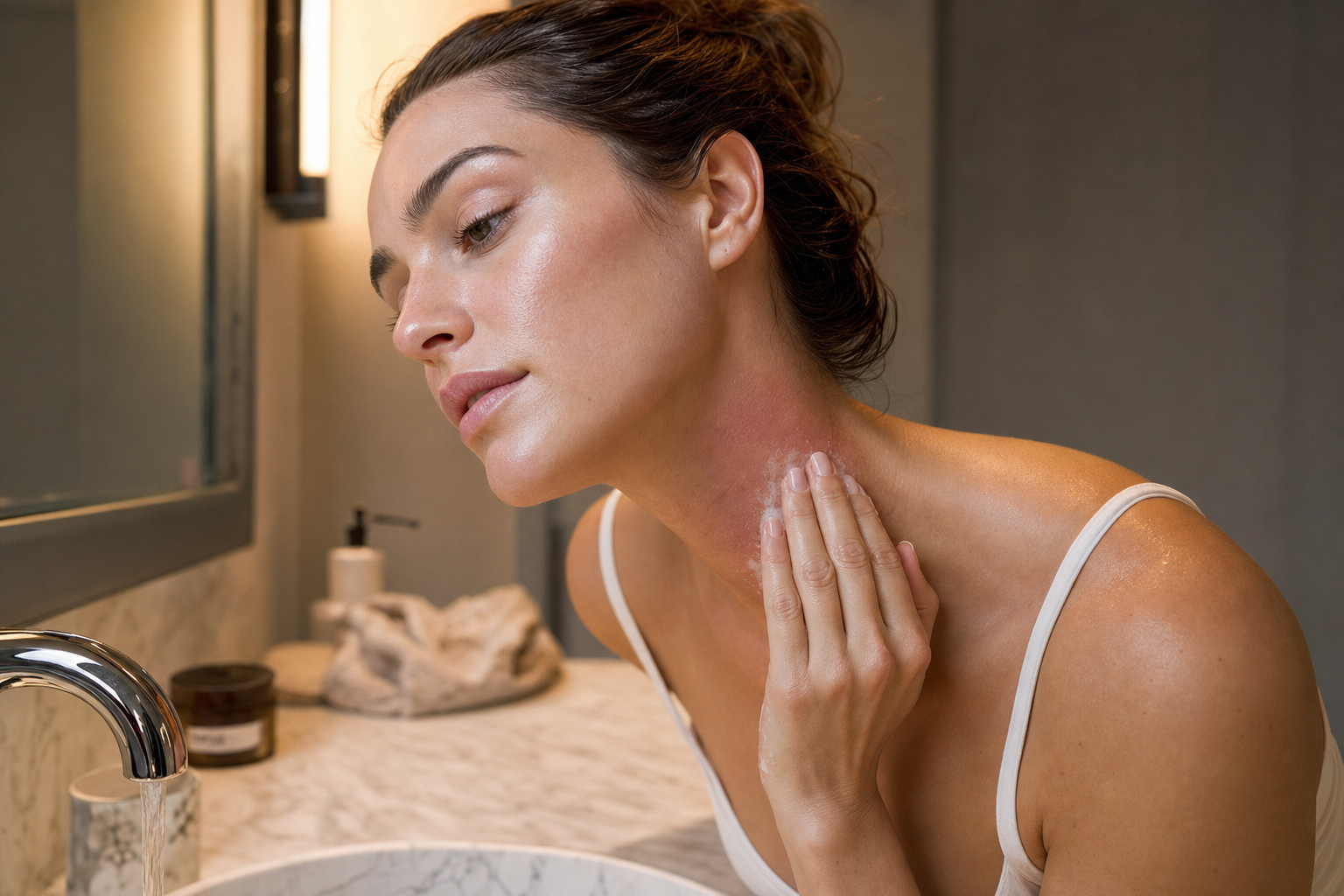
I stop the test if I see persistent redness, swelling, clusters of tiny itchy bumps, burning that lasts beyond a few minutes, or scaling that keeps worsening. A brief tingle can happen with some actives, but I do not argue with a product that makes my skin look angrier hour by hour. If the reaction is strong, I wash the area with a mild cleanser and go back to a plain moisturizer only.
This is where cleanser choice matters too. Reviews on cleansing science note that syndet cleansers are generally less barrier-damaging and less drying than traditional alkaline soaps, which is useful when skin is already irritated and you need to remove a product without scrubbing (PMID: 29231284). When my skin is upset, I want removal to feel uneventful.
What I do after a product passes
A passing result only earns the product a cautious trial. It does not earn my trust forever. I still introduce one new leave-on product at a time, and I give it several days before adding another variable. That matters most with retinoids, exfoliating acids, benzoyl peroxide, and pigment-focused treatments, because combinations can irritate even when each formula seems fine alone.
I also adjust frequency based on category. A bland moisturizer can move faster. A potent serum has to earn its place gradually. When I ignore that difference, I end up blaming a formula that might have worked perfectly well at a lower cadence.
Common patch testing mistakes I try to avoid
- Testing too many products at once: if everything is new, there is no clear culprit.
- Testing on broken skin: this exaggerates irritation and muddies the result.
- Using too much product: a thick blob can cause occlusion and unnecessary sting.
- Skipping the wait: delayed reactions are common enough that one calm hour proves very little.
- Changing the full routine at the same time: I keep the rest of my lineup dull on purpose.
When I skip home testing and call a dermatologist
If I have repeated unexplained reactions, eyelid dermatitis, lip irritation, or rashes that return with multiple unrelated products, I stop playing detective by myself. That is when actual patch testing becomes more useful than another home experiment. PubMed reviews on allergic contact dermatitis repeatedly describe dermatologist-supervised patch testing as the standard diagnostic tool, and that matters because the real value is not just finding a rash. It is identifying a pattern you can avoid long term (PMID: 27886903; PMID: 30269296).
I also get help quickly if the reaction is severe, painful, infected-looking, or paired with symptoms beyond the skin. A beauty routine problem should not turn into a stubborn medical problem because I wanted to prove I could fix it alone.
The calmest version of this routine
If your skin is reactive, the safest setup is boring: one new product, one small area, four days, and a backup plan that includes a plain moisturizer and a gentle cleanser. That method does not remove all risk, but it has saved me from turning curiosity into a full-face setback. I have learned that patience is often the most useful part of a sensitive-skin routine, even if it is the least glamorous one.
Sources: Allergic Contact Dermatitis (PMID: 27886903); Patch Testing Pearls (PMID: 30269296); Epidermal barrier function in dry, flaky and sensitive skin: A narrative review (PMID: 38140732); The science behind skin care: Cleansers (PMID: 29231284).