Why My Moisturizer Stings After Over-Exfoliation
A practical reset for skin that burns after too much exfoliation, with barrier-focused steps, warning signs, and PubMed-backed context.
Medical disclaimer: This article is for general skin-care education and does not replace medical advice. If your burning, swelling, cracking, oozing, or rash is severe, involves the eyelids, or keeps happening after you stop irritating products, I think it is smart to see a dermatologist or another licensed clinician.
Affiliate disclosure: This article does not include affiliate product links or paid retailer recommendations. I am focusing on skin-barrier logic, not steering you toward a specific purchase.
TL;DR: When my moisturizer suddenly stings after I have been too enthusiastic with acids, scrubs, or retinoids, I treat that as a warning sign instead of a challenge to push through. My reset is simple: stop the extra exfoliation, switch to lukewarm water, use a bland moisturizer on slightly damp skin, and give the barrier a few quiet days before I restart anything active.
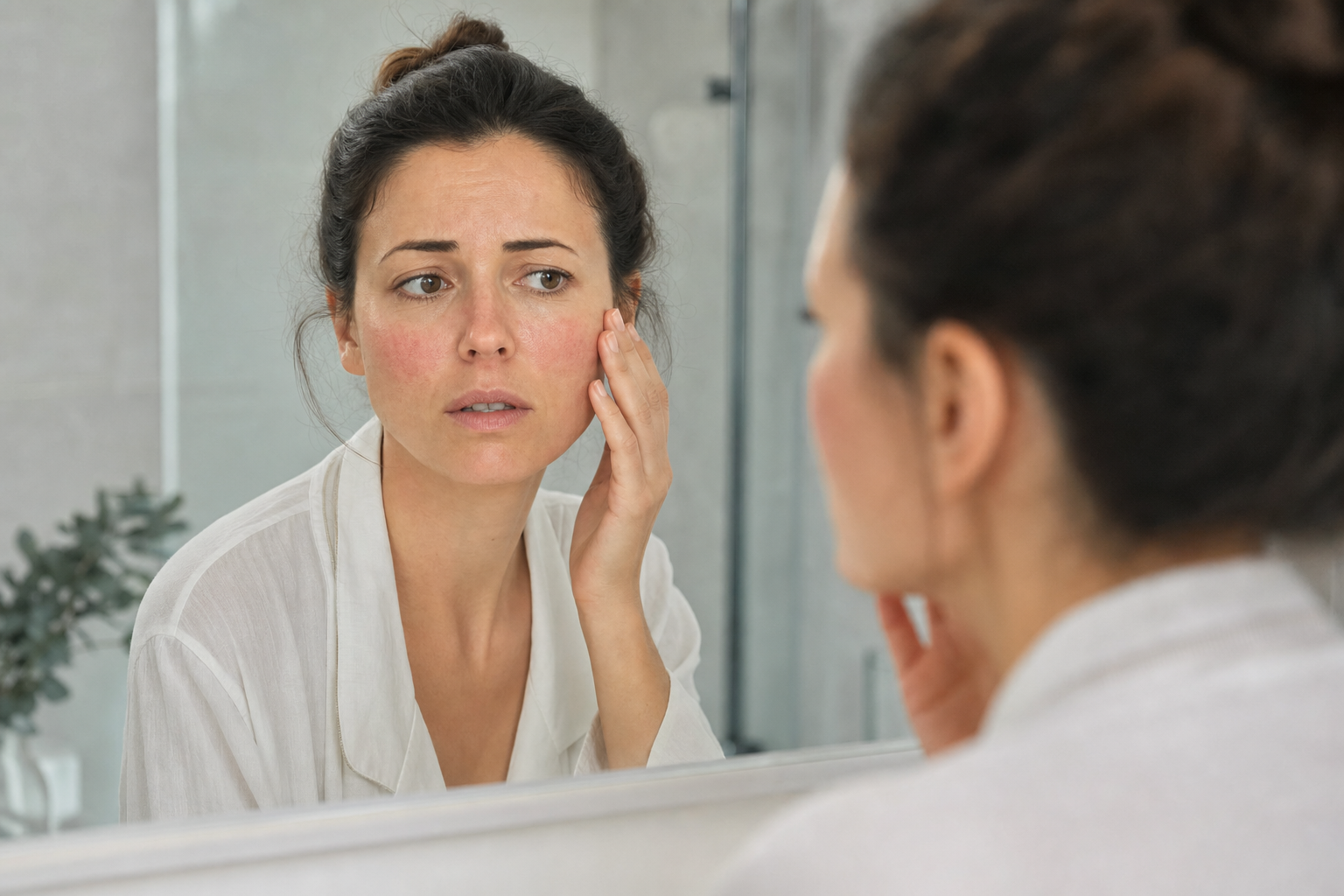
I know the exact moment this problem starts. My skin has usually been looking a little dull, a little rough, or a little congested, and I convince myself that one more exfoliating step will sort it out. Then the next night my usual moisturizer lands on my cheeks and suddenly feels sharp, hot, or weirdly prickly. That sensation is not my skin “adjusting.” In my experience, it is a signal that I have pushed the barrier further than it wanted to go.
Sensitive-skin research lines up with that lived experience. An overview of sensitive skin describes stinging, burning, and discomfort as core features of a skin state that often overlaps with barrier vulnerability rather than visible dramatic inflammation alone (PMID: 22928591). More recent work has linked facial skin hypersensitivity with altered ceramide profiles and disordered intercellular lipids, which matters because those lipids help the stratum corneum stay sealed and less reactive (PMID: 40176380). If that outer layer is not doing its usual job well, a moisturizer that felt boring a week ago can feel surprisingly intense.
Why a moisturizer can sting when the formula is not the real villain
I think this is the most useful mindset shift: the sting does not always mean your moisturizer is bad. Sometimes the formula is genuinely too fragranced, too acidic, or too full of volatile plant extracts for reactive skin. But often the problem is timing. Over-exfoliation can leave the surface more permeable and the nerve response more noticeable, so even a normally tolerable product can announce itself in a way it never did before.
That is one reason I do not judge a product only by how it feels on my worst skin day. If my routine recently included a strong acid toner, a leave-on exfoliant, a gritty scrub, a cleansing brush, multiple actives in the same week, or a retinoid layered over already dry skin, I look at my own behavior first. The barrier discussion in dermatology is not abstract here. Barrier dysfunction is closely tied to increased water loss, irritant penetration, and a lower tolerance threshold for everyday products (PMID: 20711259; PMID: 40476522).

How I tell over-exfoliation apart from a possible allergy or dermatitis flare
I try not to flatten every sting into the same explanation. For me, over-exfoliation usually comes with a pattern: my skin feels tight after washing, looks a bit shiny but dehydrated, and reacts most on the cheeks or around the mouth. Makeup may sit unevenly. The discomfort often shows up right after cleansing or right after applying products that normally feel bland.
What makes me more cautious is when the reaction looks different from my usual irritation pattern. If I see persistent swelling, sharply outlined red patches, hives, eyelid involvement, scaling that keeps spreading, or itching that feels stronger than burning, I stop assuming it is just “too many acids.” Sensitive skin reviews stress that stinging and burning can overlap with other conditions, including rosacea, eczema, or contact dermatitis, so pattern recognition matters (PMID: 40736518). If the skin keeps getting angrier after I simplify everything, I do not keep experimenting at home.
What I stop immediately
The first thing I do is remove every product whose job is to speed things up. That means leave-on exfoliating acids, scrubs, retinoids, benzoyl peroxide, strong vitamin C formulas that feel acidic on my skin, and any cleansing device that adds friction. I also stop “balancing” toners if they contain exfoliating acids, astringent alcohol, or lots of fragrant essential oils. If I am not sure whether something is contributing, it goes on pause.
I do this quickly because I have learned that keeping one active in the routine “just in case” usually turns a two-day problem into a week-long one. The 2026 review on dermo-cosmetic skin care around aesthetic procedures makes a similar point in a more clinical context: when the barrier is stressed, supportive skin care should focus on soothing, hydration, and helping recovery rather than piling on extra irritation (PMID: 41773167). I am obviously talking about home over-exfoliation, not lasers or peels in clinic, but the logic still holds.
My 72-hour reset when moisturizer stings
This is the short routine I return to.
- Cleanse only when I need to. In the morning, if my skin is not oily, I often just rinse with lukewarm water. At night, I use a gentle, low-foam cleanser and keep contact time short.
- Use lukewarm, not hot, water. Heat is one of the easiest ways to make already irritated skin feel worse.
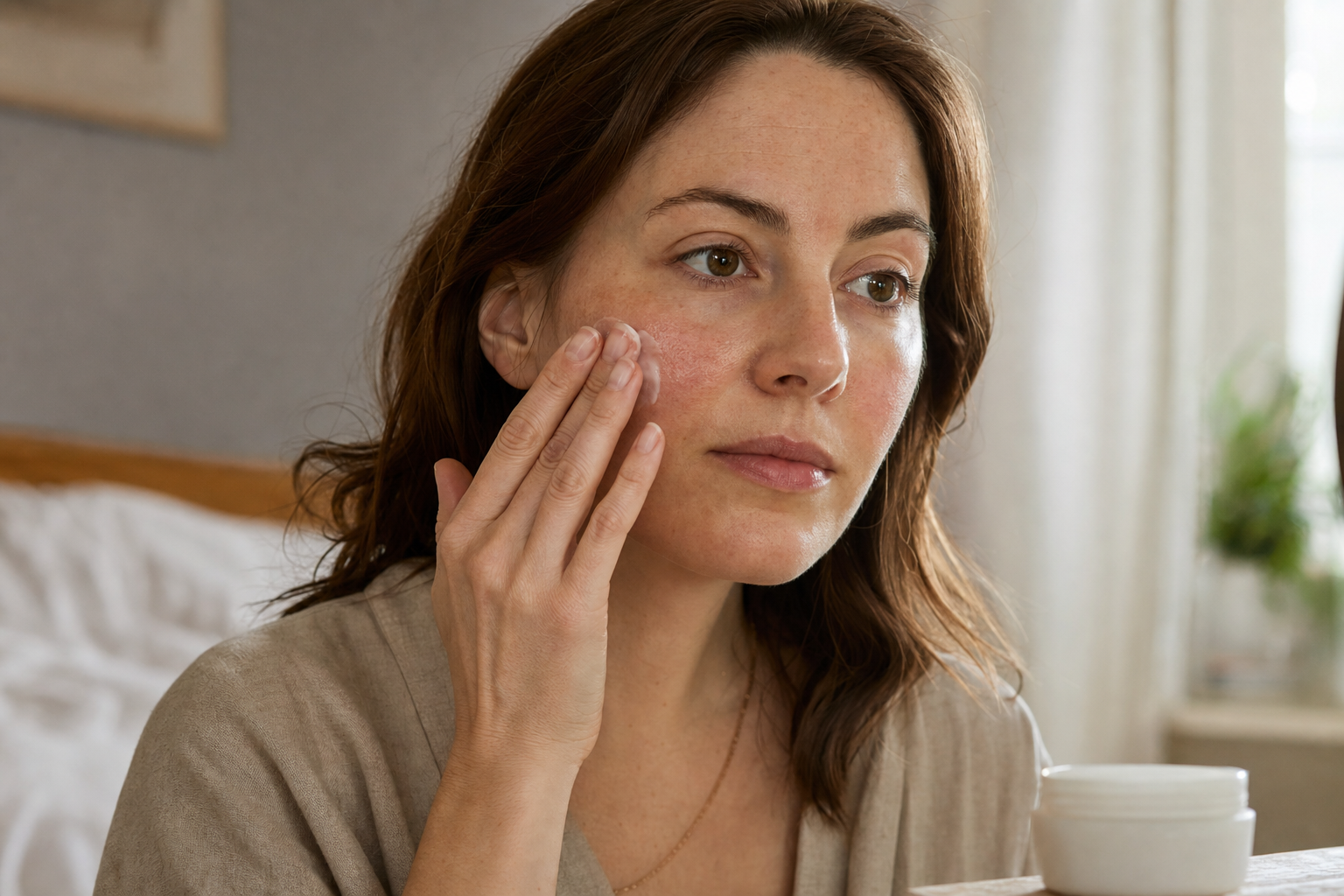
- Apply moisturizer to slightly damp skin. I do not rub aggressively. I spread it with the lightest pressure possible.
- Choose bland over impressive. I look for a simple moisturizer without fragrance, exfoliating acids, scrub particles, or a long list of plant extras that my skin did not ask for.
- Use sunscreen if I am going outside. If every sunscreen burns, that is a signal to simplify further and troubleshoot carefully rather than layering random replacements.
During these few days, I want the routine to feel almost boring. That is the point. I am not trying to get glow back overnight. I am trying to stop the cycle of sting, panic, and over-correction.
What I look for in the moisturizer itself
When my barrier feels raw, I want a formula that behaves quietly. I generally do best with moisturizers built around humectants, emollients, and occlusive support rather than treatment claims. Glycerin, squalane, petrolatum, dimethicone, and ceramide-containing formulas often make more sense to me in this phase than anything marketed as resurfacing, brightening, clarifying, or pore-refining.
That does not mean every ceramide cream will feel perfect on every face. Texture matters. Some people prefer a lotion during the day and a richer cream at night. I mainly care about whether the formula avoids obvious triggers and helps reduce that immediate post-application sting over several uses. The emerging literature on sensitive skin and altered barrier lipids makes the case that restoring surface comfort is partly a barrier story, not only a redness story (PMID: 40176380; PMID: 38635324).
If a moisturizer keeps burning for more than a minute or two, or the discomfort intensifies every time I use it, I stop. I do not force loyalty to a formula just because it is labeled gentle. “Fragrance-free” helps, but it is not a guarantee. The same goes for products labeled for sensitive skin. Labels are starting points. Skin response is the final filter.
When I restart exfoliation
I restart slowly, and only after my face stops feeling reactive during the boring routine. For me, that means no sting on cleansing, no heat from moisturizer, and no tight shiny feeling after rinsing. If those signs are still there, I wait longer.
When I do restart, I bring back one active at a time. Not two. Not a full routine reset in a single night. I would rather use an exfoliant less often than re-create the exact problem I was trying to fix. If my skin is naturally sensitive, I find that spacing exfoliating steps farther apart usually works better than chasing a schedule that sounds efficient on paper.
What I skip while my skin recovers
I skip facial scrubs, steaming, hot showers aimed at my face, washcloth friction, peel pads, and the temptation to “detox” with masks that tingle. I also skip the self-criticism that tells me I should have known better. Barrier mistakes happen because many of us are sold the idea that more renewal is always better. Usually it is not. Calm skin is often the result of restraint.
When I think it is time to get help
If the burning is severe, the rash spreads, the eyelids are involved, the skin cracks, or the reaction does not settle after several days of a simplified routine, I stop guessing. The same goes for repeated episodes where many unrelated products suddenly sting. At that point I start thinking about rosacea, eczema, seborrheic dermatitis, or allergic contact dermatitis, and I would rather get a proper assessment than keep playing ingredient roulette.
My rule now is simple: when moisturizer stings after over-exfoliation, I take it as a request for less. Less friction. Less chemistry. Less urgency. That approach is not dramatic, but it is usually the fastest way I know to make my skin feel like itself again.
Sources
- Berardesca E, Farage M, Maibach H. Sensitive skin: an overview. Int J Cosmet Sci. 2013. PMID: 22928591.
- Joichi T, Yoshida H, Katsukura H, et al. Altered Ceramide Profile of Facial Sensitive Skin: Disordered Intercellular Lipid Structure Is Linked to Skin Hypersensitivity. J Cosmet Dermatol. 2025. PMID: 40176380.
- Borghi A, Guarneri F, Pacetti L, et al. Does sensitive skin lie in epidermal barrier impairment or abnormalities? Results from an observational study assessing biophysical parameters. Ital J Dermatol Venerol. 2024. PMID: 38635324.
- Elias PM. Therapeutic Implications of a Barrier-based Pathogenesis of Atopic Dermatitis. Ann Dermatol. 2010. PMID: 20711259.
- Kundu D, Jayaraman A, Sen CK. Clinical Measurement of Transepidermal Water Loss. Adv Wound Care (New Rochelle). 2026. PMID: 40476522.
- Nikolis A, Nestor MS, Czuwara J, et al. Concomitant Use of Dermo-Cosmetic Skin Care in Aesthetic Procedures: Systematic Review with Expert Panel Recommendations. Clin Cosmet Investig Dermatol. 2026. PMID: 41773167.
- Kim HO, Um JY, Kim HB, et al. Diagnosis and Treatment of Sensitive Skin. Ann Dermatol. 2025. PMID: 40736518.